
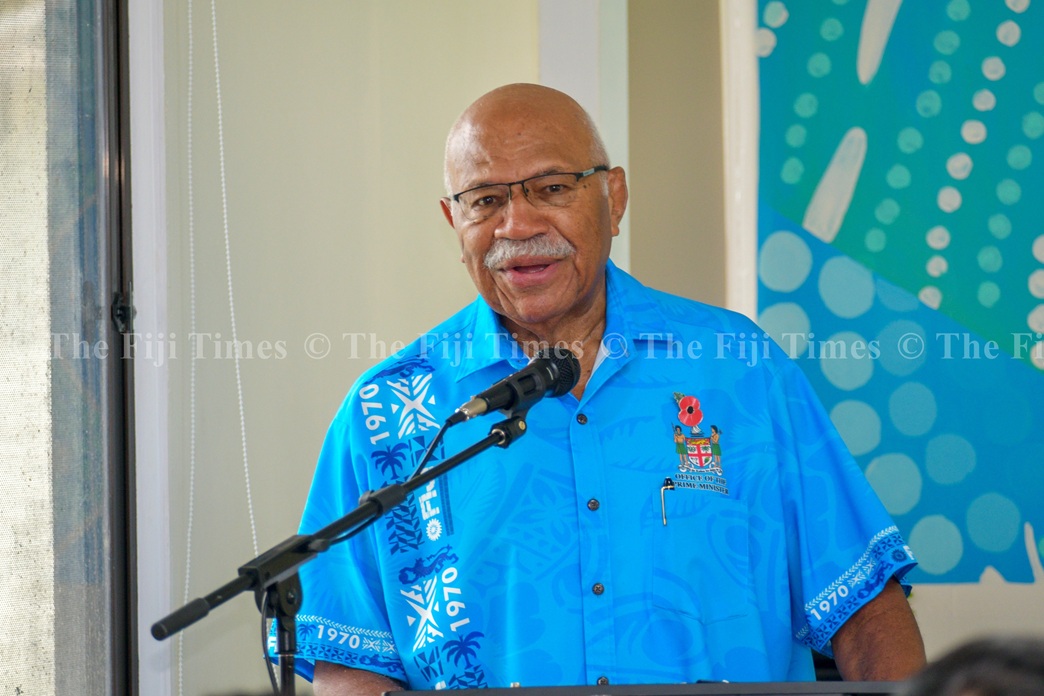
Bold statements
Prime Minister Sitiveni Rabuka has been kept busy with things happening around the nation. His bold statements have attracted both negative and positive criticism. On Wednesday night, our PM ordered sweeping austerity measures, slashing minister’s pay by 20 per cent and grounding overseas travel for politicians, civil servants and permanent secretaries. He stressed on the need to reduce Government expenditure, preserve resources and demonstrate fiscal responsibility. Via yesterday’s The Fiji Times, PM shared his opinion on the national identity debate. While calling for careful, inclusive dialogue, his position was crystal clear- every citizen of Fiji is Fijian. He referred to indigenous Fijians as iTaukei. We can go arguing on this matter but I guess we have other matters of national interest that need our attention — behaviour of children, the rising cases of drugs, violence against women and children, declining human values, rise in social issues, poverty, crime, and the rise in fuel price and cost of living. Rajnesh Ishwar Lingam Nadawa, Nasinu
Thank you PM
Thank you Prime Minister for telling the nation that, “every citizen of Fiji is Fijian”. Rakesh Chand Sharma Nadi
Traffic issues
I am writing again to share my serious concern about the traffic signal timings at the intersections of Queens Road and Mountainview Road, as well as at the Mount St. Mary’s junction. As someone who commutes daily on this route, I have observed that the current timing of these traffic lights is causing significant and unnecessary delays, especially during peak morning and evening hours. The current signal sequence appears to be poorly synchronized for the high traffic volumes on the highway, resulting in several ongoing issues:
- Long wait times: The green light duration for highway traffic is often too short, while the red light lasts much longer. This leads to many vehicles having to wait, even when there is little or no cross-traffic.
- Heavy congestion: This inefficiency creates long lines of vehicles that extend far beyond the intersection, resulting in dangerous conditions and unnecessarily lengthy commute times for hundreds of drivers each day.
It is frustrating to see that despite raising this issue several times, the problem is still not resolved. I cannot understand why this situation has not been addressed yet. I would like to directly ask the relevant authorities—why has this not been fixed? Are citizens’ concerns not taken seriously? If they are not, an explanation is needed.
This is a serious issue that requires immediate attention and resolution. I urge you to take action on it without further delay. I hope this time someone will take action. Suresh Chand Nadi
Ministerial pay cut
As announced by Prime Minister Sitiveni Rabuka, government ministers, assistant ministers and MPs will take a 20 per cent pay cut and halt overseas travel under sweeping austerity measures. This announcement received mixed reactions from the public. But will it happen? The so-called pay cut will require parliamentary approval. That is because salaries of elected officials are typically set or protected by law, so they cannot simply be reduced by announcement, no matter how dramatic the press conference may sound. DINESH KUMAR Ba
Rolling with punches
When the USA President imposed a 32 per cent tariff on Fijian exports to the USA this time last year, our Prime Minister said at the time that Fiji will just have to “roll with the punches”, a message that was apt at the time. I guess we are going to “roll with the punches” again this time but also throw counter punches while rolling and ducking. And the PM has already announced those counter punches already. Donald Singh Nausori
Ridiculous proposal
The common idiom of “Two steps forward, one step back”, best describes the proposals by the Great Council of Chiefs to the Constitution Review Commission. Kemudou! Wise Muavono Balawa, Lautoka
Legibility matters
As a longtime reader of The Fiji Times and member of the fastest growing demographic in Fiji, I would buy the $2 print version more often these days if the body text font was a bit larger and easier on the eyes. Willard Miller Ellis Place, Suva
Vinaka vakalevu
Thank you Ratu Tevita Uluilakeba Mara; Roko Tui Bau, Ratu Timoci Tavanavanua, and Akuila Yabaki-Jnr among many others for recognising us as one. This is very much appreciated, welcomed, and acknowledged. Vinaka and may God bless Fiji. Dr Prashneel Goundar NSW, Australia
That name
I hope not that any typical Fijian will wake up from a beauty sleep and start proclaiming — I had a vision from above, that name is only for us. As my Pu likes to say: Luveni kania a omu i …! AREKI DAWAI Suva
Engines off
I support the new law requiring government vehicles to be turned off when not in use. We have all witnessed government vehicles left running for hours with the air conditioning on. A clear waste of fuel and public funds. This measure will help reduce unnecessary expenses and promote responsible use of resources. Maybe now the drivers can step outside, stretch their legs, and enjoy a bit of “free air-conditioning” straight from nature itself! RODNEY CLARENCE RAJ Naleba, Labasa
Common name or identity
Fijian name
The recent public discussion on the use of the name “Fijian” raises a serious national issue that should not be treated casually. It is not simply about a word. It touches identity, history, land, culture, belonging, and the moral direction of Fiji. For the iTaukei people, identity is deeply rooted in ancestry, vanua, customs, and inherited responsibility. These are not abstract matters. They are sacred and deeply felt realities. Any attempt to discuss national identity without proper respect for this truth will only deepen fear, hurt, and mistrust. At the same time, Fiji is a multiracial nation whose different communities have contributed much to the life of the country over many generations. That reality also must be recognised with honesty and fairness. A wise nation does not deny its indigenous foundations, nor does it humiliate others who also belong to the country. What concerns me most is that such issues are too easily drawn into political argument and used to stir emotions for public support. Fiji has suffered enough from racial tension, manipulation, and leadership failures. We should not allow identity to become once again a weapon of division. As a Christian, I believe all people are equal in worth before God. But equality does not mean erasing the special place, rights, and dignity of the indigenous people of Fiji. True justice requires both protection and inclusion: protection of iTaukei identity and rights, and inclusion of all citizens in the national community. Fiji now needs mature leadership, careful language, and sincere dialogue. The future of our country must not be shaped by fear or slogans, but by truth, justice, respect, and wisdom. This issue is not only about a name. It is about the soul of the nation. Rev Dr Paula Tekei Brisbane, Australia
Illusive common denominator
There has been much discussion in the news and on social media about the origins and proper use of the term: “Fijian”, since the GCC’s submission to the CRC renewed interest in it. Some claim it belongs to the indigenous iTaukei and others believe it should be the common name for all people’s in Fiji. The arguments for and against on both sides are undoubtedly sincerely held and robustly advanced. However, the gratuitous name-calling, sarcasm, and personal denigration is unhelpful to the public debate and should cease. As an indigenous native from the island of Rotuma I have always referred to myself as a “Rotuman”. I also grew up knowing that the indigenous natives of Fiji are/were called “Fijians”. I am proud of my Rotuman heritage and name and have no desire at all to be called a “Fijian”. Neither do I feel diminished or alienated by not being called by a name that I have long known belongs to another or, in not having a common name with other ethnic groups in our multi-racial country. Indeed, on my travels overseas, I have been doubted by frequent visitors or former residents of Fiji or followers of the abbreviated rugby code, whenever I introduce myself as “Fijian”. I often get a quizzical look followed by: “… you don’t look Fijian, you look more like a Tongan or Samoan”. I don’t mind the comparison, after all I am Polynesian. But the brief example shows, that a “Fijian” has unique features, characteristics and even, appearance. The same might be said of the other ethnic communities in Fiji with little disagreement or protest. Of one thing I am sure and that is, that a common name or identity cannot be imposed, declared, or dictated by legislation however well- intentioned or Supreme. Much less respect is due to a bare declaration: “…that we are all Fijians…” in a constitution that was unilaterally promulgated by a military decree that purports to grant and continue entrenched, absolute, unconditional and irrevocable immunity from criminal prosecution or civil liability to coup perpetrators. If I may say so, that is what is truly “disastrous” to the rule of law and our future generations, not, the public discussion about whether Chapter 10 of the 2013 Constitution should be amended or removed altogether. Do we need to have that constant reminder of past treasonous acts and events with no obvious benefits, which we would prefer to forget, entrenched in our future Constitution? Why can’t we just agree (in a referendum), to remove that malignant cancer with no adverse consequences to the unnamed, faceless beneficiaries “in the public interest”? So, let the discourse continue unabated because, I for one, have never felt particularly elevated or united with my fellow countrymen by being called “Fijian”. To those who disagree, please tell us your personal experience — do you feel a greater sense of unity and belonging to this wonderful nation of ours by being labelled “Fijian”? Daniel Fatiaki Suva

