
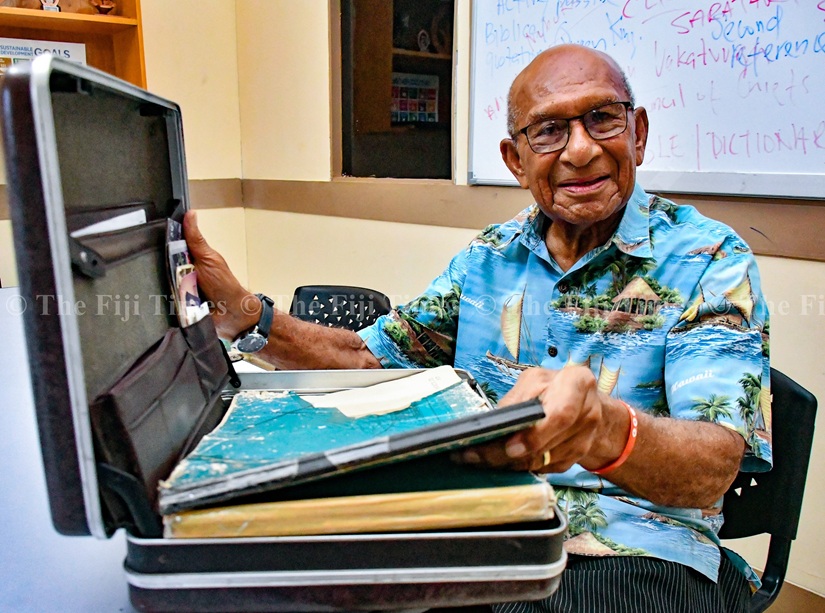
The 50-year-old briefcase that holds Fiji’s past for 82-year-old Pita Nacuva, history is not just the subject of books and school classrooms.
It is something he carries with him quite literally.
If you ever spot him in town, his worn, 50-year-old briefcase would always be in his hand, aged but still sturdy.
In the modern world, the box-shaped bag is a staple accessory for many successful men. For the octogenarian, it holds fragments of a life intertwined with some of Fiji’s most defining moments and one of its most respected leaders, Ratu Sir Penaia Kanatabatu Ganilau.
The Cakaudrove chief was a prominent Fijian statesman who served as the last Governor-General of Fiji from 1983 to 1987 and the first President of Fiji from 1987 until his death on December 15, 1993.
Beginnings at Flagstaff
Ratu Penaia and Mr Nacuva’s story began in the late 1950s at colonial Flagstaff, more than a decade before independence and after the Malayan Campaign, where approximately 1,600 Fijian soldiers were deployed to fight communist insurgents in the jungles of Malaya (modern-day Malaysia) between 1952 and 1956.
History records note that Fijian forces, specifically the 1st Battalion Fiji Infantry Regiment, played a significant role in this successful British Commonwealth counter-insurgency operation, gaining a lasting reputation as expert jungle fighters.
“We lived at the Flagstaff barracks in the early 1950s, before we moved to Toorak, where I eventually attended Suva Methodist Primary School from 1950 to 1958.
“I later attended Lelean Memorial School. After the Malayan Campaign, Ratu Penaia came back home and his family lived just across the road… we were neighbours.”
At the time, Mr Nacuva was just an innocent boy, unaware of what awaited him in the world outside his home.
“I was a 10-year-old boy… I used to play marbles and fly kites with his sons Ratu Epeli and Ratu Rabici.”
Those simple childhood moments would later grow into something deeper that forged relationships and later padded up his career opportunities in the civil service.
“That was how and when I began to admire and respect Ratu Penaia.”
A nation finding its direction
Years later, their paths crossed again. This time in service to a young nation after British colonial rule.
Mr Nacuva had just returned from Edinburg, Scotland in 1971, armed with a postgraduate qualification in town planning, having been abroad during Fiji’s independence in 1970.
He returned to a country at a crossroads, trying to find its way in the world during a period that evoked freedom and exploration.
“At the time, we relied heavily on the sugar industry,” he says.
“The idea of tourism came in… under Ratu Penaia, who was then the minister responsible.”
With support from international institutions, including the IMF and the Asian Development Bank, Fiji embarked on its first serious tourism study. Consultants were brought in from Hawaii.
Ratu Penaia, hearing of Mr Nacuva’s return, made a request.
He wanted the new graduate on the team and was to serve as the local counterpart in what would become Fiji’s first tourism development plan.
For nearly two years, Mr Nacuva worked alongside the Hawaii-based consultants and came up with Fiji’s Tourism Plan and a plan to develop Natadola.
“Till today, these remain the blueprint of tourism development in Fiji,” he says.
He credits Ratu Penaia’s leadership as central to that vision.
“Ratu Penaia was key… and we became very close because of our work.”
The briefcase
It was during those years in Hawaii—1972 and 1973—that the now-famous bag entered his life.
“Belt Collins and Associates (lead consultants) bought it and gave it to me as a gift,” he says.
“I’ve kept it with me ever since… to remind me of a bygone era, my career development and the embryonic stage of Fiji’s tourism industry.”
Inside the bag are pieces of that history—documents, photographs, and two tourism master plans, some of whose ideas, he notes, remain unfulfilled.
“There’s a lot of things in this report that is yet to be implemented,” he says.
“This is why this bag is still important and dear to me.”
“It has both sentimental and historical value.”
Diplomat in Washington
More than a decade later, following the 1987 coups, Fiji faced strained international relations with democracies around the world, including the United States.
Efforts were made to rebuild those tattered ties.
Ratu Penaia, alongside Ratu Sir Kamisese Mara, turned again to Mr Nacuva.
“They decided to send me to the United States,” he says.
He admits he questioned the decision.
“I told Ratu Penaia, I am a professional town planner not a diplomat…”
But the reply was firm.
“He insisted I was the right person for the job and I could use my experience from the years I worked with American consultants in Hawaii.”
From 1992 to 1997, Mr Nacuva served as Fiji’s Ambassador to the United States, based in Washington.
“I valued my relationship with Ratu Penaia and trusted his judgement. So I took the job with respect.”
The hairbrush
Among the most personal items in Mr Nacuba’s half-century bag is one that carries emotional weight – a hairbrush once owned by the late president.
After Ratu Penaia’s passing in 1993, one of his daughters, Adi Sivo, made a gesture Mr Nacuva has never forgotten.
“She told me, ‘you’ve done a lot for daddy, why don’t you keep this as a treasure’.”
She gave him her late father hairbrush.
“This is his hairbrush… and I’ve kept it to this day because it is special to me, just as it was to its original owner,” Mr Nacuva said, taking out the heirloom from his briefcase.
The object itself is modest, its handle chipped, worn by time and constant use. But its meaning runs deep.
“When I use it, I feel close to him through memories of the past.”
Bonds beyond duty
Mr Nacuva’s connection to the Ganilau family extended beyond official roles.
“I became so close to the family… they treated me like I was part of them,” he says.
“I’ll never forget Ratu Penaia for that… even Ratu Mara and Ratu Kadavulevu.”
One memory stands out.
“The former Governor-General used to call me ‘My Boy’.”
Their lives intersected in many ways—neighbours at Flagstaff, colleagues in government, even sharing a mad love for rugby.
A life in the pages of history
Mr Nacuva’s love for history began early.
It was his favourite subject in school, nurtured by a habit of reading widely and coaxing by teachers and uni lecturers
He recalls spending hours immersed in books—and newspapers.
“Yes… that’s why I enjoy reading the articles in The Fiji Times,” he says.
“There’s a lot of historical stuff in it… which is wonderful.”
“If most people read it, they could have some idea of the world around them and get enlightened.”
The bag that endures
Throughout his working career, the briefcase has remained by the Korotogo, Nadroga, man’s side.
It followed him through the corridors of Parliament—during his time as a Cabinet minister and later as Speaker of the House of Representatives in 2006.
Even as political tides shifted, including his removal following the December 2006 coup led by Frank Bainimarama, the bag endured.
“My bag is very old but it still works well,” he says with a laugh.
“I can lock it with my secret four digits… an easy number that I can think of, because as you grow old you forget numbers easily.”
It travelled with him to Washington for five years and back.
And today, it remains what it has always been, a keeper of fond memories.
“I will treasure it as a memento,” he says, “to remember my career and my association with Ratu Penaia.”

