
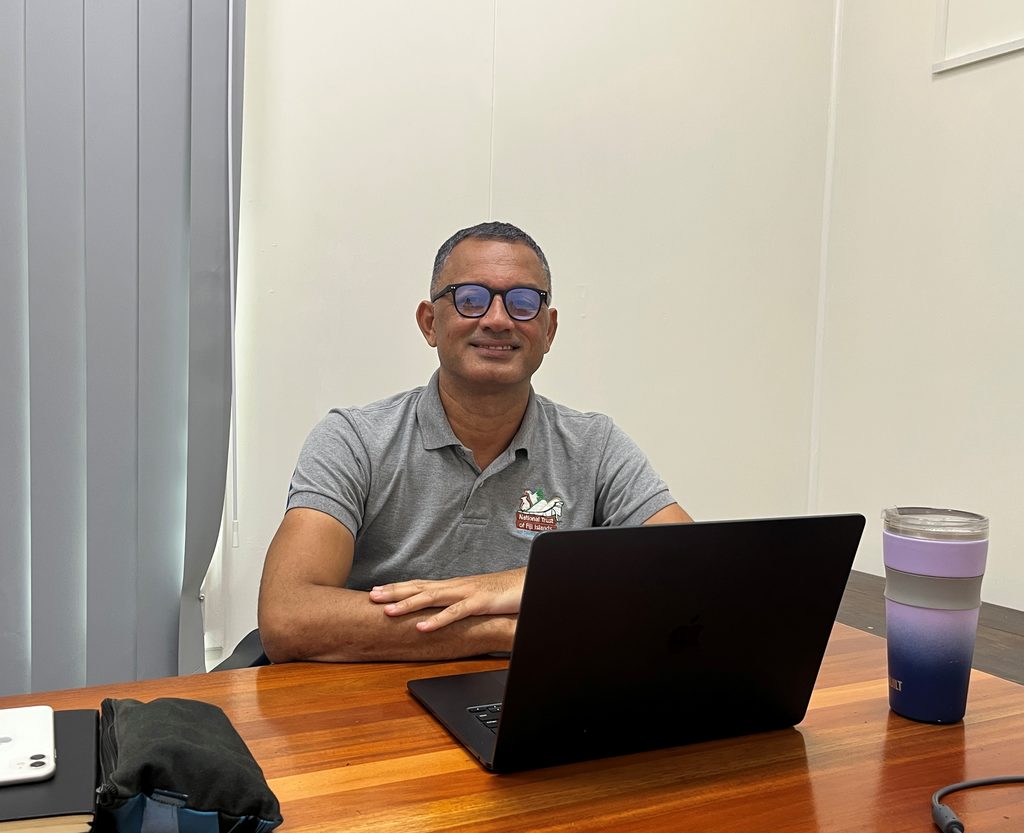
On Fiji’s sunlit Coral Coast, where shifting sands hold centuries of history, Sigatoka has long shaped the life and work of Jason Tutani.
It is here that his career first took root, among the windswept dunes of the Sigatoka Sand Dunes National Park, and where his understanding of leadership began to evolve in ways he never expected.
Tutani, now the education program manager at the National Trust of Fiji, didn’t always see himself as a leader.
Stepping into leadership
Tutani was part of the Leadership Fiji Program in 2012.
“I joined the Leadership Fiji program in 2012 because I was in a managerial role and I felt I was lacking in leadership skills. I thought this (program) would help me build on that,” he said.
At the time, he was managing one of Fiji’s most significant heritage sites. The work was demanding, balancing conservation and community engagement, but it also revealed a gap in his own approach. Leadership, he felt, was something he needed to learn more deliberately.
What he found at Leadership Fiji, however, was not what he expected.
“I thought it would be like a full-on university course,” he said.
“You know, lectures, units, that kind of thing. But it wasn’t like that at all. The way the program was set up, I enjoyed it.”
Instead of classrooms, the program unfolded across the country. Participants visited different communities, engaged with speakers from diverse sectors, and were exposed to perspectives that challenged their assumptions.
For Tutani, this immersive structure became one of the program’s greatest strengths.
“It wasn’t stationary. We got to experience different aspects of Fiji while learning about leadership,” he said.
“And I was with people who were already leaders in their own fields. That made it even more meaningful.”
Standing for conservation
Among a cohort dominated by corporate professionals, Tutani stood out as the only representative from the conservation sector. At first, he wondered how his voice would fit into conversations often driven by economic priorities.
“I’m a conservationist at heart, so when we talked about development, I was always thinking about the environment. I was worried conservation might be overlooked.”
That concern came to a head during discussions about a shared vision for their group.
“I was adamant that conservation had to be part of that vision,” he said.
“I didn’t want it to become purely economic.”
And it was precisely these moments of tension that proved transformative.
“There were times when the values I held strongly were challenged,” Tutani said.
“But that’s what made it powerful. Everyone had different perspectives, and it pushed me to think differently too.”
Redefining leadership
Through these exchanges, he began to see leadership less as a position of authority and more as a space for collaboration.
“Leadership is about coming down to the same level as others, working as a team,” he said.
“You’re given that position as a privilege, to guide people and help the team achieve something together.”
But perhaps the most profound lessons were not about systems or strategies — they were about self-awareness.
“Talking to others in the program, I realised I’m an emotional leader,” Tutani said.
“In some ways that’s good, but in other ways it can be challenging.”
In conservation work, where resources are often limited and outcomes uncertain, emotional investment can run high. For Tutani, this realisation prompted a period of reflection.
“Being too emotional doesn’t always help when the team needs to perform,” he said.
“You have to know where to draw the line to get the work done.”
New perspectives, new possibilities
The program gave him not just insight, but tools and, importantly, a network. Conversations with fellow participants, including those from the banking sector, opened his eyes to new possibilities.
“In conservation, one of our biggest challenges is funding,” he said.
“Hearing from participants who were bankers about investment strategies was helpful. I took those ideas back and shared them with our director — it started conversations about financial sustainability for protected areas.”
Today, in his role overseeing education and community programs across Fiji, Tutani continues to draw on those lessons. His work connects people to heritage, bridging knowledge gaps between communities and conservation efforts.
“One thing I realised is that people can be very important in their communities, but they might not know what we do,” he said.
“That’s where we come in. That’s our value.”
A lasting impact
Looking back, Tutani sees his Leadership Fiji experience not as a single chapter, but as a turning point, one that reshaped both his professional path and his personal philosophy.
“I went in thinking I needed to become a better leader,” he reflects.
But Tutani came out understanding that leadership is about balance, between people and purpose, emotion and action, development and conservation.
And in that balance, much like the shifting sands of Sigatoka, he continues to find his footing.

