
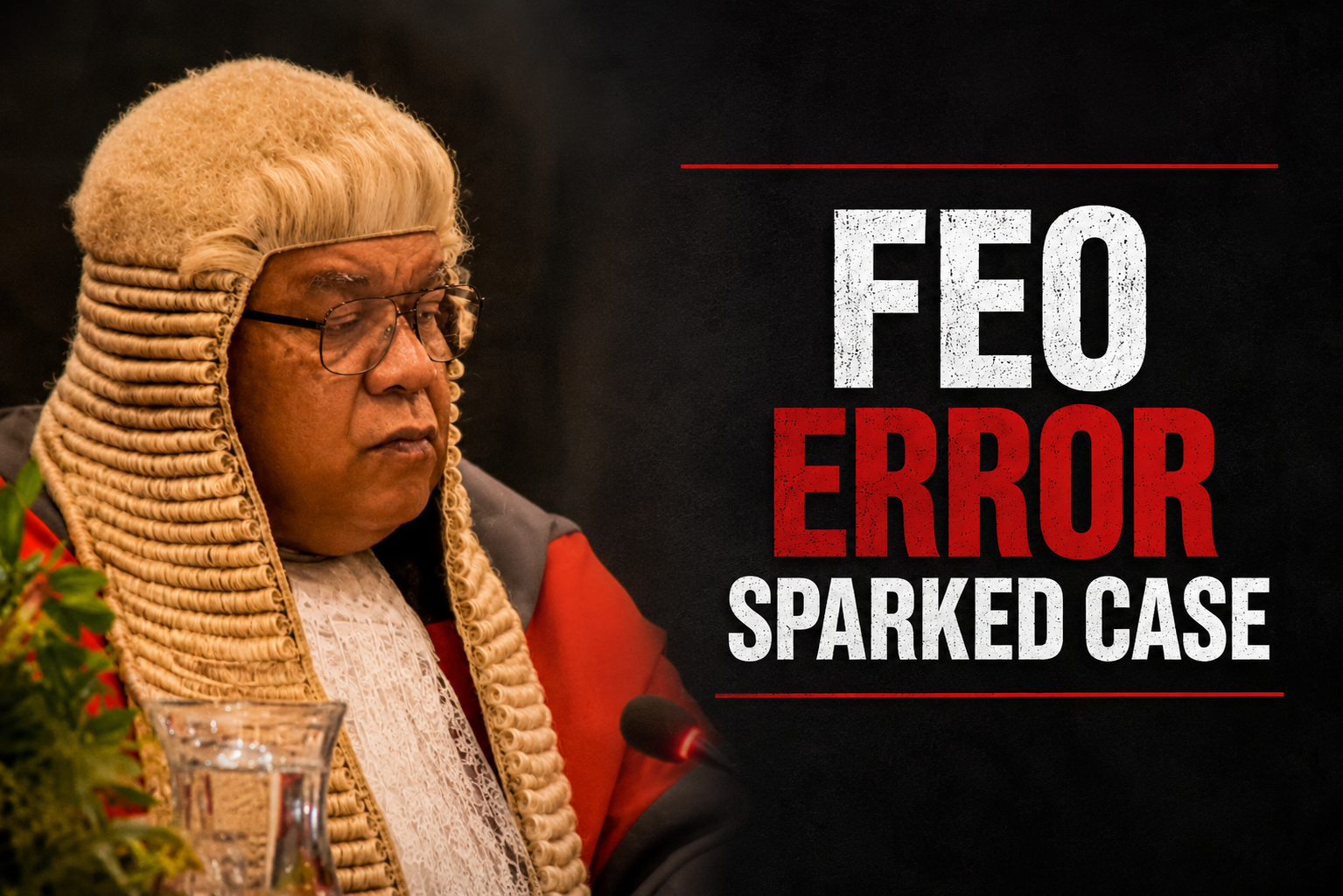
Chief Justice Salesi Temo has ruled that the prosecution’s case against former Attorney-General Aiyaz Sayed-Khaiyum and former Supervisor of Elections Mohammed Saneem stemmed from a flawed interpretation of a contractual clause, ultimately leading to their acquittal.
Delivering judgment today, Chief Justice Temo said the prosecution failed to prove its case beyond a reasonable doubt because the matter originated from a misreading of Clause 2.2(1)(aa) of the Second Deed of Variation, which formed part of Saneem’s contract of service.
“I find the prosecution had not proven their cases against both accuseds beyond a reasonable doubt.”
Justice Temo said the problems began when Fiji Elections Office Director of Corporate Services Sanjeshwar Ram misunderstood the contractual provision.
“The problem started with a misreading of clause 2.2 (1) (aa) of the Second Deed of Variation (Prosecution Exhibit No. 17), which was part of the Contract of Service between the Government of Fiji and Accused No. 2.”
According to the judgment, Ram interpreted the clause to mean that the Government would pay Saneem’s additional deductible tax arising from his 2021 back pay.
The Chief Justice said Ram raised the matter with Financial Controller Romika Devi, who in turn discussed it with then Acting Supervisor of Elections Ana Mataiciwa.
Justice Temo noted that Mataiciwa subsequently sought legal advice from then Acting Manager Legal Mesake Dawai, who recommended that the matter be referred to Police.
The Chief Justice said the flawed interpretation was never identified as the matter progressed through the criminal justice system.
“The police and their legal advisers did not pick up on the FEO’s flawed interpretation of clause 2.2 (1) (aa) of Prosecution Exhibit No. 17. Then the matter proceeded to the Magistrates Court and then the High Court.”
Justice Temo concluded that the prosecution’s case was built on an incorrect interpretation of the contractual provision, resulting in the failure to establish the charges against either accused beyond reasonable doubt.

