Part 2
The Fiji experiences of native Tongan missionary, Joeli Bulu, was one filled with varied encounters, some with great light while others filled with darkness and fright.
This is a continuation of the account of his life published in a booked titled: “Joel Bulu: the autobiography of a native minister in the South Seas,” Joel shared how he had a dream of a shark attack which had turned into reality days after.
This occurred during his time at the mission station in Rewa when Joeli was invited by a young chief for a swim to which he refused fearing the sharks. But the young chief was persistent and would not take no for an answer.
Fearing the chief would be angry with him, Joeli gave in to his request. The river was packed with many boys swimming with their toy canoes and the young chief told Joeli to pick a canoe and see whose would win the race.
“So, I took one and presently seeing that his was shooting ahead, I gave mine a push to make it go faster; whereupon he also pushed his and soon we were swimming in the deep water, following our canoes,” Joeli said.
The young chief suggested that they go to the other bank, and they swam across the river as a great crowd of Bauans and Rewans followed. While they all climbed out of the bank, Joeli decided to stay in the river as he thought he would swim back to his house.
“As I was wading towards the deep water, I saw two little waves coming towards me on the surface. It is a shark; my dream is true.”
Afraid to turn back and swim as he was too far from the shore, Joeli kept still hoping the shark would not see him.
As he held his breath and waited as the waves crashed, he thought he had made the wrong assumption until he began to swim for Nasali and suddenly felt something sharp struck against his thigh.
“It was the shark biting me, but I did not feel much pain and thinking it was only one of the young men who had dived and caught hold of me, I put my hand down to seize him, and lo, it was a shark.
“A great darkness fell upon my eyes, and I could no longer see the shore or the people or the houses: all was dark. One thing only I remembered— the lotu and I said, today my life is at an end.
“I no longer feared the shark. It was as nothing to me, though my flesh was torn, and my blood was flowing. But now he let go my thigh and came at me again to bite me.”
Joeli then began to gain his consciousness and this time he grew angry and fought the shark back as if an enemy was trying to kill him.
“When he drew near and opened his mouth to bite, I thrust my hand down his throat.
“His teeth closed on my arm and tore the flesh, but still I worked my hand downwards with all my might and at length he could not longer bite me but opened his moth as if he were sick.”
Joeli eventually got hold of the shark and dragged them both towards the shore where the shark swam away ‘slowly and feebly.’ Later, when the terrors of war between Bau and Rewa were on the rise, missionaries had to leave, and it wasn’t long before Joeli did also by going to Viwa where Mr Hunt lived.
“When I had stayed some time at Viwa, Mr. Hunt sent me over to Vanua Levu in a canoe, that I might go throughout the land as far as I could and see whether there were any place where we could gain a footing.”
Soon after he was moved to Nadi with Mr Watsford and Mr Ford when a great hurricane had come and destroyed every house on the coast.
“At length I was removed from Nandi to Ono. The lotu had be- come firmly established there long before; but trouble had arisen because of the teachers, who had grown proud, and wanted to live as chiefs among the people, taking upon them- selves to interfere in the affairs of the land,” Joeli said.
“It was during my stay on this island that I was thought ‘worthy of being solemnly set apart to the work as an assistant missionary, whereat great was my rejoicing.
“Very different from the comforts and: encouragements wherewith the Lord blessed me at Ono, were the hardships and disheartenings which I met with at Nandi, when I was appointed there again.” This was because of the raging war of the heathens that aimed to drive those who were chose to the lotu.
“We could not stir out of the town without danger, for the enemy was lurking in the forest round about; where they killed two of our men who had gone to cut grass for thatching our chapel.
“The enemy grew bolder and ever bolder as our people grew weaker and more discouraged, until at length they came in great force and began to build a war fence against our town, surrounding us so that none might escape.”
Joeli stated that while they expected the worst from this situation, the Lord delivered them a great storm with heavy rain that lasted many days. While they were sheltered well within the town, the heathens had no shelter and bore through the cold and wet, then had no choice but to flee.
“But though we were thus saved from destruction, yet we were still in great straits; for, when the fine weather returned, the enemy lay in wait for us in the forest as before, killing those who went out to search for food.”
This prompted Joeli to take his wife and children to Bua where they would be much safer and then returned to Nadi.
“And so it was; for, upon the king’s promise to spare their lives, the townsfolk opened their gates to him; whereupon all the heathen warriors rushed in and burned the town.”
After returning to Bua his next appointment was to the Cakaudrove Kingdom with Aaron Fotofili.
“We lived at Wairiki, where we saw much fruit of our labours, for many turned from heathenism.
“The women and the children were especially zealous in the schools, learning to read with great quickness.”
They were joined by two missionaries, Mr Waterhouse and Mr Carey but living at Wairiki proved difficult for them because it was a place where it rained often and was quite hot.
“It was thought good to remove the station to Waikava (Fawn Harbour) and thither I also went having the Training Institution given into my hands. “I went, but my wife went not with me for she died at Wairiki and there I buried her.
“Ratu Ngolea (he who is now Tui Thakau ) was a heathen; but nevertheless he was very friendly towards us, helping us in many ways, so that we were cheered in our work, and went’ joyfully on from day to day, hoping for still better things.”
Tui Cakau was requested to help in the fighting at Macuata, a request received from the chief Ritova. Ngolea hoped Joeli would join in this war party.
It was decided that Joeli would not go. The lotu people also refused to join the war. Golea told them that he would go and attack them with his warriors and upon his return he would do the same to the Christians because of their refusal to join him in war.
“The warriors went away in many canoes; and it was not long before we heard of burnings and slaughters, as town after town was taken, none being able to stand against them,” said Joeli.
“Nor was it long before the fighting began, which ended in Wai ni Nggolo’s (Wainiqolo) death in front of the Wairiki war fence, and the great slaughter of his army; Ngolea also being wounded in the fight by a musket ball, which broke his arm.”
Soon after Golea did not spare Joeli. He dragged his daughter during his absence from home and forced her to live with him.
“After these things I was removed from Wairiki to Mbau, where I have been living ever since, doing what I could to help on the great work.”
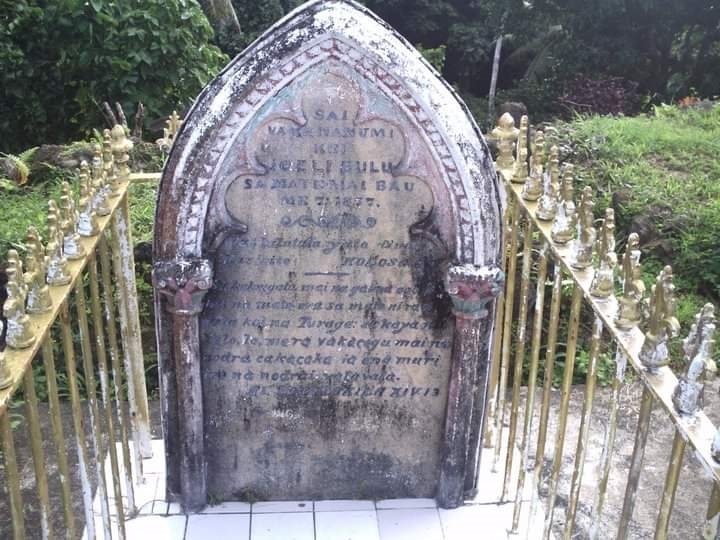
It was on May 7, 1877, that Bulu took his last breath and Cakobau felt it was his duty as an old friend to bury him in a coffin.
He was buried near an old church on the neighbouring isle of Viwa where many mourned the loss of a great friend, a man of God and noble man.
History being the subject it is, a group’s version of events may not be the same as that held by another group. When publishing one account, it is not our intention to cause division or to disrespect other oral traditions. Those with a different version can contact us so we can publish your account of history too – Editor