
WHEN I first landed in Japan last month, it struck me just how clean the country is.
A stark contrast to the situation here at home, where litter and garbage are disposed of indiscriminately.
This shows how little regard we have for our environment.
And the group of journalists I travelled with on this trip all had similar views about their home countries.
Recycling is a part of everyday life in Japan, especially in one town, Osaki.
This agrarian town, which has a population of 12,331, has deeply ingrained recycling habits that stretch back to 1998.
Presently, the town enjoys a recycling rate of more than 80 per cent.
But getting to this stage hasn’t been an easy ride. There was significant pushback from residents when the policy was first introduced, as town mayor Yasuhiro Higashi told journalists.
Today, the town’s successful implementation of its recycling model works in their favour – extending the lifespan of its landfill by another 40 years and inculcating these good habits in the next generation of youngsters.
Where does it begin? In Osaki, recycling begins at home. The entire town is responsible for sorting out its own rubbish into 27 different categories.
These are cans, returnable bottles, brown bottles, colourless transparent bottles, other bottles, PET bottles, cardboard, newspapers, and fliers, magazines and miscellaneous paper, copy paper, shredded paper, paper cartons, paper boxes/wrapping paper, paper containers/bags, fluorescent lights, dry batteries, used clothes, waste cooking oil, plastics, spray cans/cylinders, metals such as lids, pots, disposable chopsticks, skewers, pottery, small appliances, raw/ organic food waste, landfill waste, and largesized waste.
One day each month, residents arrive at a designated area to dispose of the recyclables, and they take turns to volunteer and help with unloading and sorting garbage on the day. All plastic waste must be packaged in special transparent bags, with the resident’s name written on them.
According to Shoichi Hidaka, the president of Nishizako Sanitary Neighbourhood Community Association, there are still challenges as some elderly citizens are not able to transport their trash to the collection site.
However, in these instances, the residents and council step up to assist It seems an arduous process, but this is now part and parcel of their lives.
Private-public partnership Materials collected for recycling are transported to the Soo Recycling Centre. The organic (food waste) is sent off to the compost facility while the remainder of the items are at the recycling site.
From there, it undergoes secondary sorting by staff. Items such as bottles, aluminum, styrofoam, and used cooking oil are processed and recycled. This means that byproducts are either sent out to be resold or used at the centre, which has been running for about two decades.
According to the chief of intermediate treatment, Daisaku Kozono, the centre employed about 40 people, and they worked under commission from several municipalities.
“We have a commission fee, so whatever profit we make will be returned to the municipality, so we have a sort of a fixed fee to work with,” he said.
They’re not required to make profits, but as a company, Mr Kozono said they relied on the support of the public.
“We really need to have co-operation and understanding, when we say cooperation, it’s about separating garbage carefully.”
In addition, the company also produces its own biodegradable fuel from used cooking oil.
“It is a very good deal because diesel, and if you go to regular petrol stations, one litre costs 150 yen, whereas our production cost for one litre is 50 to 60 yen, so it is a very competitive process of filtering and making biodegradable fuel, used to power our forklifts and trucks. I think this can be a rather
important product because the used oil, if you don’t recycle, then you will throw it away, but we are recycling and we are making profits out of it.”
The company is also working with Unicharm, a company that specialises in making biodegradable diapers. Most of the waste at the landfill is used diapers, and the company is hoping to take a step towards recycling used diapers by remaking disposable diapers to reduce garbage at the landfill.
Natural composting All 150 communities in the town have about two to three blue buckets, in which food waste is dumped.
Three times a week, the recycling centre workers collect the waste for a small fee and bring it back for processing at their compost site.
Here, the buckets are emptied, and once empty, they are cleaned with sawdust.
According to Kasumi Fujita, the director of Osaki SDGs Promotion Council, kitchen waste as well as tree cuttings, leaves, and branches are also brought to the centre where they are shredded into small pieces.
The next stage involves mixing kitchen and grass waste in equal portions and relying on natural chemical reactions to break down the food items.
Mounds of these mixed portions are then left in pits to decompose further.
Often, vapour is seen rising, which Ms Fujita said was necessary for a proper breakdown.
“Temperatures can sometimes go up to 80 to 90 degrees, and we don’t put any extra chemicals, we just use the natural activity,” she said.
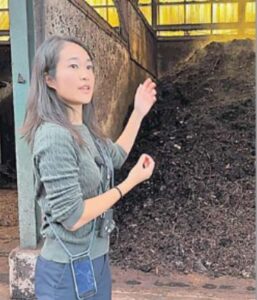
High temperatures have an antibacterial effect and stop mold and insect eggs from growing. After about a month, small grains are separated from bigger grains. It is at this stage that staff can clear other materials like plastic.
After six months, fertilizer is ready to be bagged. Ms Fujita said this is sold to farmers and even used at their own farm which grows carrots and leeks.
In a year, they produce about 220 tonnes of fertiliser and while they don’t make a lot of profit, the idea is to treat waste.
Landfill longevity In the 90s, residents of Osaki thought long and hard about the future they would leave their children.
Growing waste meant the sole landfill for the town had a fast-approaching expiration date.
Getting an incinerator was out of the question, as maintenance costs were too high. The idea of a second landfill was not welcomed by residents. Thus, the only logical solution left was to recycle.
Today, the recycling efforts mean the landfill can enjoy a prolonged lifespan – up until 2060 as opposed to the 2004 proposed before.
As of 2020, only 690 tonnes of non-recyclable waste made its way to the landfill, while 3346 tonnes of waste were recycled.
These figures are a stark contrast to the program’s inception, wherein the town recorded 35 tonnes of recyclable waste and a whopping 4382 tonnes of non-recyclables.
Ruru Nakagaki, the public relations director for Osaki SDGs Promotion Council, stated that currently, more than 60,000 people from Osaki and Shibushi use the landfill to dispose off non-recyclables.
In Osaki, about 17 per cent of total waste generated goes to the landfill.
Compost makes up about 60 per cent and more than 20 per cent is transferred to the local recycling centre.
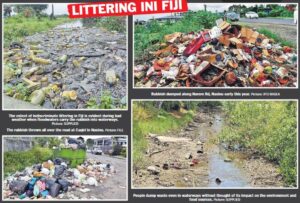
What can we Learn? Fiji has a serious littering problem.
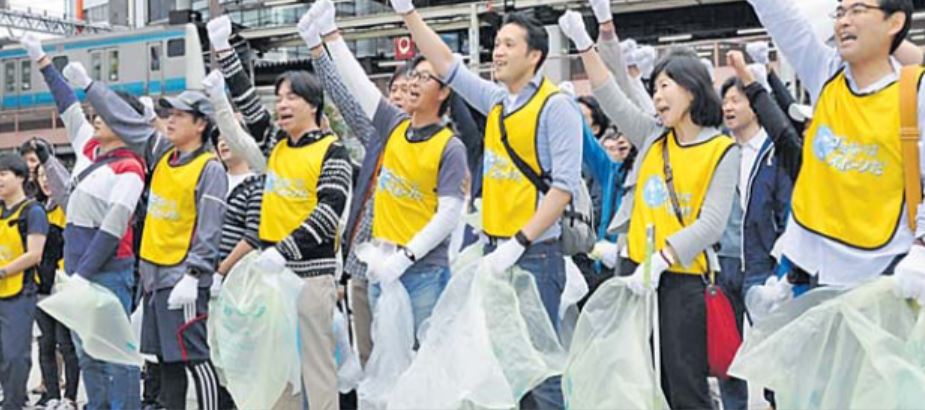
In August this year, news of a group of Japanese volunteers picking up rubbish in Lautoka also prompted Prime Minister Sitiveni Rabuka to label our littering issue as “an embarrassment”.
Mr Rabuka said that littering had spread widely and converted parts of Fiji’s landscape into shameful eyesores. According to a report published by the International Union for Conservation of Nature (IUCN) and Asia Pacific Waste Consultants in 2022, Fiji disposes about 140,000 tonnes of solid waste annually, of which around 15,000 tonnes are plastics. The report also pointed out Naboro Sanitary Landfill is the only disposal site that entirely satisfies current limited and is not used at its full capacity. The potential for plastics recycling in Fiji is substantial and requires further investment,” the When asked about the issue, Local Government Minister Maciu Nalumisa also agreed it was a concerning issue.
“Something that we are trying to do now is have a taskforce that’s going to review our waste management practices that we have,” he said. “We believe we need to do more, so we are looking at the legislative part of it and also working with other agencies to come only going to benefit Fiji but also benefit our future. It is something Time will only tell if Fiji’s rubbish problem is solved, and hopefully, it will be done sooner rather environmental standards.
“Recycling infrastructure is report said. up with maybe a model that’s not that we are looking at.” than later.

