
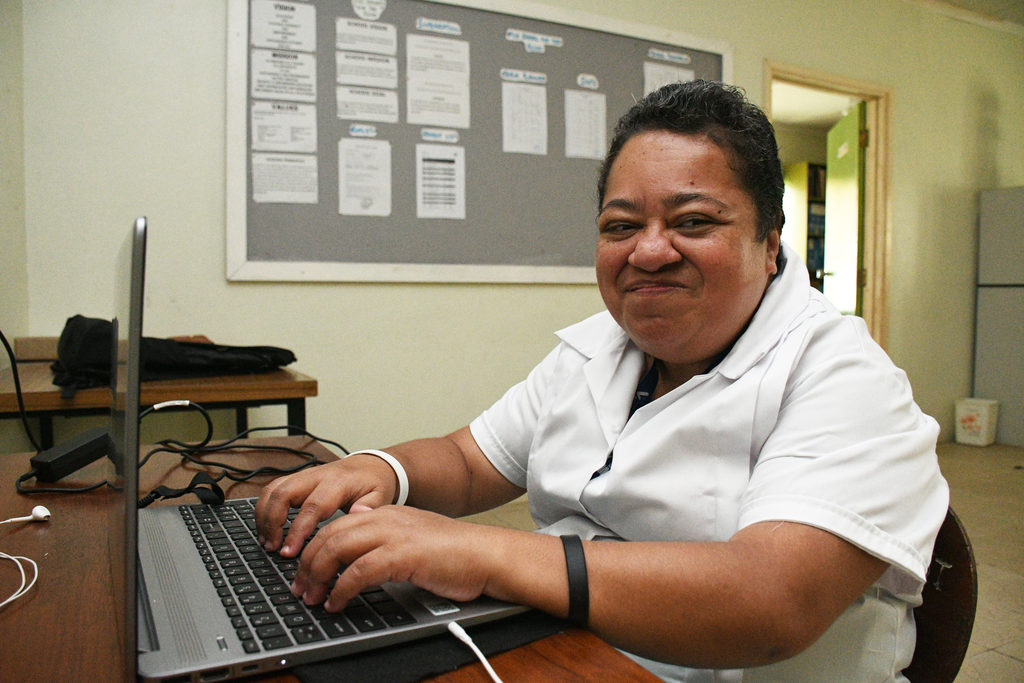
THERE is a method to how Veronica Narayan moves through the world. Every turn and stop is counted in her mind. The crowd thinning out tells her she is close — she takes this as her cue to walk.
In her teen years, she worked that out herself navigating Suva’s public buses with her white cane and a mind that turns everything unfamiliar into something she can learn.
“Before learning to go by bus, I would just count how many turns right, how many turns left, and how many stops. Then I can just tell about this crowd and I walk,” she says.
Veronica was born blind and spent her early years in Taveuni. She came to Suva in 1985, aged six, after community-based rehabilitation field workers learned of her plight and told her family about the Fiji Society for the Blind.
Her father had wanted her in school but had not known such a place existed.
However, her grandmother who had raised her was reluctant to let her go. She only relented after hearing that nuns from the Sisters of the Lady of Nazareth were caring for the children at the hostel.
In Suva, Veronica attended St. Marcellin Primary School, sitting next to classmates living in a world apart from hers, while teachers wrote on the blackboard. She felt that the lessons mostly moved on without her.
“It was silencing,” she remembers.
“Sometimes when the teachers are writing on the board, I feel that I’m left out a bit.”
Instead of complaining or feeling sorry for herself, she borrowed exercise books, took them home for the night, and Brailled the notes herself.
She asked teachers if she could work that way and slowly, they began to understand. By Years Seven and Eight, something had changed.
“The teachers would say, no, I will dictate because of Veronica.”
Veronica went on to attend Cathedral Secondary School where teachers dictated through Forms 9 to 12. When she had to repeat Form 4, embarrassment was the least of her worries.
One subject still defeats her, and she names it without bitterness. “Mathematics is not disability friendly at all,” she says.
She sees it now in the students she teaches Braille to, watching them run into the same difficulties she once did. Diagrams cannot be read. They have to be felt, and producing a tactile diagram for a blind student requires a separate worker and separate time.
When printed, a single A4 becomes four Braille pages and a single exam paper can take a full day to transcribe.
“For me, that’s one whole day just for Brailling, manually Brailling.”
In 2000 she spent 10 months in Japan, on a leadership course through the Einore Tuscan Foundation, learning Japanese Braille and screen reader technology.
Following the completion of her pre-vocational studies in 2003, she applied to become a Braillist at the Fiji Society for the Blind, ready to give back to the very place that nurtured her academic journey.
She was placed on a waiting list for four years. In 2007, when a coordinator finally came to test her, she told him something she had carried throughout that wait.
“I’ll never ever forget my Braille dots. Never mind I’m qualified or not, but Braille is my pen and paper.”
She got the job.
Today, she uses non-visual desktop access (NVDA), a free screen reader, to have her computer read exam papers aloud before she converts them to Braille by hand.
Over the years, Veronica says people have suggested she undergo surgery to try and regain her sight. But she has turned the idea down, confident in the decision she’s made.
“What God gives us, He just accepts it gladly. I want to be in my own world because I only know myself.”
Veronica is today a second-year student at Fiji National University, studying a Diploma in Special and Inclusive Education. She continues to work as a Braillist, with her white cane still leading the way.
“The white cane I’m holding is my eye. It takes me everywhere, in and out of the school. Never mind you know the premises, or might be in a familiar environment, or a new one, I’m never afraid because this is my eye.”
“Everyone has the right to education and employment. No one should be shy of a child’s disability because God created everyone in His image. If you have a disability, ask for assistance, where to go, what to do, how to do it.”

