
GLOBAL challenges aside, bilateral trade between New Zealand and Fiji is expected to be put through the test with an earlier target set by the joint business councils from the two sides – a $F2billion worth of trade between the two countries by 2030 – still very much on the table.
The Fiji Times Sports reporter Vereimi Wara caught up with New Zealand-Fiji Business Council (NZFJBC) president Chandra Sen for an interview while in New Zealand to cover the Fijian Drua’s Super rugby Pacific match against the Auckland Blues last weekend.
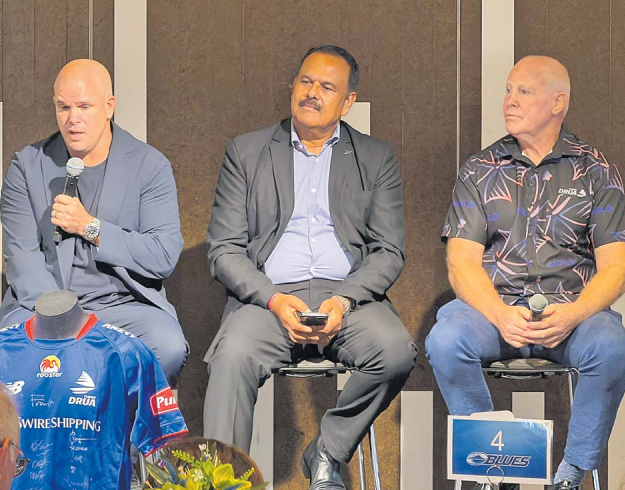
FT: The Blues Business Breakfast in partnership with the New Zealand Fiji Business Council (NZFBC) and the Blues, the Drua and the Auckland Chamber of Commerce has just ended. What’s been the highlight of your experience here today?
Mr Sen: I think the highlight of the experience is seen by the number of people that attended the event. We were reaching almost 300 people for the event. And when we heard the Dua and Blues were playing, the Council felt it was important as you heard the speakers, the importance about sports into business.
So we thought why not have this business breakfast and I’m so thankful that the Drua, the Blues and Auckland Chamber came on board and together we could deliver such an eventful programme this morning.
So yeah, I think it is something we’d want to do again, brings people together, gives the business council an opportunity to showcase what it does, why it does, share the wins that it does. So yeah, from that perspective, you know, if you want to call it whether it’s successful or not, it’s beyond successful and you judge that by the numbers.
FT: The two-way trade path between Fiji and New Zealand, which is aiming for $F2 billion in Fiji by 2030, how is that progressing so far?
Mr Sen: I think we have crossed $F2 billion in Fiji and it’s already $NZ1.4 billion in New Zealand. So we are looking at the target of $NZ2 billion by 2030. And you would have heard me say, the council was the one which had set the target some years back to have $2 billion by 2025.
But we had to do a reset because of COVID. And as you heard me say earlier on, we don’t want another reset because of the Iran, Israel, US war. I’m sure there is an impact and I’m sure businesses and people are feeling the pinch already.
When I left New Zealand to go to Fiji on Sunday (early this month), the petrol price was around $NZ3.50 ($F4.56). When I got back yesterday, it was $NZ4 ($F5.21), so a jump of 50c in just a few days. Hopefully, it doesn’t go on forever.
And then the $2 billion is really, you know, without this hiccup of the war, I had been saying to our members that the $2 billion is actually a low hanging fruit.
But then came, you know, this unforeseen thing. So, we’ll work around it. We do not want to reset the target.
FT: So no need to reset the target despite the war.
Mr Sen: No. The target is actually $NZ1.4 billion. That’s what we think it is – which is about $F2 billion already. So let us go for the target that’s common to both countries, which is $NZ1.4 billion. And that’s by 2030. We should do thatbecause there are a lot of opportunities, especially in Fiji, for New Zealand companies to take part in. Organisations such as Energy Fiji Limited (EFL) – they have a billion-dollar work program in front of them.
Water Authority of Fiji, who I met on Monday, they have a half a billion-dollar program to upgrade Kinoya. Airports Fiji Limited – they have a billion-dollar program. Fiji Ports has a $2 billion program.
So with all of this work, then the trade in goods and services, we should meet it. And I’m very comfortable, very helpful, confident that we will meet the target.
FT: What’s been the interest from New Zealand companies wanting to do business in Fiji since the last Fiji-NZ/NZ-FJ Business Council joint conference held in Fiji in 2024.
Mr Sen: The business interest has not been limited to a particular industry. The membership of the council is across the board. So we have people who provide legal services. So one of our member companies has since started providing legal services to Airports Fiji Limited, for example.
I have a business of my own. We’re doing work for Water Authority of Fiji, for example. So it’s varied. We have a member company which actually is invested in manufacturing facility in Fiji. So they have a licensed accredited manufacturing factory in New Zealand.
But they’re doing a lot of the work in Fiji and bringing it finally to New Zealand to put it together to get the accreditation thing. So it’s across the board that we are seeing people. Of course, tourism, you know, Novotel, the CP group – they are members of course – across the board, we have people doing engineering consultants. You saw the participants here earlier this morning from Beca, one of our pre-eminent engineering companies. So it is across the board, really. There’s no one particular industry that has got a big pool.
By virtue of being one of the biggest revenue earners tourism, a lot of it ends up being somewhere directly or indirectly attached to it. We have a member company which is looking at investing close to $80 million in Vanu Levu. So that is in cacao plantation and eco-tourism.
So it’s across the board. And it’s good to have that diversity so that if one thing goes down, it’s not down everywhere. Others are still pumping forward.
FT: Has that interest translated to actual New Zealand businesses setting up in Fiji?
Mr Sen: Yes, of course. Of course. I mean, I mentioned earlier on this manufacturing company that is doing manufacturing of the components in Fiji and taking advantage of that.
And when we are taking our business mission over in June (this year), we’re going to travel from Suva to Nani via the King’s Rd. We want to show the investors that that’s a tax-free zone in that area.
We want to show the investors the infrastructure that exists there, the businesses that are existing there.
So we’re going to stop at a few manufacturing places along the way. One of our member companies, Duco Consultancy, has just opened up a huge facility in Nadi. So we will stop over there as well on June 17 when we’re travelling to Nadi.
So, it’s actually not just talk, you know, as you would have said, just do it. We just don’t talk about it. Otherwise, it’s pointless.
FT: What’s your take, as head of the FNZ business council, on growth moving forward in the next five to 10 years?
Mr Sen: I think this council is poised for immense growth. And we’re sort of at the turning point.
You’ve heard how much time it takes (to do work for the council), it’s a volunteer thing… I give 20 per cent of my time roughly, give or take, to make sure that, you know, matters of the council are in order.
We have secretarial help but the committee members are all voluntary, and they all have a day job as well.
This year, one of the ways to measure the strength of a council, amongst others, I mean, Honourable Simon Bridges had a bit to say about the work of our council because they see the work of city councils.
And of course, he said we are the best performing one. So that was good to hear from someone independent like that. We’re not in competition with our fellow councils, of course.
But it’s always nice to know that you are a winner. This year, we are having an event. And it takes up time and effort. In the previous years, we were looking at almost one event every two months. I think we are going to do at least two events every three months.
And with a bit of push and luck. And our vice president is right here, he travelled up from Wellington. And you know, he’s really coming behind me with probably more energy than me.
And, you know, single-handedly, he held the event in Wellington. So this is only the third month of the year, we’ve already had two events, because January is hibernation in New Zealand.
So we had the event in Wellington. And then we had the webinar where we had investment Fiji, Mark Halabe, Duco Consultancy to speak to our members and show to them that whatever you’re hearing in Fiji on the political phase is happening, but business is still going up, and so we had to, you know, just re-convince our members that they need to continue down the path that they’re headed.
So we had that event. And then we got a business Bingo in Auckland in April. And then the road show to South Island later.
In May, we are planning a webinar. And then June, we have the business mission, we have the conference. So it’s a fairly packed up outline.
And the membership is growing quite well. I mean, when I took this role up some 10, 20 years ago, there were 40 members.
We have 200 (now). So that’s a sign of facts. And as you heard me say, the council has done good for its members, you know, getting the Fiji Government, the Fiji tax office to accept that they can’t apply non-resident withholding tax to work done here as consultancy, we got that happening.
And we’re talking to the tax department to make sure double tax agreement is resolved and an income is taxed only once in one place. At the moment, it’s not the case. You heard about what we do for our members with the Fiji Airways discount.
So that’s a massive discount that our guys have negotiated with Fiji Airways. So we continue to do things like that.
I know member companies have had difficulties trying to maneuver their way through the bureaucracy at times. And because we have direct line to the bureaucracy, we’re able to pick the phone up and make it happen for them.
We have our high commissioner here, we acknowledge that, we have our high commissioner from New Zealand in Fiji, we acknowledge that.
But, you know, they have protocols to follow. We want to do it now. We haven’t got the time to go through the bureaucracy. Cut the red tape.

