
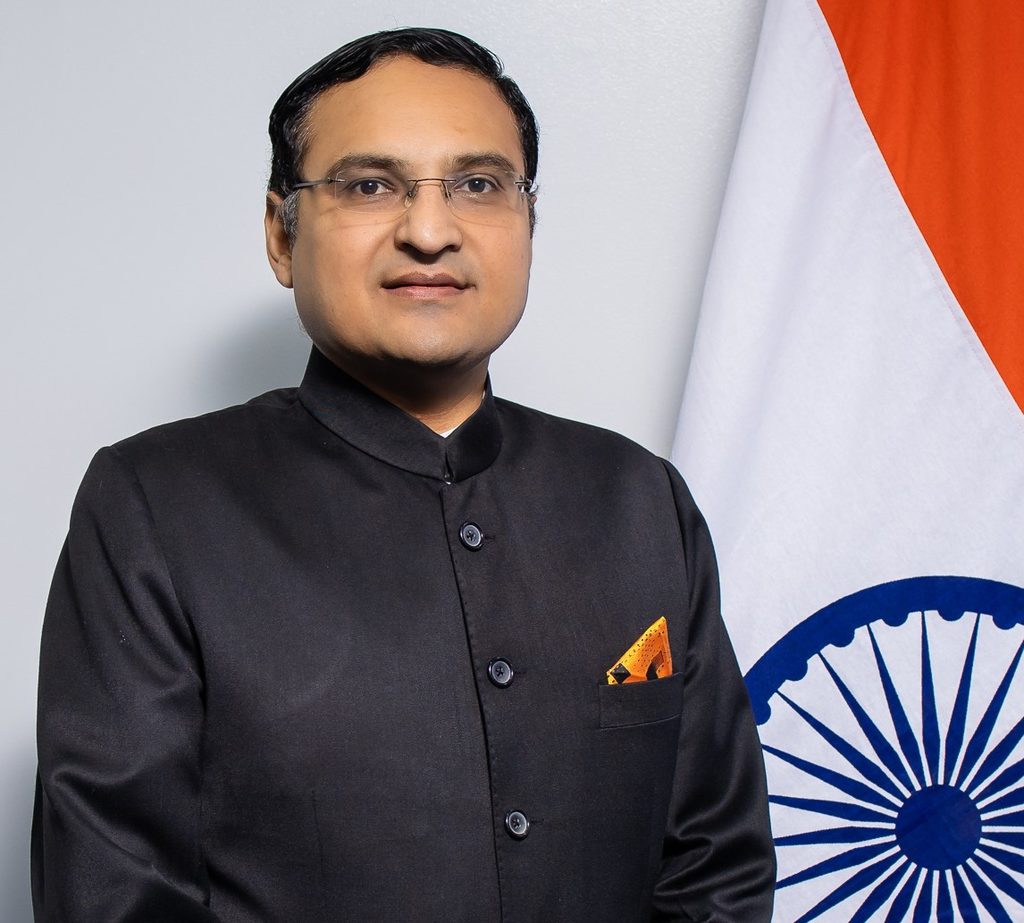
On the occasion of India’s 77th Republic Day, I extend my warm greetings and heartfelt wishes to the people of Fiji, Kiribati, Tonga, and Tuvalu. As we mark this important day, we reflect on India’s remarkable journey since becoming a Republic in 1950.
Republic Day commemorates the adoption of the Indian Constitution, a visionary document that laid the foundation for a sovereign, democratic republic committed to justice, liberty, equality, and fraternity.
Reflecting India’s civilisational values and modern democratic principles, it guarantees fundamental rights, upholds the rule of law, and ensures social justice and equal opportunity for all citizens.
Over seven decades, the Constitution has remained resilient, adaptable, and responsive to the evolving aspirations of the Indian people, guiding India’s growth into one of the world’s largest democracies, with a thriving economy, rich culture, and enduring commitment to peace and global cooperation.
Since gaining independence in 1947, India has undergone a profound transformation, emerging as one of the world’s largest democracies and among the fastest-growing major economies with confidence, reform, and global engagement.
In 2025, India’s economy sustained robust momentum, growing by around 7.4 per cent, driven by strong domestic demand, investment, and structural reforms. The nation has now consolidated its place as the world’s fourth-largest economy by nominal GDP.
Exports remain a key engine of growth, with merchandise and services exports delivering strong performance across petroleum products, pharmaceuticals, engineering goods, electronics, chemicals, textiles, and IT and digital services. India’s services sector, especially in IT and digital services, continues to be globally competitive.
Flagship initiatives such as Make in India, Atmanirbhar Bharat, and the Production Linked Incentive schemes have strengthened domestic manufacturing and integrated India more deeply into global supply chains.
Landmark labour reforms, consolidating multiple labour laws into simplified labour codes, have improved ease of doing business while protecting workers’ rights. Complementing these efforts, targeted GST reforms and new employment initiatives announced in 2025 further strengthened MSMEs and expanded opportunities for India’s youth.
India’s achievements in space, science, and technology in 2025 showcased the nation’s growing innovation capacity and strategic ambition. ISRO successfully launched India’s heaviest commercial satellite, enhancing the country’s global standing in space launch services. India also achieved the rare feat of docking two satellites in space, placing it among a select group of advanced spacefaring nations.
Group captain Shubhanshu Shukla created history by becoming the first Indian in nearly four decades to visit the International Space Station, conducting extensive scientific experiments and strengthening India’s human spaceflight ambitions.
These accomplishments were complemented by the joint India-NASA launch of the NISAR satellite, which will significantly enhance global monitoring of climate change and natural disasters, and by continued progress in indigenous technologies, including space-grade microprocessors and the upcoming PSLV-C62 mission in early 2026.
In 2025, India added around 48 GW of renewable energy capacity, with solar power leading the expansion, followed by wind energy.
This rapid growth accelerates progress toward India’s 500 GW non-fossil fuel capacity by 2030 goal, showcasing its commitment to clean energy and climate action.
India’s digital revolution continues at an extraordinary scale. The Unified Payments Interface (UPI) now drives around 50 per cent of the world’s real-time digital payment transactions, a testament to India’s leadership in fintech infrastructure.
In India, UPI accounts for over 85 per cent of digital payments, and digital payments now comprise virtually all non-cash retail transactions. This digital ecosystem fuels financial inclusion, innovation, and economic participation, making digital services accessible nationwide.
India’s global engagement is proactive and grounded in peace, respect for international law, and multilateral cooperation. As a founding member of the United Nations, India actively supports peacekeeping, humanitarian relief, and sustainable development.
Its voice is respected in forums like the G20, BRICS, Quad, ASEAN, and the Shanghai Cooperation Organisation, while also championing coalitions such as the International Solar Alliance, Coalition for Disaster Resilient Infrastructure, and the Global Biofuels Alliance to advance climate action, energy security, and a rules-based international order.
While celebrating these achievements, India remains committed to addressing enduring challenges: ensuring inclusive growth, uplifting all sections of society, eradicating poverty, expanding quality healthcare and education, and tackling climate change.
As we celebrate Republic Day, we honour the vision of our founders, salute the achievements of our people, and reaffirm our collective resolve to build a strong, inclusive, and peaceful Viksit Bharat, realising the dream of a fully developed India by 2047, the centenary of our independence.
This occasion allows me to acknowledge the growing India-Fiji relationship, deeply rooted in shared history, culture, and values. The Indian diaspora in Fiji, dating back to the 19th century, has played a key role in shaping the nation’s social, cultural, and economic landscape.
Today, the Indian community is integral to Fiji’s diverse society, contributing to agriculture, trade, education, and public service.
Both countries share a commitment to democracy and cultural diversity, which forms the foundation of our strong partnership. Over the years, our ties have expanded to include healthcare, agriculture, defence, trade, ICT, renewable energy, education, capacity building, and people-to-people exchanges.
High-level exchanges continued to anchor the India–Fiji partnership. In August, Fiji’s Prime Minister, Sitiveni Rabuka, paid his first official visit to India, holding delegation-level talks with India’s Prime Minister Shri Narendra Modi.
The visit resulted in the exchange of several bilateral documents and a joint statement reaffirming the spirit of Veilomani Dosti.
In May, Minister of State for External Affairs and Textiles Pabitra Margherita, undertook an official visit to Fiji, during which he participated in the Girmit Day commemorations in Labasa as the chief guest, virtually inaugurated the Yoga Centre in Seaqaqa and witnessed the signing of an MoU on the recognition of the Indian Pharmacopoeia.
India’s engagement with Fiji has also been marked by an exceptional 24 ministerial-level visits since December 2022, including seven in 2025 alone, reinforcing strong political and diplomatic bonds.
The year also saw the 6th round of India–Fiji Foreign Office Consultations held in Suva in July, reviewing cooperation across priority sectors and outlining future engagement.
Looking ahead, parliamentary exchanges are set to deepen further, with visits of a parliamentary delegation and a delegation of the Great Council of Chiefs from Fiji to India in 2026.
In 2025, India and Fiji significantly strengthened health ties through sustained cooperation and high-level engagements, including the 3rd India-Fiji JWG on health convened in August which provided a platform to deepen collaboration in healthcare delivery, capacity building, and joint programs.
This growing cooperation complemented India’s ongoing support for Fiji’s healthcare infrastructure, most notably through one of India’s largest development projects in the entire Pacific region—the construction of a 100-bedded Super Specialty Hospital in Suva.
The construction of this landmark project is expected to commence in 2026 and will expand access to advanced medical services locally while serving as a regional hub for tertiary care.
India also continued to enhance access to healthcare through the supply of quality generic medicines under the Jan Aushadhi scheme, telemedicine consultations, the Heal in India initiative, and the announcement of the second round of the Jaipur Foot camp.
A major milestone in health cooperation was the donation of a large consignment of anti-retroviral (ARV) drugs, supporting Fiji’s HIV prevention and treatment programmes and strengthening overall health system resilience.
Defence and security cooperation witnessed notable progress. The first India–Fiji JWG on Defence was convened in July, focusing on training, capacity building, maritime security, and humanitarian assistance and disaster relief.
In September, the Indian Navy ship INS Kadmatt paid a goodwill visit to Suva, featuring professional exchanges, joint cultural activities and community medical outreach.
India also committed to gifting ambulances to the Republic of Fiji Military Forces and establishing a Cyber Security Training Cell in Fiji.
In the maritime domain, Fiji’s decision to join the Indo-Pacific Oceans Initiative (IPOI) further aligned the two countries’ shared vision for a free, open, inclusive, and rules-based Indo-Pacific.
Agriculture and rural development emerged as an important area of cooperation.
India donated 5 tonnes of black-eyed cowpea seeds to the Government of Fiji to support food security and enhance agricultural productivity.
India also committed technical assistance through the deployment of experts and targeted training programs for the sugar sector, including capacity building for Fiji Sugar Corporation personnel.
The partnership further expanded to include support for mobile soil testing laboratories and agricultural drones, which are expected to be delivered this year.
The Tubalevu Village water project is underway to provide clean and sustainable groundwater addressing long-standing water shortages and improving community resilience.
Education, digital cooperation, and capacity building expanded steadily. India and Fiji signed a declaration of intent in the field of migration and mobility, IT skilling through collaboration between NIELIT India and Pacific Polytech Fiji, and rural development cooperation between NABARD and the Fiji Development Bank.
Capacity building was further enhanced through ITEC and ICCR scholarships, with 85 Fijian professionals participating in ITEC courses in 2025 alone, and more than 1000 Fijians benefiting from ITEC training since 2007.
Support continued for Tamil language education in Fiji, with teachers deployed from India, and preparations are underway for the placement of a Hindi-cum-Sanskrit teacher at the University of Fiji.
Trade and economic cooperation gained momentum in 2025. Indian ghee secured market access in Fiji, marking a tangible outcome in bilateral trade.
An MoU was signed between the Bureau of Indian Standards (BIS) and Fiji’s Department of National Measurement and Standards (DNTMS) to strengthen cooperation in standardisation, quality infrastructure, and conformity assessment.
Institutional business linkages were also reinforced through the signing of an MoU between the Confederation of Indian Industry (CII) and the Fiji Commerce and Employers Federation (FCEF), supporting private-sector engagement, MSME cooperation, and trade promotion.
Cultural diplomacy and people-to-people exchange continued to flourish in 2025 through a range of activities organised by the Swami Vivekananda Cultural Centre (SVCC) and the High Commission of India, encompassing Indian film screenings, Kathak and painting workshops, Yoga classes, Hindi language events, and Bollywood dance workshops, which have drawn broad participation across communities in Fiji and deepened cultural appreciation.
In the spiritual domain, Fijian purohits participated in a specialised training course as part of the International Gita Mahotsav in India, enhancing their ability to serve Sanatan religious practice back home, reflecting the rich, shared cultural heritage between India and Fiji.
In the area of sports cooperation, India has announced the deputation of an Indian cricket coach for Cricket Fiji.
Looking ahead, our partnership will continue to evolve. India’s expertise in renewable energy, climate change adaptation, and digital technologies offers opportunities for collaboration with Fiji. The success of India’s UPI and Aadhaar-like National ID system could serve as a model for Fiji, helping to modernise its services and infrastructure.
India’s commitment to multilateralism and regional cooperation remains unwavering. We will continue to work with Fiji and other Pacific nations to address security, economic growth, and climate resilience through platforms like the United Nations and Pacific Islands Forum.
As we celebrate Republic Day, it is an occasion to reflect on India’s progress and the challenges ahead. Our journey as a republic has been marked by resilience, innovation, and inclusivity. India remains committed to democratic values, social justice, and global peace.
On this auspicious occasion, I extend my sincere gratitude to the people of Fiji, Kiribati, Tonga, and Tuvalu for their continued friendship and cooperation. Let us work together to build a future that is brighter, more prosperous, and more inclusive for our peoples and for the global community.
Jai Hind!
Picture: AI

p
p

