
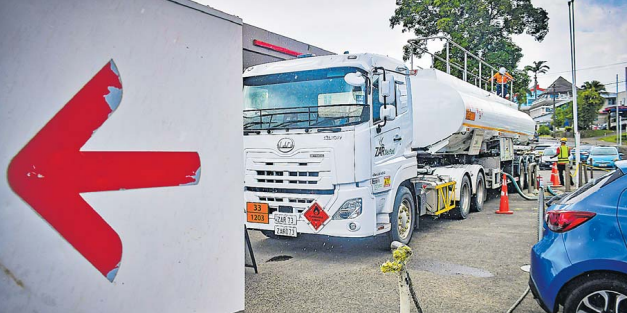
FOR weeks now, public debate has intensified around questions raised in homes, on social media, and by major organisations.
“Why did fuel prices rise when cheaper stock was still available?”
“Why did the increase come earlier than expected, and perhaps more importantly, who really benefits?
Critics, including the Fiji Trades Union Congress (FTUC) and the Asia Pacific Regulatory Centre, have challenged the methodology used by the Fijian Competition and Consumer Commission (FCCC).
They argue that the timing of the increase removed an important buffer period and unfairly shifted the burden onto ordinary Fijians.
It is a view that resonates.
After all, when prices rise before households are prepared, the impact is immediate and real.
To properly assess the issue, The Fiji Times decided to take a step back and examine the broader context by speaking with relevant agencies.
Fiji’s fuel pricing system is a deliberately controlled mechanism: monthly price regulation using a least-cost pricing methodology.
This means the price is set based on the cheapest realistic cost of getting fuel into Fiji, plus a small, controlled profit.
And It’s not arbitrary. It takes into account the global price of fuel, the cost of shipping it to Fiji, and currency exchange rates, while also making sure fuel companies don’t charge more than a set profit limit.
So normally, fuel prices in Fiji are based on what it cost to buy fuel the month before, meaning people were paying for cheaper, already imported fuel when things changed in April.
The cheaper fuel stocks were running out faster than expected, while new fuel being ordered was much more expensive due to rising global prices.
So instead of only using the older, cheaper price like usual, FCCC adjusted the system slightly by including some of the newer, higher costs earlier than normal.
In simple terms, prices didn’t just look back at the cheaper fuel, they also looked ahead at what it would cost to replace it, which is why the increase came sooner than people expected.
“During this time, FCCC observed that February 2026 stock was being depleted more quickly than usual, while replacement supply was being secured in a significantly higher cost environment,” FCCC said.
“In light of these conditions, FCCC extended the pricing reference window beyond the usual one-month period to include an additional 20 days of the subsequent month, so that the assessment reflected a more representative picture of market movements and replacement costs during a period of rapid change.”
Importantly, it did not pass on the full extent of international price increases immediately.
That detail matters. Because in a country like Fiji, small, import-dependent, and with only three fuel suppliers, the margin for error is razor thin.
There is no real bargaining power in global markets.
Fiji does not influence prices, we absorb them. And without intervention, those shocks would hit consumers faster, harder, and more frequently.
Now this is where the conversation shifts from criticism to context.
Reserve Bank of Fiji (RBF) Governor Ariff Ali dismissed suggestions of imminent deregulation and instead reinforced the value of the current system.
To deregulate fuel prices as some suggest, would mean the government, through the FCCC, will no longer set or control fuel prices, leaving oil companies to decide prices based on market forces.
In theory, that sounds efficient. In practice, for Fiji, it could be destabilising.
Fuel is not just another commodity. It is embedded in nearly every part of daily life — transport, electricity, food distribution.
When fuel prices rise, everything else follows. According to Mr Ali, fuel and gas make up 6.9 per cent of the average household consumption basket, but their indirect effects can nearly double that impact through higher transport and energy costs.
Now imagine those prices moving unchecked. Deregulation would likely mean sharper, more frequent price fluctuations. Global spikes would pass through immediately, while any relief from falling prices might lag behind.
For low-income households and those in outer islands, who already spend a larger share of their income on essentials, the consequences would be disproportionately severe.
This is where the criticism begins to lose some of its footing.
Because while the current system is not perfect, and no system is, it is designed with Fiji’s structural realities in mind.
“Given Fiji’s structural characteristics, maintaining a regulated fuel pricing framework continues to provide an important buffer against external shocks, supports price stability and helps contain cost of living pressures,” Mr Ali said.
“Importantly, Fiji’s approach to regulated fuel pricing is not new or unique in the global context.
“Many developing and small open economies who share structural characteristics similar to Fiji apply some form of oversight or administered pricing for fuel.
“For instance, countries such as Indonesia, Malaysia, Vietnam and Sri Lanka retain varying degrees of government control over fuel prices through price formulas, subsidies, regulated price bands or adjustment frameworks.
“Similarly, several Pacific island countries including Samoa and Tonga, maintain regulated fuel pricing regimes that reflect small market size, high import dependency and heightened exposure to external shocks.”
In that sense, Fiji’s model is less an outlier and more a reflection of economic pragmatism.
Still, the timing of the recent increase cannot be ignored. Critics are right to question whether consumers should bear higher costs while older, cheaper stock remains in the system.
It is a valid concern, and one that underscores the delicate balance regulators must strike.
But the alternative, delaying adjustments until new stock arrives, comes with its own risks.
Suppliers must plan for future purchases, often at higher prices. If pricing does not reflect those realities early enough, it can disrupt supply chains and create shortages.
Again in a country like ours, where fuel availability is critical, that is a risk policymaker are understandably reluctant to take.
And hovering over all of this is a larger, more unpredictable force: geopolitics.
The recent announcement by Iran to close the Strait of Hormuz serves as a stark reminder of how quickly global conditions can shift.
Any disruption there has the potential to send oil prices surging overnight.
For Fiji, a price-taker in every sense, such shocks are not hypothetical, they are inevitable.
Which brings us back to the central question: are Fiji’s price control measures flawed, or are they functioning exactly as intended? The answer, perhaps, lies somewhere in between.
They are not flawless. They cannot eliminate global volatility. They cannot shield consumers from every price increase.
But as Mr Ali earlier alluded to, the buffers can, and do, moderate the impact. They slow the transmission of shocks.
They prevent extreme pricing behaviour and they provide a measure of predictability in an otherwise unpredictable market.
In times like these, that may be our greatest strength.
Because while it is easy to critique a system when prices rise, it is much harder to design one that works when everything else is falling apart.

