
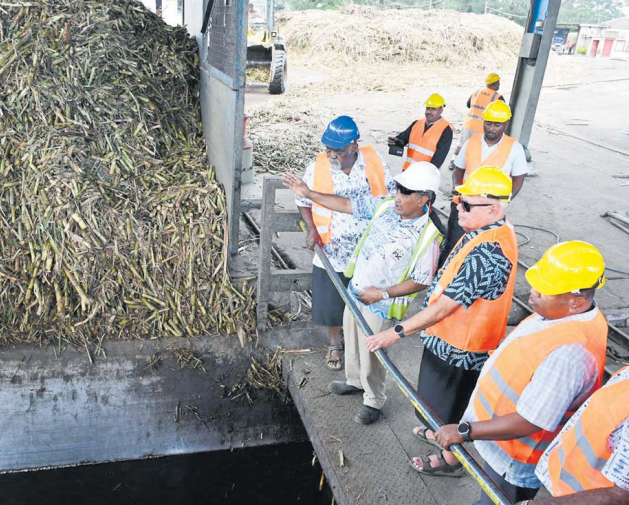
THE sugar industry is draining Fiji’s economy, and the country can no longer afford to continue supporting it in its current form, says People’s Alliance party (PA) president Ratu Josefa Dimuri.
Ratu Josefa believes major changes are needed, including considering private management of the Fiji Sugar Corporation (FSC), closing the mills on Viti Levu and making Labasa the main centre for sugar production.
“I do not think we can afford to continue depending on this crop for much longer. It is draining the economy rather than contributing to the economy,” he said.
Ratu Josefa said sugar used to be one of Fiji’s biggest contributors to the economy but that was no longer the case.
“It has now become one of the biggest drains on the economy.”
His comments come as Government continues to invest millions of dollars into the industry while facing problems with cane supply, ageing mills, labour shortages and rising costs.
Sugar Minister Tomasi Tunabuna has acknowledged that Government was investing significant money into the sector while returns remained a concern.
Mr Tunabuna had also confirmed Government was paying about $18million each year to service debts, including money owed to the Exim Bank of India.
Ratu Josefa said the situation could not continue.
“I believe it is time to make that shift. We have to make that shift because we cannot afford to wait any longer.”
He suggested that the Government consider closing the mills on Viti Levu and concentrating sugar production in Labasa.
“I would like to suggest that we close the mills in Viti Levu and only concentrate sugar production at Labasa. We should improve the quality of the crop and increase production there.”
But the proposal comes at a difficult time for the Labasa mill.
The mill stopped crushing during the first three weeks of the current crushing season because of low or no cane supply.
No mill breakdowns were recorded during that period.
Mr Tunabuna said the start of the crushing season had been difficult because of the fuel crisis and other disruptions.
“It’s not a normal year. It has been a very difficult year for us to start with one with the fuel crisis, and second with some interferences along the way,” he said.
Despite the difficulties, Mr Tunabuna praised Northern farmers for continuing to harvest and deliver cane.
“I am particularly happy about the farming community here in the North for their perseverance and how resilient they are in carrying out required tasks towards harvesting.”
Farmers had signed the Master Award Growers Agreement and decided to continue harvesting.
“They decided for themselves that they would have to continue, and they did exactly that.”
The Labasa mill needs between 5500 and 6000 tonnes of cane each day to keep operating.
However, it has been receiving only about 3500 to 4000 tonnes. The shortage means the mill cannot operate at its full capacity.
Fiji’s aging sugar mills is another major concern.
Mr Tunabuna said the mills needed regular maintenance because of their age and defended the practice of closing mills on Sundays.
“Closing on Sundays for repair and maintenance work is very normal. It gives time for some maintenance to be done for the mills.”
“This has been the practice simply because our mills are very old mills. We simply cannot wait until we have a big breakdown.”
He said it was also not practical to keep crushing when there was very little cane available.
“It also coincides when there is a very low supply of cane on Sundays. So it is not a very good idea to be crushing when you won’t have the cane.”
Mr Tunabuna said stopping the mill allowed maintenance workers to carry out checks and repairs before more cane arrived.
“A better idea is to stop the mill and do some maintenance while you wait for a big supply coming in on Monday.”
But Ratu Josefa believes the continued cost of keeping the industry operating is becoming too heavy for the country.
He said Government needed to take the bull by the horns and make difficult decisions.
The future of FSC could also involve private ownership.
Prime Minister Sitiveni Rabuka has confirmed that selling FSC to a private company is an option.
However, he said FSC was a strategic asset and Government needed to consider its importance before making any decision.
“Selling is an option, but there are certain things that we call strategic assets, and these are strategic assets,” he said. “They belong to the Government, and what we can do is improve the performance of the industry.”
Mr Rabuka said Government was focused on improving the performance of the sugar industry while considering its future.
A special committee on the sugar industry is consulting farmers and other stakeholders about the problems facing the sector.
The committee has already visited sugar-growing areas in the West and is expected to visit the North.
Ratu Josefa said Fiji should also look at crops that could give farmers better and more regular income.
He said high-value vegetables could be grown around Nadi and exported because of the area’s close access to the international airport.
“We can also try this approach in Nadi because we have an international airport there. We can establish a 15-kilometre or 20-kilometre radius and venture into high-value vegetables that can be exported,” he said.
He said there was already a strong market for vegetables because of the number of hotels and resorts in the area.
However, some resorts continue to import vegetables because local farmers could not always supply the quality required.
Ratu Josefa also identified pawpaw as a crop with export potential.
“Fruits such as pawpaw have strong export potential, especially in New Zealand where there is high demand. One pawpaw in New Zealand can sell for around $12,” he said.
He said farmers could earn money more regularly from vegetables and fruits than from sugar.
Sugar provides income mainly during the crushing season, while other crops could be harvested and sold throughout the year.
The problems facing the sugar industry have also led to Fiji importing sugar.
Mr Tunabuna said the decision was made to ensure there was enough sugar available for consumers.
“The importation was based on the need that we have for sugar,” he said.
He said delays in harvesting and low cane supply at the start of the crushing season may have contributed to the need for imports.
“Whether it was triggered by the low supply of cane right from the start of the mill, which could have also been part of the problem when we had delayed harvesting.”
FSC had prepared for possible supply problems by keeping sugar stocks available.
“FSC also knew that was going to come, so we wanted to make sure that we had some available sugar in stock in case some retailers were going to restrict sales of their sugar.,”
Farmers and harvesting operators are also dealing with changes in mechanical harvesting rates.
The Fiji Competition and Consumer Commission reduced the mechanical harvesting rate from $24.63 a tonne to $20.52 a tonne after fuel prices dropped.
The new rate is 16.7 per cent lower than the previous interim rate.
Some harvesting operators have raised concerns that the lower rate could affect their ability to continue providing services.
Mr Tunabuna said the FCCC would have to explain how the new rate was calculated.
“The FCCC will answer that. But I’m not sure how they formulate their formula charges. They will have to explain,” he said.
He said the rate was linked to fuel costs.
“The fuel subsidy that was given to them will be readjusted when there is a change in fuel. That’s very normal practice.”
The sugar industry now faces several major challenges at the same time.
Farmers are struggling with cane supply and production costs. Mills are old and require regular maintenance. Government is spending millions of dollars to keep the industry operating, while FSC continues to carry debt.
At the same time, Fiji is importing sugar to ensure consumers have enough supply.
Ratu Josefa believes the country must now consider a different approach.
He wants Government to focus sugar production in Labasa, consider private management of FSC and encourage farmers to move into crops that could provide higher and more regular returns.
Mr Rabuka said FSC remains a strategic asset and Government is looking at ways to improve its performance.
The special committee on the sugar industry’s consultations could help determine what happens next.
For farmers and communities that depend on sugar, the decision will have major consequences.
The debate is no longer simply about how to produce more sugar. It is about whether Fiji can continue paying the rising cost of keeping the industry alive or whether it is time to change the way the country produces, manages and earns from agriculture.

