
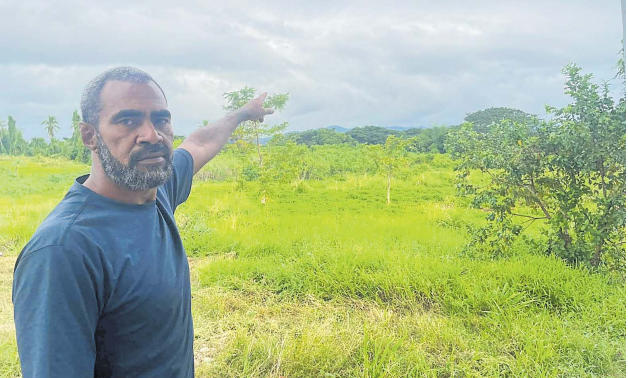
NEARLY 20,000 residents in the greater Labasa area could be left without water after close of business today if landowners of the Nasarava water catchment do not receive an outstanding payment of $410,000.
The ultimatum, issued by the Nabukarabe Mataqali (clan), which owns the land where the Nasarava catchment is located.
At the heart of the standoff is an outstanding payment of $410,000. Landowners claim the State and relevant statutory bodies have breached a comprehensive compensation package negotiated earlier this year.
The clan claims authorities have failed to pay the full amount agreed to earlier this year under a compensation deal worth about $1.4million.
Under the deal, the Nabukarabe clan was entitled to receive a premium payment of $765,000, alongside $610,000 in direct compensation and an additional $35,000 for land rent.
Instead, the clan reveals they have only received a fraction of the promised funds, leaving community development projects in limbo and pushing traditional leaders to take drastic measures.
Speaking exclusively to The Fiji Times, clan spokesperson Osea Waqanivatu confirmed that a hard deadline had been delivered to authorities.
“If the money is not in our bank account, we will move ahead with plans to shut off the water supply,” he said.
“The mataqali has waited for 75 years. We are not asking for anything unreasonable. When you look at how many people use this water every day, the amount we are asking for is very small.”
Mr Waqanivatu said the State distributed an initial sum of about $607,000 on April 7. This money was subsequently divided equally among the three primary families comprising the clan.
“We were told the rest would be paid before the end of the month, but that has not happened.”
Mr Waqanivatu said the landowners had repeatedly sought answers but were given different explanations by various agencies.
“We have been told the matter is with the Ministry of Lands and WAF. Even two weeks ago we were still being told the issue was being worked on.
“It feels like everyone is passing responsibility to someone else.”
The Nasarava catchment functions as the primary hydraulic artery for the North, supplying thousands of domestic homes, commercial businesses, schools, regional hospitals, and government administrative complexes throughout greater Labasa area.
The escalating dispute exposes severe structural friction between indigenous landowning units and state apparatuses.
Earlier this year, high-level negotiations were convened between representatives of the Nabukarabe clan and officials from the iTaukei Land Trust Board (TLTB), the Department of Lands, and the Water Authority of Fiji (WAF).
The clan had initially sought a $6m settlement, arguing that the State had systematically extracted water from their customary boundaries for decades without valid lease mechanisms or fair financial recompense.
In a gesture of goodwill to ensure public utility continuity, the landowners agreed to drop their demands to the heavily reduced $1.4m package.
Mr Waqanivatu said he had contacted government officials seeking an update.
“We have sent numerous emails and letters regarding the matter but were still waiting for a clear answer.
Mr Waqanivatu said the clan had also not been given a copy of any lease agreement relating to the catchment. There has been no proper consultation with the mataqali regarding the promised payments.
The delay has affected plans to use the money for development projects with the clan initially intending to invest part of the compensation into projects that could create jobs and generate income for future generations.
“We wanted to use this money to create opportunities for our people.
“We had plans for investments and community projects, but nothing can move forward until the payment is made.”
The clan members had also discussed creating a trust to manage future investments and ensure benefits were shared fairly but those plans had been put on hold.
Mr Waqanivatu said landowners had been patient but were now becoming frustrated.
Mr Waqanivatu questioned why landowners were still waiting for payments that had already been agreed to.
Hesaid institutions responsible for protecting landowner interests needed to be more accountable.
“There are too many barriers and too many delays. These organisations are supposed to help people, not make things harder.”
Mr Waqanivatu said many landowners in the North felt their concerns were not being heard by the TLTB.
“Communities needed more support to understand their rights and have a stronger voice in decisions affecting their land.”
Mr Waqanivatu said the issue went beyond compensation and was about trust.
“We have attended meetings and followed the proper process. We have done everything we were asked to do.
“How can people trust these agencies when promises are not being kept.”
Mr Waqanivatu said such issues could influence how people cast their votes in the next general election following similar instances in the past where promises made to iTaukei communities in previous election campaigns were not kept.
“People were promised opportunities and development.
Many are still waiting for those promises to become reality.”
Mr Waqanivatu said the Nasarava dispute was just one example in the grand landscape of issues affecting landowners around Fiji.
“If this is happening to us, imagine how many other landowners are facing similar issues.”
The Fiji Times has sent questions to TLTB, WAF and the Ministry of Lands and is awaiting responses.

