
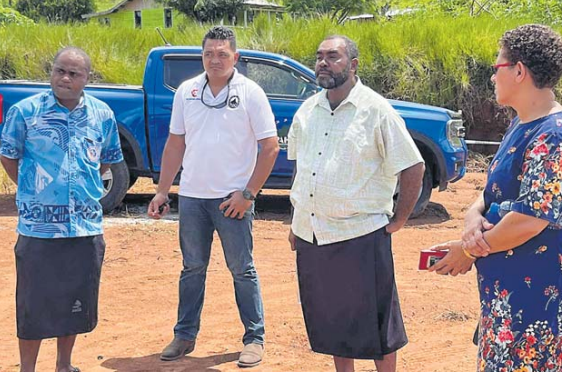
HOMES at Nabavatu are now expected to be completed ten months after the earlier promised completion date.
This extends the wait for families who have already spent almost five years living in tents after being forced from their original village site.
During the ground-breaking ceremony in March last year, the former Rural and Maritime Development Minister, Sakiasi Ditoka, told villagers that all 37 homes would be completed by December.
That deadline has passed, and the new completion date has been set for October 2026.
However, Rural and Maritime Development Minister Mosese Bulitavu said the project was now tracking ahead of schedule, with some families expected to begin moving in earlier than planned.
“The proposed timeline was October this year, but we are actually moving ahead of schedule, he said, adding that some may move to their homes earlier than July.
“We are now looking at July or August, when occupancy of the houses should begin. We are still working towards the October timeline, and we are hopeful that some families can move in by July.”
He said weather conditions continued to affect progress on the site.
“The road and terrain here become very muddy during heavy rain, which impacts construction work.”
Mr Ditoka said seven houses were up to beam level.
“Our deadline is for all 37 homes to be completed this year,” he said.
He said materials on site were being maintained as required while work continued.
“Tarpaulins and pallets are replaced according to the needs of the families still living in tents. We have more than enough available resources to take care of those that needs it.”
The relocation of Nabavatu followed an assessment that declared the original village site unsafe due to land instability and widening cracks, conditions that worsened after Tropical Cyclone Ana in 2021.
Families were forced to leave their homes and move into tents and makeshift shelters while awaiting permanent relocation.
Nadoiviri was later approved as the new relocation site.
The project includes 37 homes, an evacuation centre, and a church, as well as internal roads, drainage, water, and power infrastructure, at a total cost of $5.9million.
Funding is provided through the Climate Relocation of Communities Trust Fund, administered by the Ministry of Climate Change and Environment, with support from bilateral partners.
Mr Bulitavu said the new settlement would follow a village-based layout.
“Yes, it will be village-based,” he said.
“There will be terraces in between and footpaths installed. There will be no individual compounds for each house.
“While families own their houses, the land belongs to the village, so decisions will be based on consensus.”
He said residents would be briefed before moving in.
“Before they move in, we will conduct briefings with the Provincial Council and the roko to explain how residents are expected to conduct themselves, given the layout,” he said.
On the allocation of houses, Mr Bulitavu said the list would be provided by the Commissioner Northern’s office.
“The 37 households were prioritised following a geotechnical survey by Lands,” he said.
“Allocation will be based on the list approved by the Commissioner’s office.”
Engineering Express Company general supervisor Viliame Sanawa said the project site presented major engineering challenges, particularly during wet weather.
“The site has been carefully divided into three terraced areas, with drains dug between each terrace to keep the ground dry,” he said.
However, Mr Sanawa said a single night of rain could undo weeks of work.
“It may take up to two weeks to construct the footings for seven houses,” he said.
“Then, when the engineer comes to sign off, the rain falls overnight. All that work is rejected, and we have to start again.”
He said rain not only damaged work already done but also disrupted the construction schedule.
To rebuild, he said, the team had to purchase gaps 40 and 60 gravel to compact the soil and refill the house footings, waiting for a clear day for engineers to inspect and approve.
“The weather has been our biggest challenge. No work can proceed when it rains,” he said.
Macuata provincial administrator Reveni Rakasalu said the project, which officially began on March 5 this year, faced early setbacks.
“The project was initially set back by heavy rains for two months following the groundbreaking ceremony,” he said.
Mr Rakasalu said steady progress was being achieved across all terraces, giving hope that the project would stay on track despite earlier setbacks.
“The 18-month project aims to provide safe and durable homes for residents whose previous houses were damaged.”
Village headman Moritikei Waqawaqa said the prolonged delays had been difficult for the community.
“For some, they can no longer bear living in tents,” he said.
“There have been a lot of expectations for the past four years.
“Some of the villagers really want to move to their new homes, but we have to match those expectations with the special challenges the company encounters.”
Despite the frustration, he said he continued to encourage villagers.
“For my part, I’m just encouraging the community that the building work is progressing.
“In the near future, this project will be completed, and we will finally move into our new homes.”
As construction continues at Nadoiviri, villagers remain cautious, having already seen deadlines shift.
For families who have spent nearly five years living in tents, September 2026 now stands as the latest promise and the hope that this time, the wait will finally end.
If this is not fulfilled, Unity Fiji leader Savenaca Narube said this would be another broken promise by the Coalition Government.
“Promises are made to buy political support, but they do not intend to honour them,” he said.
Mr Narube said Fiji’s journey over the past three years was littered with some broken promises, including those made to the people of Nabavatu.
He said the Government should live up to the commitments it makes.

