
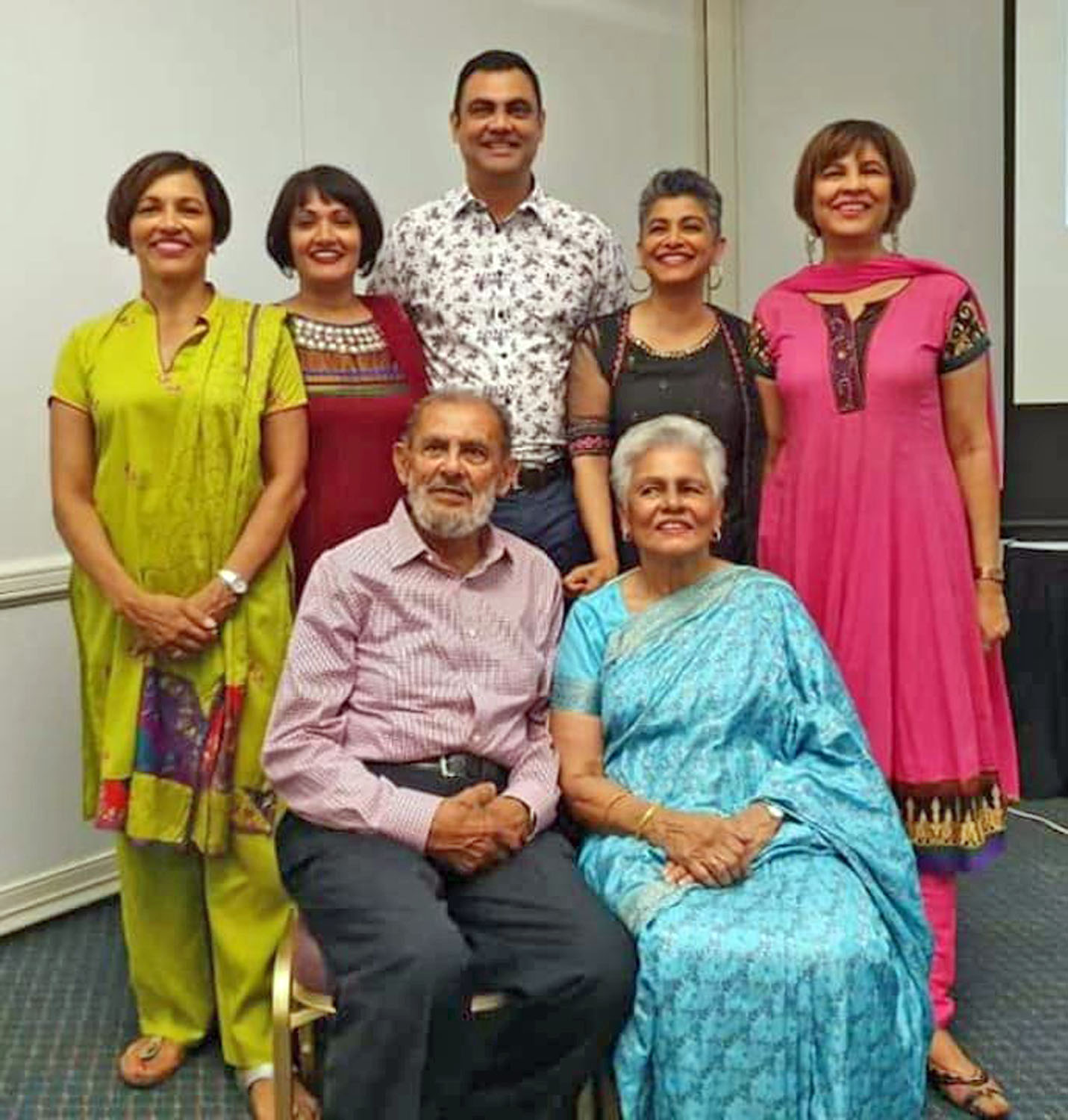
THE saying ‘love conquers all things’ is perhaps best epitomised by Imrana Jalal’s parents’ courtship and marriage in the ’50s.
It is a tale of curses and emotional exile amidst trying times in Fijian society.
It is an interesting story of cross-religion love and the fallout that affected both sides of the family.
Her father Saiyed Abdul Jalal’s family did not speak to him for a long time after he had married Rosemary Bimla Grant, a Catholic.
And they regarded Mr Jalal’s decision to get hitched in a Catholic Church as the last straw.
“Our mother, a devoted Catholic and our father, a devoted Muslim,” she said.
“They had five children, some of whom were raised Catholic, some as Muslims and some as both. There were many fights over religion and how the children should be raised when we were growing up.
“I am still in search of a religious identity, a bit like Pi in The Life of Pi.”
Rosemary was born in Suva, the daughter of a wealthy family who were descendants of a Hindu Brahmin.
Her family eventually converted to Catholicism and became patrons of the early Catholic Church in Fiji.
Her great-great-grandfather, Gurudin Cawnwaijia Pathak, took the name “Peter Grant” on joining the church and her family was replete with nuns, priests and brothers, one even secluded himself in a monastery in France, and took the vow of silence.
The Grants’ ancestry can be traced back to Lucknow, India.
As a young girl, Rosemary went to boarding school at the Marist Sisters’ College in Woolwich, Sydney, Australia.
She completed high school among the wealthy of Sydney and got a tertiary education in commercial studies.
Upon her return to Fiji, she was a secretary and personal assistant to various well-known chief executive officers in the country.
“In those days there were limited opportunities for bright young women like her.”
According to Imrana, her father’s family did not speak to him for a long time after he had married her mother, a Catholic.
It did not matter to them that she was a descendant of a pukka Indian Brahmin who had converted to Catholicism.
“My mother was forbidden to my father on several levels — her provenance was Hindu rather than Muslim, she was a convert to Catholicism and she came from the wealthy upper classes of Fijian society.
“In addition, our father agreed to marry her in the Catholic Church — a scandal indeed in the Suva of 1959.
“Family lore has it that my formidable paternal grand-aunt, Saira Dadi, who had partly raised our father, cursed him on his wedding day, and said that he would never have any sons as a punishment for marrying a Catholic.
“My mother set out to prove her wrong but she had to have four daughters before she finally got her son.
“My parents were cursed on both sides, however.
“My mother’s family could not believe that their overseas-educated daughter had married a Muslim, a poor Muslim at that, even if he was a Saiyed.
“My maternal grandmother, Elizabeth Kamla Grant, did not speak properly to our mother because she had married our father until I was one. Needless to say, their marriage has survived many pressures, both religious and cultural, and has lasted 60 years. The couple now live in Brisbane.
“When I asked my mother what had first attracted her to our father, she said, ‘he made me laugh’.”
In the meantime, it was hard to believe that because of her privileged background, Rosemary had limited knowledge of cooking when she married Mr Jalal in 1959.
This, however, changed in a relatively short period of time after their nuptials.
“Our father taught her and his five children — especially his daughters — to cook.”
Imrana said her father’s cooking prowess has left a very high benchmark, one that she and her siblings have tried to attain.
“For most of our lives, we have all been on a quest to cook a dish that most closely resembles dad.
“After cooking a palau, I will say something like, ‘that was 80 per cent of dad’s’.
“We are also our own worst critics.
“For most of us, dad’s cooking represents just what the perfect Indian meal should taste like. This is a matter of great (secret) pride to dad, although he would
never admit it.
“He is our, and his own, worst critic.
“Nothing upsets him more than falling from his own exceedingly high standards.
“But what upsets him, even more, is when mum’s version of a dish that he taught her is better than his own.
“Occasionally one of us will say, ‘mum, that lamb curry was fantastic — better than dad’s’ — and dad will walk around the house with a grumpy face for the next 30 minutes.”
Despite the chaotic background, Imrana feels that she had a happy, if somewhat
tumultuous, family life and upbringing, and their parents taught them sound values and principles, which all the siblings embody one way or another.
The siblings get along extremely well with each other, recently travelling to holiday in Russia for three weeks, without spouses and children.
“I suppose my empathy for those who are disadvantaged in society, especially
women, is strongly shaped by my father. It has affected all my choices, personal, professional and career, including establishing three organisations. I have been so lucky and privileged to have had several different careers, including as a lawyer, a
gender specialist and now at the World Bank as the head of the Inspection Panel, all of which have goals which resonate with my personal and ideological
goals.”
In honour of her father’s 80th birthday in 2014, Imrana and her sisters produced The Stupid Girls’ Indian Fijian Cookbook, documenting her father’s recipes,
some family history and anecdotes for their children and friends.
She still gets requests from people, even strangers, and she sends them free e-copies via email.

