
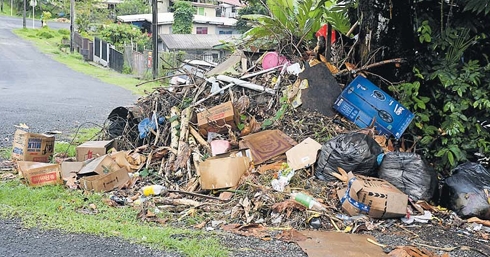
THE Ministry of Environment and Climate Change has raised serious concerns over the growing incidence of illegal dumping, warning that stronger penalties and tighter enforcement are needed to curb environmental damage.
Permanent secretary Dr Sivendra Michael said the issue was being addressed in close coordination with the Ministry of Local Government and municipal councils.
“We are very concerned,” Dr Michael said.
“We are working very closely with Ministry of Local Government on this issue.”
He said one of the most troubling aspects was that some reported cases involved companies that already held valid waste disposal permits.
“I think one of the saddest realities is some of these issues that are being reported are companies with valid waste disposal permit.”
Dr Michael said this raised broader accountability concerns for regulators and local authorities.
“So, it is equally our concern, as it should be of the Ministry of Local Government and the councils, that there are companies that apply for permit but still are not following their permit conditions.”
He said enforcement action was already being taken, but current penalties were inadequate.
“So, for that we issue fines. Fines range from between $1000 to $1250, which I believe is not enough and we are looking at the amendments to the regulations to increase the fines for those that are in breach of their conditions, and also the types of fines.”
Dr Michael said the environmental impact of certain types of illegal dumping could be severe.
“For example, if it’s sewer or chemical waste that is dumped in our riverine system, this is going to have a mass impact to the environment.”
He said such actions should be treated as serious offences.
“So, it is an environmental crime and in light of that, it’s just like any other criminal offence. We should be giving them a severe fine so that they can have a deterrence culture.”
To strengthen enforcement on the ground, Dr Michael said, the ministry had trained 326 Litter Prevention Officers (LPOs), with plans to increase that number.
“The LPO training is continuing. We want to reach a number of 500, but I think it’s important to disclose that the number is not the issue, the target is not the issue, it’s making sure that the LPOs that are trained have the necessary tools.”
“I have with me my Litter Prevention Officer card. They also have their IDs, they have their fine books that they can go out and they can issue the fine.”
He said enforcement applied equally to everyone.
“Even when I’m driving in my government vehicle and I see something, I stop the car, I issue the fine.”
He said empowering officers was key to effective enforcement.
“I think this is very important that the enforcement officers are empowered to enforce the legislation and to enforce the responsibilities that have been given to them.”
He said the ministry’s current focus was on strengthening capacity through continued training and support.
“Right now, the focus is making sure that there is refresher training.
“There are also tools, like we give them a small key-chain handbook, where they can refer to the different sections of the legislation and then when they are writing the fines, it is readable, so the person that is paying the fine knows exactly what they are paying and what offence they created.”

