
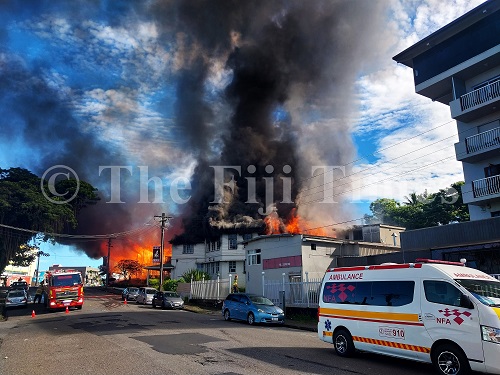
Suva’s iconic Defence Club has been reduced to ashes after an early morning blaze engulfed the property, torching over a century of history in a matter of minutes.
Onlookers in the city poured onto the streets to witness dark smoke billowing from the site as firefighters rushed to the scene.
The National Fire Authority (NFA) managed to contain the flames before it encroached upon neighbouring buildings, particularly the Southern Cross Hotel, as the inferno raged.
According to the NFA, about 40 on and off duty firefighters responded to the incident with five trucks and three utility vehicles from Suva, Lami and Valelevu.
The NFA also clarified that Energy Fiji Ltd (EFL) was contacted to shut off power supply to the building.
The total operation time took about seven and a half hours, as firefighters had to extinguish even the smallest ember.
The premises suffered more than 90 per cent damage.
NFA officers will begin investigations from today.
Considered one of the capital city’s most famed institutions, the Defence Club was established in 1915 as a gentleman’s club prior to the outbreak of World War I.
It was established as a club for young men, at first, those who were enlisted to serve.
Throughout its history, a number of notable names have held the role of club president over the years.
Sir E.B Sweet-Escott is noted to be the first president, with others following in his stead, including Sir Len Usher (1950), Ratu Sir Edward Cakobau (1967), Joe Campbell (1973), Rod Jepsen (1990) and Leo Smith (1995).
Part of what made the Defence Club’s past so colourful has been unique and memorable experiences, such as the visit of Kingsford Smith while he carried out an impressive flight of the Southern Cross, over the South Pacific, in 1928.
And among the memorabilia stood ‘The Chandos’ wooden bar counter, which originated at a watering hole in London.
The counter contained carved names of those who fought for Britain in the war, and this was also a prominent feature of the Defence Club for years.
The club was frequented by those from all walks of life throughout the years, including politicians, members of the security forces, sports people and business people among others.

