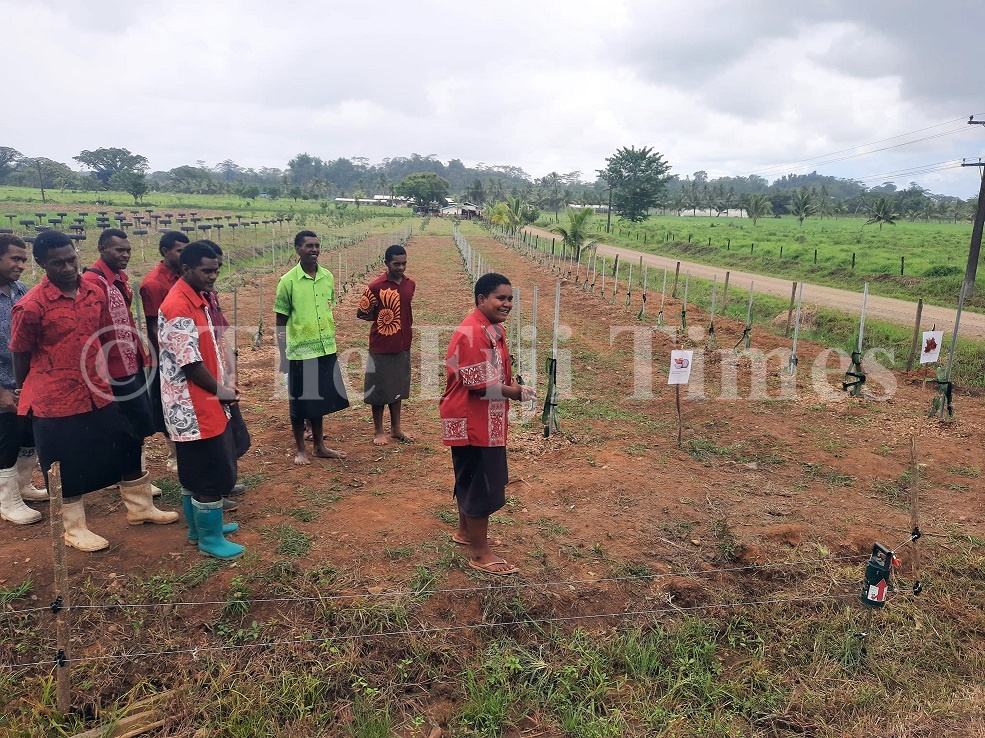
Navuso Agricultural Technical Institute (NATI) is operated under the Methodist Church of Fiji and Rotuma with grant support from the Ministry of Agriculture and the Ministry of Education.
The institute, which is also known as Muainase and situated in Navuso, Naitasiri, educates and creates “replacement and commercial farmers” for Fiji.
LM Thompson, the Methodist Church’s secretary of education at the time, bought the 1200-acre freehold property from Scott and Turner in 1923 when the church was still operated and administered from Australia with the intention of establishing an agricultural school.
The idea was developed with the help of international experts, and Ben Meek, a graduate of the Hawkesbury Agricultural College in New South Wales, became the institution’s first principal in 1924.
The institute started enlisting Fijian youths in communities to engage in specialised agriculture training.
Many years later, Navuso expanded its reach into the Pacific Islands region and began taking students from Tonga, Samoa, and the Solomon Islands, making it the largest agricultural school in the region to offer a Certificate in Tropical Agriculture in the 1950s.
NATI farm manager Meciusela Tikoinayavuloa, during a presentation at the Rewa Council Provincial meeting, said the school curriculum prepared young men and women to become future replacement and commercial farmers in Fiji.
He said their major programs included the NATI Certificate in Level 4 — training of future replacement farmers for Fiji in collaboration with a certificate II in Agriculture.
“We have realised the saturation in the job market, especially with white and blue collar jobs, therefore, we have refocused now to creating, innovating and incentivising the farmer job market,” he said. “We have an adult training centre that provides in-service training.
“The new direction for NATI is offering a competitive program that is attractive to our young generation. The programs offered are relevant, holistic and complete. And to develop and offer incentives to start off our graduates. “We hope to recruit 100 students annually.”
Mr Tikoinayavuloa said the institution had revived the student farmer’s scheme. “The program was launched on October 6, 2022 with six students, with the training of rural youths in a controlled environment.

“And building them up with a start-up capital of $35,000 before transitioning them to their own land.” He said the student farmer’s scheme was a three-year training program.
“NATI will meet food security costs for three months,” Mr Tikoinayavuloa said.
“The institution will clear up an acre for each student by digger. A four-acre land parcel will be allocated per student.”
Mr Tikoinayavuloa said with ginger being the common crop, all farm income would be saved in students’ accounts.
“The institute opens up individual bank accounts for first year students during enrolment, so deposits earned by them can be made to their accounts.
“Then the students take home $35,000 after three years.”
Mr Tikoinayavuloa said the future for Navuso was to have a clear intention and pathway.
“The programs offered will enable the students to market their produce. “Incentive packages will be provided for young men and women on what is known as the graduation package.
“The students are then released into the community with a graduation package that includes land with lease titles to give them a head start.”
He said it was also hoped the institute would be a hub for agricultural demonstrations in collaboration with the Agricultural Ministry.
“This includes agriculture best practices (agricultural production, value addition, clusters). “It could facilitate the expansion of the NATI commercial farm and have adoptable and affordable improved technologies.”
Mr Tikoinayavuloa said a total of 37 students would graduate this year. The institute’s two-year Certificate in Agriculture (Integrated) Level IV program is highly practical in nature, of which 80 per cent is hands-on with students doing practical through attachments with the 10 different enterprises provided in the institute facilities.
These are — dairy, piggery, poultry, aquaculture, rootcrops and vegetable crops, fencing, cottage industry, farm machinery and carpentry. Students are also introduced to extra-curricular activities like driving tests, individual farms and setting up individual bank accounts in addition to the standard academic program.
Mr Tikoinayavuloa said spiritual empowerment would also feature in the training.
“Since it is a Methodist Churchowned institute, spiritual development to students is a cross cutting program that runs parallel with all technical programs.
“We strongly believe that once these young men are holistically empowered, that is spiritually, technically and socially, they will create changes in their respective communities and growth in the agriculture sector.”
The Ministry of Agriculture, in its 2023-2024 budget, has allocated a total of $863,270 to NATI.