
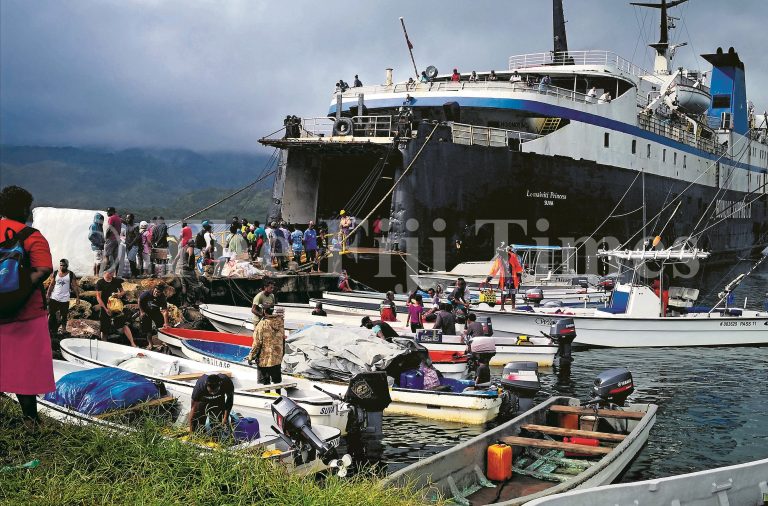
Losalini Leba, a small business owner in Suva, sources her supplies from her island home on Lakeba in the Lau Group.
Her supplies include coconuts and vau (native hibiscus fiber) which she either sells in its natural form or its byproducts for more profit.
Speaking to The Fiji Times, she said that local inter-island ferry Goundar Shipping has been profiting significantly from the inconsistent cargo charges imposed on its customers.
“For my business, I sell coconuts and vau. Both of them are brought over from my village by boat. Before, we used to pay $5 for one sack of coconut on the boat, but now we’re paying $7 per sack,” Ms Leba said.
“We pay $20 for a 25-kilogram sack that’s only half-filled with vau and $40 for a sack that’s fully packed. I think the shipping company is getting more money from cargo charges than from passengers’ fares, and we suspect that the increase in cargo charges was due to this.
“We pay $25 to transport a 2kg bucket of frozen food from the island to Suva, while root crops would cost either $7 or $10 per sack.
“The only item that’s not paid when taken onboard is one suitcase filled with clothes.”
According to Ms Leba, passengers often wonder why a sack of vau costs more than a sack of coconut, even though coconuts are heavier.
She said there was no proper weighing done or a standard given for which passengers could follow when packing their goods. Boat officials could also utilise these standards to determine cargo charges.
“I believe that some locals are advising the franchise owner, telling him that we usually earn thousands of dollars from one sack of vau, compared to a sack of coconut because even with a half-sack of vau that we have to pay $20 to get across from Lau, we can still get $500-$600 from making sisi (garlands) from it.
“I also believe that is why they’re charging us more, even though the weight of a bag of vau is less than a third of the weight of a sack of coconut.
“We’ve taken these complaints and grievances up with them, but nothing has been done up until now.”
Ms Leba said she could be spending between $200 and $300 for one cargo trip, and this amount doesn’t include the $30-$40 fare for transporting it from the Suva wharf to her home, where she operates her business.
She explained that Lakeba, unlike the other islands in Lau, has its own boat run because of the large amount of cargo that comes from there to Suva.
She said the only way these issues could be mitigated was if Government shipping increased its fleet numbers and services other routes as well.
“We’ve taken our complaints to the authorities so many times, but I believe there’s nothing more that we could do because this is the only inter-island shipping company that’s servicing these routes.
“We really hope that the government will step in and assist us because these cargoes are our source of income here. The fares aren’t really an issue, but it’s the cargo cost that most of us are concerned about.”
Joeli Kete, another inter-island ferry user, who travels frequently to Lakeba and back, confirmed that the cargo charges were an issue that has been really affecting them.
“There are times when we are unable to bring our bedding into the cabin due to the additional cost. At times we’ve had to put it in bags so that it could pass as carryon luggage’s just so we could save some money.
“When travelling to Lau, we have to really prepare well because there’s the boat fare to pay, cargo fees on the boat, and then fees that we have to pay again to transport our cargo from the boat to our village.
“For taking a carton across, we could be charged $10; a sack of fish could be $30-$40 depending on how full the sack is; a sack of coconut is $7. These are some of the charges that we pay.
“In addition, we must eat while traveling, and food onboard is expensive.
“I returned from Lakeba about three weeks ago in the ‘Lomaiviti Princess 6’. We left Lakeba around 7 am, sailed for one whole day, throughout the night, and it wasn’t until 12pm the next day when we reached Suva. This ship didn’t go to other islands; it was primarily for the Suva-Lakeba route.
“Meanwhile, ‘Lomaiviti Princess 12’ does pick up from a number of islands, and it reached Suva before us.”
Goundar Shipping Limited’s response
In response, Goundar Shipping owner George Goundar said for 13 years there has been no review of the inter-island ferry fares, resulting in the current cargo charges.
“We’ve been asking FCCC (Fiji Competition and Consumer Commission) for a fare review for 13 years, but nothing has been done so far. The bus fare has gone up, taxi rates have gone up, and (domestic) airline fares have gone up but nothing for shipping,” Mr Goundar told this newspaper.
“For 13 years, we’ve been sitting on the same rates, and we’ve been asking them to please review this. Fuel has gone up by almost five or six times, right? From $1 to almost $3 now, right? But the fare and everything’s been the same.
“You go to FCCC and ask them why the fare has not been reviewed for 13 years. The airline has gone up triple times. You fly with FijiLink from Suva to Nadi; you pay sometimes over $400.
“Taxi fare has gone up, budget has gone up, everything has gone up except shipping. The fuel, labour and everything has gone up and our freight’s been the same.
Mr Goundar said with the bigger ships that are currently operating in our waters, the cost of operations has increased a lot.
“These are bigger ships, so the cost has gone up. That freight was done when there were fishing vessels operating in Fiji. Now we have proper vessels.”
Questions sent to FCCC last Friday remained unanswered when this story went to press.

