
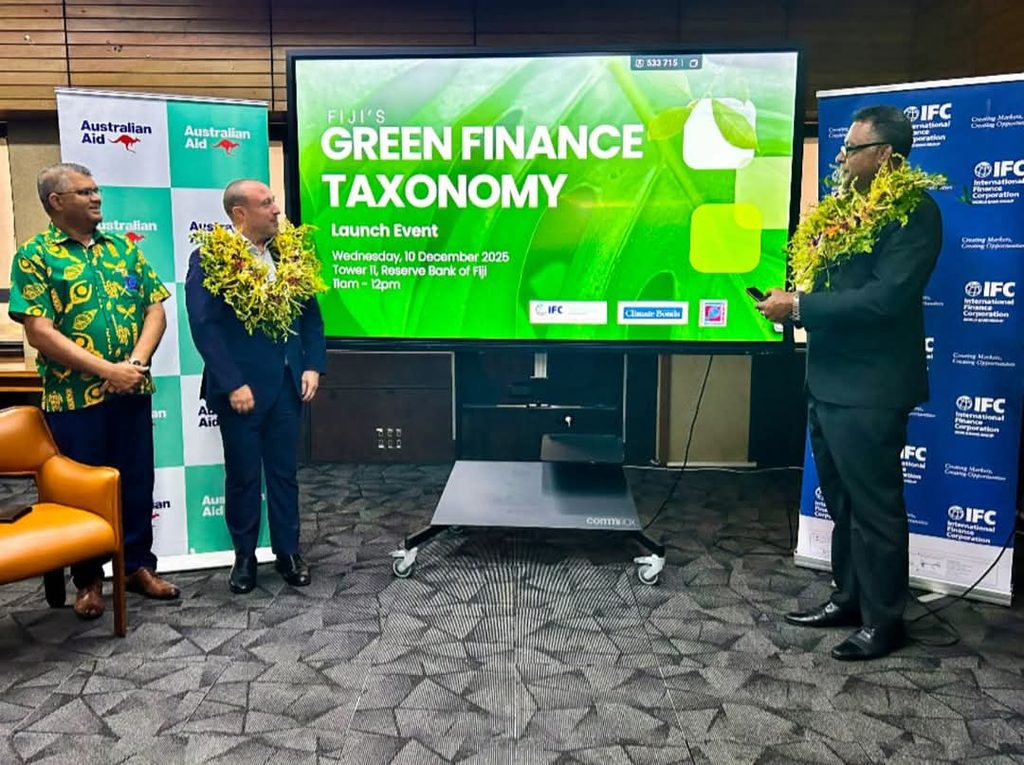
FIJI now has a Green Finance Taxonomy. Officially unveiled last week by Minister for Finance Esrom Immanuel, the framework was developed under the leadership of Reserve Bank of Fiji (RBF) with technical support from the International Finance Corporation and Climate Bonds Initiative.
“This landmark framework provides a clear, science-based classification system for economic activities that are environmentally sustainable, tailored to Fiji’s context and aligned with international best practices,” RBF Governor Arif Ali said in his foreword to the document.
“By defining and labeling green and sustainable investments, the Taxonomy empowers investors, financial institutions, and policymakers to direct capital flows toward projects that advance Fiji’s climate and development goals.
“At its core, the Taxonomy is structured around environmental objectives, with an initial focus on climate change mitigation and a vision to expand into adaptation and resilience.”
The first phase of the initiative prioritises the energy and transport sectors – key contributors to Fiji’s greenhouse gas emissions and economic activity, Mr Ali added.
“Through a rigorous traffic light system, activities are classified as green (aligned), amber (transition), or red (ineligible), guided by science-based technical screening criteria and robust social safeguards.
“This framework enhances transparency, prevents greenwashing, and supports the development of innovative green financial products,” Mr Ali said.
According to the document, the Taxonomy is a critical instrument in realising Fiji’s ambitious national goals, including achieving net-zero emissions by 2050 and reaching 100 percent renewable energy in the electricity sector by 2035.
“This first version of the Taxonomy primarily focuses on mitigation activities in the two key sectors of energy and transport, with the intention to expand its scope to include A&R (adaptation and resilience) and other environmental objectives in future iterations.
“As such, this Taxonomy is considered a ‘living document’ and will be regularly reviewed and updated to reflect advancements in science, technology, policy and market developments.”

