Two defining factors in times of uncertainty.
Effective organisations rely on both strong leadership and sound governance to stay on course.
While they serve different functions, together they provide the stability, direction, and accountability needed to perform effectively.
Where leadership is weak, organisations often see confusion, declining professionalism, and reduced productivity.
But in board-led organisations, it is governance that ultimately sets the tone from the top.
So, what’s the difference?
Leadership focuses on people and progress – motivating teams, guiding performance, and driving movement toward a shared goal.
Governance operates at a higher level.
It provides oversight, structure, and discipline, drawing on experience, data, and legal frameworks to guide decision-making and safeguard long-term success.
Governance in uncertain times
Strong board governance provides an organisation with the structure and discipline needed for clear, timely, and well-informed decision-making.
The Middle East conflict is a reminder that strong board governance is critical in times of global uncertainty.
When organisations face volatile economic conditions, geopolitical tensions, rapid technological change or ethical issues, ambiguity and uncertainty can easily lead to reactive or fragmented responses.
A well-governed board ensures that decisions are anchored in strategy, guided by reliable information, and aligned with the organisation’s purpose.
This steadiness helps organisations avoid short-term panic, for example around supply chain impacts, and instead maintains the focus on sustainable outcomes.
Boards play a central role in identifying emerging threats, testing assumptions, and ensuring that risk management frameworks remain fit for purpose.
Strengthening risk oversight at a time when risks are more complex, interconnected, and fast-moving than ever before.
In uncertain environments, traditional risk models may quickly become outdated, making it essential for boards to foster a culture of continuous monitoring and adaptability.
From a Fiji context, where the domestic economy is not immune to global shocks, directors need to be diligent in ensuring the organisation remains focused on the changing landscape and the potential impacts on strategic performance. Strong board governance reinforces accountability and stakeholder confidence.
During periods of uncertainty, stakeholders, including investors, members, regulators, and communities, look to leadership for assurance that the organisation is being managed responsibly.
Transparent decision-making, ethical conduct, and clear communication from the board help build trust and maintain organisational legitimacy.
This trust is particularly valuable when difficult decisions must be made, such as restructuring, cost reduction, or strategic pivots.
While we wait for a lasting resolution to the Middle East conflict, uncertainty will remain in the months, if not years to come.
Boards must ‘step-up’ their governance practices to support organisational resilience and long-term value creation.
Boards that are diverse in skills and perspectives, and that actively engage in strategic oversight, are better positioned to challenge assumptions and explore alternative scenarios.
The practice of strong and robust board governance enables organisations to not only withstand disruption but also to adapt and thrive in changing conditions.
Board and governance workshop
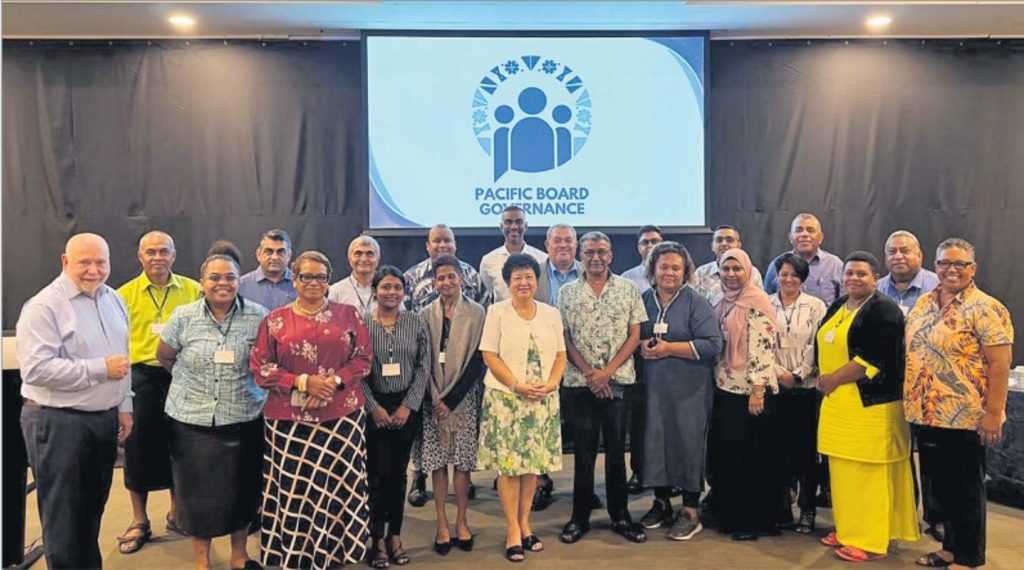
The one-day Board and Governance Workshop, delivered by Pacific Board Governance in partnership with FCEF, comes at a critical time amid rising global uncertainty and increasing governance challenges facing organisations in Fiji.
The workshop will explore corporate culture, core governance principles, and practical frameworks to strengthen governance structures.
A key focus will be the relationship between boards and management – an area that can create tension if roles and responsibilities are not clearly understood. Participants will also examine the legal and fiduciary duties of directors, supported by case studies and practical tools to help build effective, high-performing boards.
“In times of global uncertainty, strong board governance is not just a compliance requirement, it is a strategic asset that underpins stability, confidence, and sustained organisational success,” says Jenny Seeto, Facilitator and AICD Fellow. Providing both international and local perspectives this workshop will be facilitated by experienced board directors and governance experts who have facilitated for the Australian Institute of Company Directors (AICD); Jenny Seeto, Fellow of AICD and John Sing, Adjunct Associate Professor with experience in industry and academia in both the private and public sector.
About the workshop
Date: 1 May 2026
Time: 8:00am – 4:30pm
Venue: Grand Pacific Hotel, Suva
Investment: $1600 plus VAT
10 CPE Points for AICD Members | 7.5 CPE hours for FICA Members
Grant Claimable
Who should attend
Board directors
CEOs and general managers
Senior government officials and executives
Executives and senior management
Aspiring board directors
The number of participants in the workshop will be limited to ensure there is effective engagement and learning.
Learn more or register here – https://www.fcef.com.fj/pacific-board-governance/
JENNY SEETO contributed to the compilation of this article.
n GAYLENE KAMALI is manager Advocacy & Corporate Communication for Fiji Commerce and Employers Federation (FCEF). The views expressed in this article are not necessarily the views of The Fiji Times.
FCEF QR code