
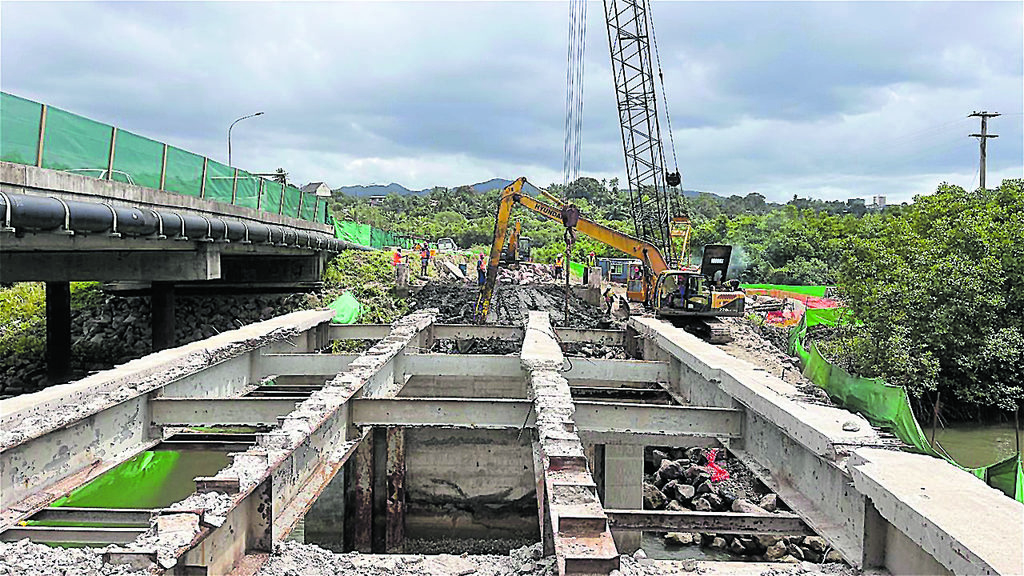
Aligning investment in transport (roads, ports and jetties, airports and bridges), utilities (electricity generation, water supply) and health infrastructure to growth in the economy and broader population is a challenge many governments, including Fiji face. The public sector drives most of the work, but the government with competing priorities and a set pool of resources available to them cannot fund all the necessary expenditures. Often, new infrastructure investment must make room for maintenance of core services including education and law and order. As a result, the supply of infrastructure and major maintenance relative to the demand is a constant challenge to manage. On top of that, the need to rebuild and repair aftershocks (such as cyclones and floods) means Fiji is constantly playing catch-up. Then came along the pandemic, a legacy of which was higher deficits and larger debt burden that further limited the government’s ability to borrow to build infrastructure and stimulate the economy. However, there are other options that would allow Fiji to speed up its infrastructure build, including climate adaptation and mitigation projects, and catch-up on its maintenance work without jeopardising future deficits.
Finance for climate mitigation and adaptation projects
Financing investment in projects and infrastructure that can better withstand climate events is a topical subject in Fiji and across the Pacific. In June 2024, the central banks of seven Pacific Island economies, including Fiji and Samoa, signed the Natadola Roadmap to Inclusive Green Finance in the Pacific. However, the funding pool for grants or lower interest rate loans is not enough to support the investments needed. A pledge by developed countries to developing countries to provide $US100billion per year for climate change mitigation and adaptation by 2020 was only achieved in 2022. At COP29, the pledge was tripled to $US300b per year by 2035. But this is in nominal terms, so it is not indexed for the higher inflation rates over the past few years. Also, the commitment is at a global level and represents a small fraction of needs. Hence, only part of it will come in the form of grants and low-interest loans. It is probable that only a small amount of funding reaches Fiji at all. So, what are some climate finance options available for Fiji?
Green and blue bonds
Fiji previously issued its own green and blue bonds, and the proceeds were used to fund projects and programs with environmental benefits, both on the land and in the ocean. The World Bank reports Fiji was the first emerging market to issue a sovereign green bond in 2017 supported by Fiji’s Green Bond Framework (also published in 2017), which aligned with the most recent Green Bond Principles at that time. It was a short-dated bond with a term of three years and the principal was fully paid in 2020. The onset of COVID-19 and a lack of suitable ‘shovel-ready’ projects at that time meant that this facility was not rolled over. Nonetheless, the initial green bond raised funding for climate mitigation and adaptation, including solar installations, rainwater harvesting and reconstruction post-Tropical Cyclone Winston. Fiji then issued a blue bond in 2023, one of the few in the market. It has four priority areas: nature-based solutions for coastal protection, scaling up of Fiji’s aquaculture sector, developing sustainable towns and cities using integrated planning solutions, and enhancing solid waste management. Hence, Fiji has the experience and could tap these bonds or issue new ones to fund projects like renewables generation, battery storage, adaptation projects and/or climate-resilient infrastructure. Green bonds may attract a ‘greenium’, where the investor may be willing to receive a lower yield to a comparable vanilla bond due to the perceived additional co-benefits of environmentally friendly investment. That said, global interest rates, while coming down, remain restrictive (that is, on the tight side of neutral). In the current structurally higher global interest rates environment, tapping the international capital markets would be a more expensive way of raising funds.
Debt for nature swaps
Given this, another potential option for Fiji to raise funding could be a debt for nature swap. The World Economic Forum defines such a swap as “a financial instrument that allows countries to free up fiscal resources to build resilience against the climate crisis and take action to protect nature while still being able to focus on other development priorities without triggering a fiscal crisis”. In practice, “creditors provide debt relief in return for a government commitment to, say, decarbonise the economy, invest in climate-resilient infrastructure, or protect biodiverse forests or reefs”. Essentially, countries are looking to swap more expensive debt, say by refinancing, for cheaper debt with the savings on interest used to fund climate mitigation and adaptation projects or for marine and forecast conservation. Several countries have adopted this financing structure and used debt for nature swaps to fund nature conservation and climate projects.
Fiji’s debt as at 30th October 2024 stood at $F10.6b and is expected to rise to $F10.9b in 2024-25 or 78 per cent of GDP.
About 30 percent of Fiji’s total debt is external debt comprising borrowings from multilaterals such as the Asia Development Bank and the World Bank, Asian Infrastructure Investment Bank, overseas export credit agencies such as the EXIM Bank of China, the Japan International Cooperation Agency, the European Investment Bank as well as the Australian Infrastructure Financing Facility for the Pacific. There is no suggestion that Fiji is having difficulties in servicing its debt. In fact, Fiji has never defaulted on its interest repayments, it has always been successful in refinancing maturing debt and retains wiggle room to take on more debt. Further, Fiji was able to successfully negotiate budget support loans at the height of the pandemic with exceptional terms such as very low (concessional) interest rates, a five-10-year grace period and long maturities. With the economy now making a full recovery from the pandemic-induced recession, interest payments as a proportion of revenue have started to trend lower and have not increased in line with the higher stock of debt (Figure 2). That said, interest payments absorb about 16 percent of all revenue, about $F500m a year. This restricts the government’s ability to roll out significant capital infrastructure build let alone implement nature conservation activities, especially ocean conservation, to protect its ‘blue economy’. In light of this and considering that the grace period on some loans will expire over the medium term, Fiji may consider a debt for nature swap by refinancing its more expensive debt to cheaper debt and use the savings on interest for climate and/or nature projects.
Complementary structures
Programs such as the Trilateral Partnership of Australia, Japan and the USA and the Australia Infrastructure Financing Facility of the Pacific can also be utilised to reduce the risk and interest rates of these new borrowings. The infrastructure asset recycling approach Recently, ‘capital recycling’ (or ‘asset recycling’) has emerged as an avenue to bolster the public sector’s ability to fund infrastructure. In this approach, governments privatise (or offer as a long[1]term lease) an existing and income generating public sector asset and use the funds to build new assets hence the phrase ‘asset recycling’.
Benefits of capital recycling
For governments facing borrowing constraints, privatisation or long-term leases can generate ‘fresh money’ to fund the next set of infrastructure projects or rehabilitate assets needing maintenance. Governments can build and own assets for a period of time until they generate a steady demand stream and income. In this sense, capital recycling works as a reverse ‘Build, Own, Operate and Transfer’ (BOOT) scheme, with governments undertaking the initial role of financier and developer. Private-sector investors come in after the asset has been built by the government, thus avoiding any construction and demand risk for such private sector investors at the early stage of a project. So, the government bears the initial risks but then gets fresh cash, while the private sector does not bear initial risks but can earn revenue from such stable assets. Globally, we have seen strong demand from institutional investors and superannuation funds for purchasing what currently remains a limited supply of ‘de-risked’ infrastructure assets. Indeed, this is in contrast to PPP-style (private/public partnerships) financing for infrastructure through the 1990s and 2000s, which played a substantial role in boosting private finance for infrastructure. However, the commercial failure of some high-profile projects in neighbouring Australia has seen a shift away from a PPP model and towards a reverse BOOT model and other hybrid financing models, such as shadow pricing arrangements for roads projects. From a public-sector financial perspective, capital recycling makes sense if the yields on the asset being sold are less than the prospective yields of building (and eventually transferring) a new asset, taking into consideration transaction costs (including potential future regulatory costs). That said, as with PPPs, capital recycling is not a financial ‘magic pudding’ and can have drawbacks if employed poorly, as you lose control of the asset that is sold and dividends through the life of an asset that is leased.
Fiji’s capital recycling opportunities
Privatisation should only take place where analysis shows that the asset would be more efficiently managed by the private than the public sector. Where there are monopoly characteristics of the asset being sold (that is, price-setting power is in the hands of asset owners, which is highly likely for ports, water and electricity networks), then effective regulation is needed to ensure that post (1) sale prices do not burden users of the asset to secure supernormal profits. It should be shown that the promised projects to be built with the privatisation proceeds should provide demonstrable net economic benefits. Without adherence to these conditions, there would be a risk that capital recycling becomes a lazy, inefficient and ultimately unsustainable way of raising infrastructure finance — where assets are sold that are just as efficient in the public sector as in the private sector, and where the resultant funds are invested in projects with low net economic benefits. That said, in Fiji’s case, asset recycling (privatisation) would not necessarily mean losing Fijian ownership, if it could be done in partnership with the Fiji National Provident Fund, other Fijian investors and/or long-term leases. A review of existing government-owned infrastructure, property and other assets would be needed to determine whether any are suitable for being privatised. Sale proceeds could then be used to fund new infrastructure or rehabilitate ageing infrastructure.
Free up land and property to unleash the Business Process Outsourcing sector
Fiji is promoting itself as an attractive location for large multinationals to set up operational functions. In other words, Fiji wants to upscale its Business Process Outsourcing (BPO) industry — BPO hubs or precincts with multiple towers and shared facilities including retail, food, accommodation, medical and parking. However, because of a scarcity of available privately owned land in and around central business districts, Fiji has not yet been able to build a one-stop technology park for the BPO sector to take off. This is where asset recycling could work in the near term: in the land sector. The government has significant premium land and property holdings in urban centres. Sale of some of these assets to BPO developers could free up money for the government to finance an infrastructure project or do major maintenance works on existing infrastructure. Fiji’s government is canvassing the possibility of part privatising its water utilities and privatising its electricity utilities. So, water and electricity are other candidates for potential privatisation under the asset recycling approach.
Attracting private finance for infrastructure
With strong underlying demand, private capital can flow into infrastructure investments in the Pacific, but to date private finance for basic infrastructure (such as transport and utilities) remains impaired. Local developers are rarely able to fund the share of project costs (25–30 percent) that most banks require, so they turn to green funds and philanthropic capital. With the current focus on sustainability there is a growing amount of capital being made available, but issues such as scale, the ability to build a portfolio, limited knowledge of the Pacific’s green ambitions and credit risks tend to discourage top tier investment funds. For projects which have demonstrative net economic benefits but less ability to capture revenue streams directly through user charges, governments could adequately support development by financing the gap between economic benefit and revenue capture. Governments can also consider (minority) stakes in joint ventures to developers as a way of showing support for the projects and ensuring common interests as well as sharing in the dividends. This hybrid style financing can shorten the timeline of complex projects.
Unlocking private capital for the electricity sector
The Fiji government has a strong desire to move away from diesel to cleaner fuels as the country’s baseload increases. Its advocacy of, and commitment to, renewable energy is strong. The high cost of importing diesel, the increased frequency of climate events and the commitment to reduce greenhouse gas emissions have pushed investment in green electricity generation, transmission and distribution to being a national priority. The Fiji government may seek private capital to increase baseload power and to hasten the transition to a de-carbonised grid. However, the key to financing power projects is an offtake, (buyer) at fixed price, for most of the power generation, with a credit worthy counterparty. Fiji’s power utility is seen by investors as a sound risk. That said, governments could offer guarantees to help bridge funding gaps.
Where to from here?
Fiji aspires to address its climate mitigation and adaptation challenges. To date, we have seen lots of discussion on kick-starting green investment projects in Fiji, but conversations around structuring for climate adaptation finance have been limited. Funding is the constraint. Using instruments such as debt for nature swaps and sales or blue and green bonds could generate fresh money and lessen the fiscal burden on the government. Concepts such as asset recycling can also free up money for investing in new assets, including infrastructure. Creating incentives for more direct private financing into the utilities sector is another way Fiji can lessen the burden on the government having to fund all public infrastructure. Addressing the infrastructure deficit and building more climate mitigation assets will support Fiji to take giant strides towards its net zero ambitions by 2050.
NOTE: This article was first published in the print edition of the Fiji Times dated FEBRUARY 17, 2025.

