
Former coup convict Josefa Jo Nata has claimed that some of the alleged masterminds behind the 2000 coup remained in the shadows while others carried the consequences, telling the Fiji Truth and Reconciliation Commission of a mysterious figure who was allegedly waiting in a Suva hotel bar during the takeover.
Continuing his testimony before the Commission, Nata said members of the Counter Revolutionary Warfare (CRW) Unit were ultimately left to bear responsibility for the events of May 2000 while others failed to emerge publicly.
“The CRW Unit were left in the lurch carrying the baby. The masters did not show up,” Nata said.
In one of the more striking claims in his submission, Nata described an unidentified individual allegedly waiting in Suva during the unfolding crisis.
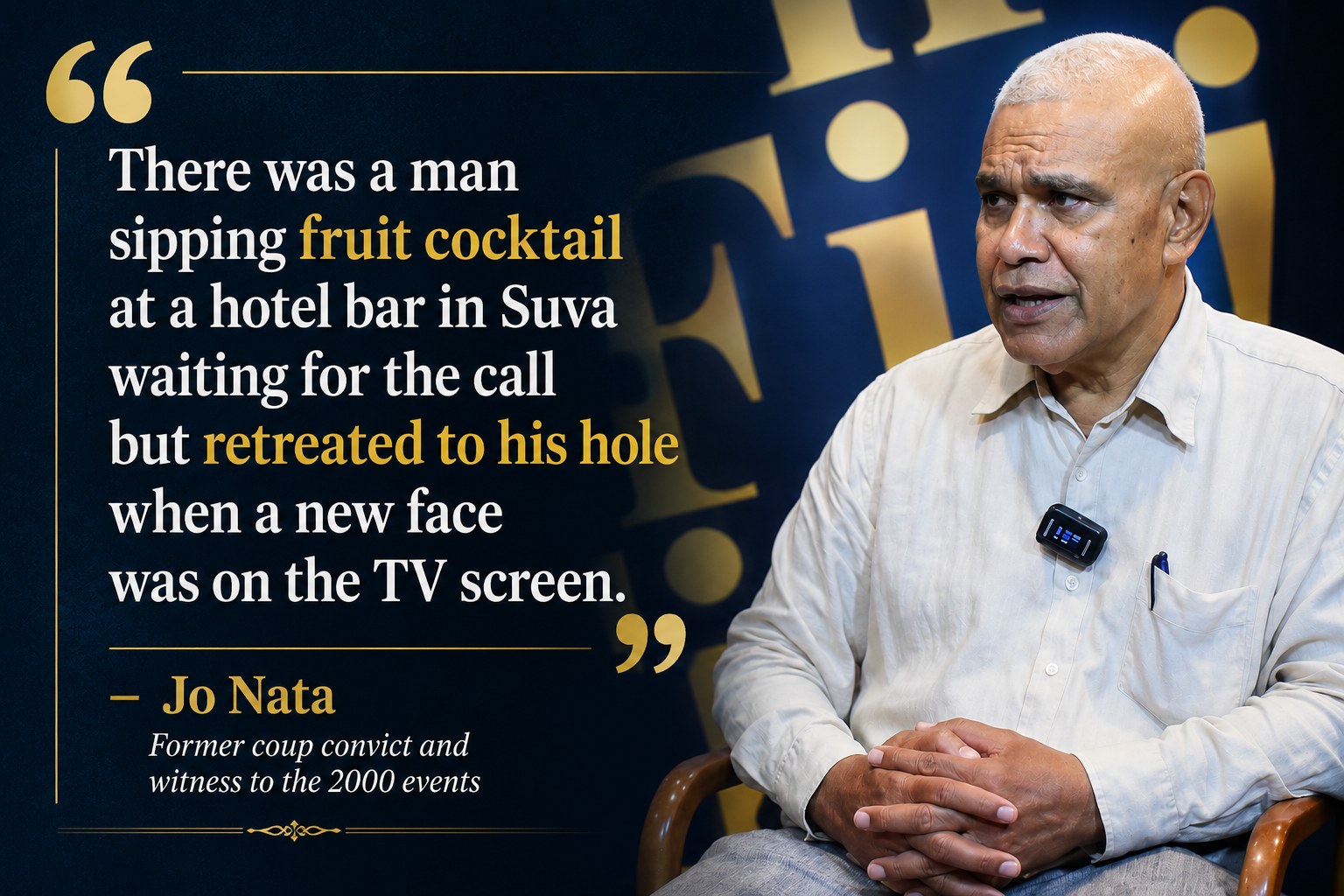
“There was a man sipping fruit cocktail at a hotel bar in Suva waiting for the call but retreated to his hole when a new face was on the TV screen.”
Nata did not identify the individual or provide further details.
He also recounted the arrival of former British Army officer Ilisoni Ligairi at the Ministry of Home Affairs on the morning of the coup.
“When Ilisoni Ligairi went to Home Affairs that morning where all the top military officials at the time and the Commissioner of Police were waiting, the first question asked, ‘Where did he come from?’”
Despite the negative portrayal of the CRW Unit over the years, Nata argued that its members may have prevented greater violence during the hostage crisis.
“Despite how they may have been negatively portrayed, if it had been not for them, worse things would have happened to those held hostage.”
He claimed there had been discussions of extreme acts during the occupation of Parliament.
“There were talks of the last cannibal feast. There were merrymaking, revelry, debauchery, and all sorts of chicanery, unbefitting the serious nature of a supposed struggle for improving the lot of the taukei.”
Nata further alleged that Parliament House itself might have been destroyed had it not been for the actions of the CRW Unit.
“Had been not for them, Parliament House would have been torched to the ground when it was vacated.”
“We were the last to leave when Col Jone Baledrokadroka entered with his squad.”
Nata also sought to challenge what he described as myths surrounding the 2000 coup and the role of its public face, George Speight.
“George Speight came into the scene only two days before May 14, and was merely meant to be a mouthpiece.”
Rejecting any notion of heroism attached to the coup, Nata said those involved had been driven by false assumptions.
“I want to destroy the false notion of the nobility of the events of 2000 that made us coup makers of 2000 as some kind of heroes in the heart and eyes of indigenous taukei.”
“If anything, we were misguided fools.”
He added that the concept of Matanitu Vanua, which later gave rise to a political party, had been founded on ideas that were “blinkered, parochial and unworkable”.
Nata’s testimony forms part of ongoing hearings by the Truth and Reconciliation Commission as it seeks to document the causes and impacts of Fiji’s coups.

