
Bula
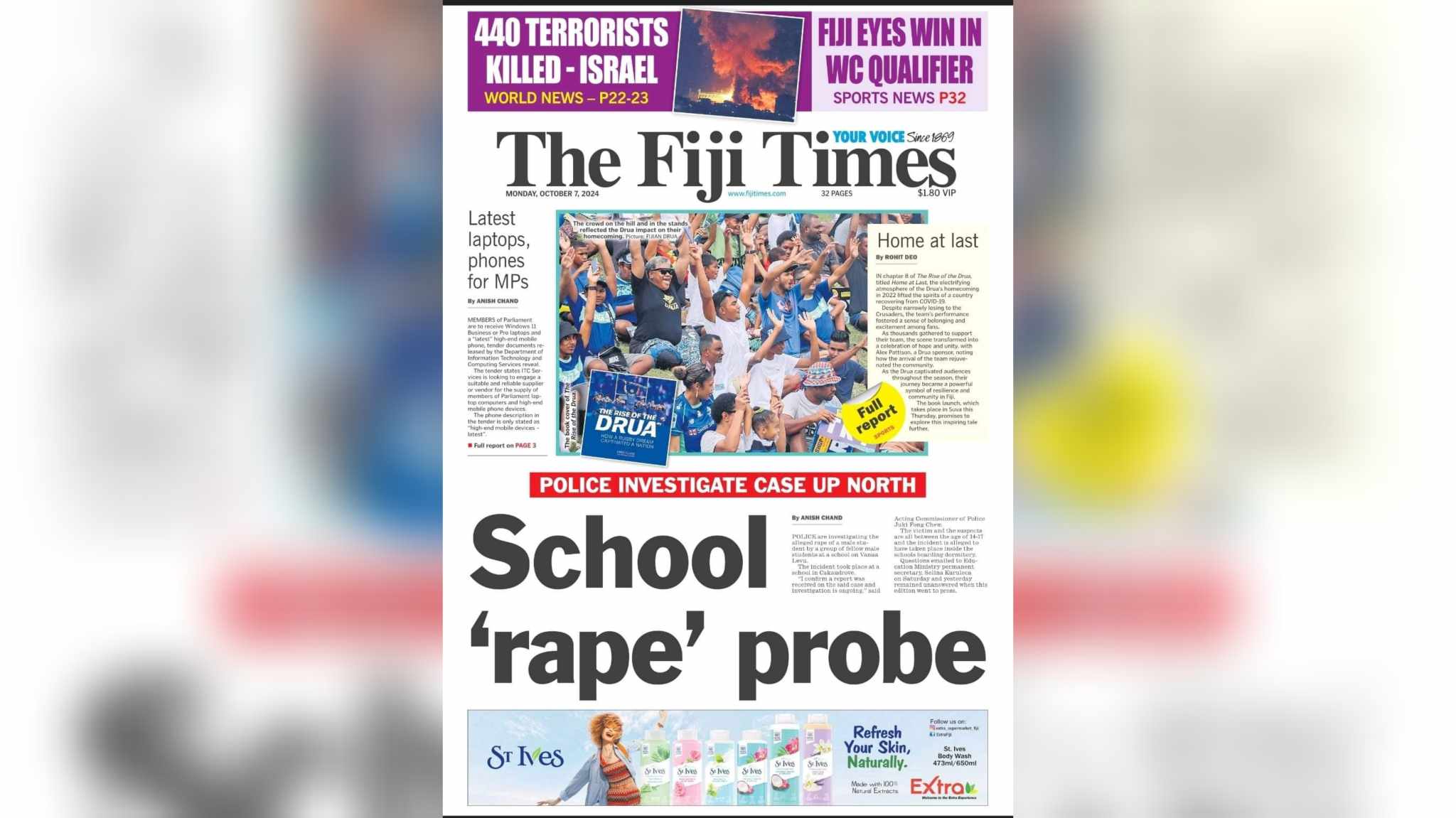
We have three stories on the front page of The Fiji Times for Monday, October 7.
We have a shocker as the lead. Police are investigating the alleged rape of a male student by a group of fellow male students at a school on Vanua Levu. The incident took place at a boarding school in Cakaudrove.
Members of Parliament are to receive Windows 11 Business or Pro laptops and a “latest” high-end mobile phone, tender documents released by the Department of Information Technology & Computing Services reveals. The tender states ITC Services is looking to engage a suitable and reliable supplier or vendor for the supply of Member of Parliament laptop computers and High-End Mobile Phone Devices.
The picture story is about the Fijian Drua. Sports Editor Rohit Deo takes us on journey of discovery. In chapter 8 of “The Rise of the Drua,” titled “Home at Last,” the electrifying atmosphere of the Drua’s homecoming in 2022 lifted the spirits of a country recovering from COVID-19. Despite narrowly losing to the Crusaders, the team’s performance fostered a sense of belonging and excitement among fans.
Synopsis
Rising to the challenge!
When Prime Minister Sitiveni Rabuka spoke about losing loved ones to diabetes, he would have been speaking for quite a number of people in the country.
That’s the extent to which diabetes and non-communicable diseases have gripped the nation.
The PM says he is now cautious of his blood sugar level.
Speaking at the Diabetes Campaign Launch 2024 at the Grand Pacific Hotel in Suva on Friday, he urged Fijians to take care of their health.
Sharing his personal journey and the loss of loved ones, he emphasized the need to be vigilant.
He shared about how his mother was later told she lost two infant sons because of diabetes.
She became blind in 1963, because of diabetes, and she died in 1992.
“She felt my uniform, and the time I got promoted in the obstacle course, but didn’t see me in uniform.”
He said in 2020, Fiji lost an estimated 5700 Fijians due to NCDs related causes.
The burden of health costs on individuals, families, the workforce and the government, he said, was alarming.
Around 80 per cent of deaths in Fiji, the PM revealed, were caused by diabetes and other NCDs and these numbers are rising.
“Children, adults and the elderly are all vulnerable to the risk factors contributing to NCDs including unhealthy diets, physical inactivity, tobacco smoke exposure and the harmful use of alcohol.”
Many lives are cut short by heart diseases, diabetes, stroke and controlled hypertension, cancers and other chronic diseases.
Mr Rabuka’s candid recollections add a personal touch to the fight against NCDs.
The fact is that NCDs are very real, and cut through every imaginary divide. They affect people irrespective of their status in society.
The PM’s message is clear. We must be vigilant.
The burden of NCDs does not only affect those who are directly diagnosed; it extends to families, communities, and the healthcare system, straining resources and threatening our workforce.
As he pointed out, the rising tide of diabetes and related diseases calls for collective responsibility and a cultural shift toward healthier lifestyles.
We have a challenge before us. We must embrace a multi-faceted approach that includes education, preventive measures, and community engagement. Schools, workplaces, and healthcare facilities can play important roles in promoting healthy eating, regular physical activity, and the avoidance of harmful substances. In saying that, we also reflect on the need for early detection and management of diabetes.
Regular health screenings can help identify at-risk individuals, enabling timely interventions that can prevent the progression of the disease.
The fight against diabetes and NCDs requires a united effort. PM Rabuka’s heartfelt appeal serves as a rallying cry for us to take charge of our health and well-being. Let us rise to the challenge and make a lasting impact in the fight against diabetes and non-communicable diseases.

