
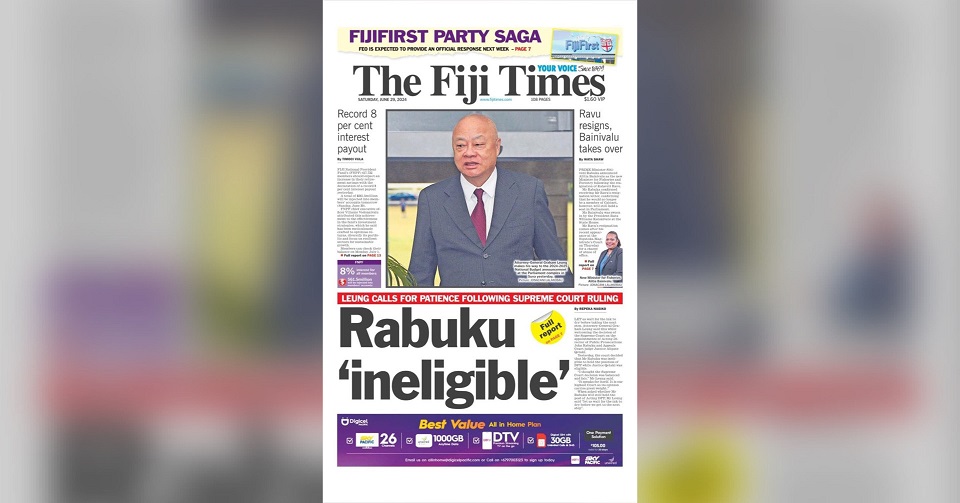
Bula
The big news for Saturday, June 29 is obviously on the announcement of our National Budget by the Finance Minister Professor Biman Prasad yeaterday.
We have extensive coverage inside and on our digital platforms.
That goes on the wraparound. On the main front page, we have been urged to wait for the ink to dry before taking the next step.
Attorney General Graham Leung said this while welcoming the decision of the Supreme Court on the appointments of Acting Director of Public Prosecutions John Rabuku and Appeals Court judge Justice Alipate Qetaki.
Yesterday, the Court decided that Mr Rabuku was ineligible to hold the position of DPP while Justice Qetaki was eligible.
Synopsis
A pay rise for civil servants and increase in the minimum wage stood out as a major takeaway when Finance Minister Professor Biman Prasad delivered our 2024/2025 National Budget.
While delivering his address in Parliament yesterday, Professor Prasad spoke about ensuring Fiji’s long term economic stability, security, and sustainability, the theme for this year’s budget.
He stressed the need to build political consensus, on how to manage long term economic social challenges, highlighting our national debt, infrastructure needs, health medical care delivery and education system.
He spoke about poverty, non-communicable diseases, drugs and domestic violence and inequality as challenges that need attention.
These challenges do not stop or start between elections, he said.
He spoke about a commitment to solving these challenges.
Building long term consensus, he said is critical.
He spoke about bringing down our national debt, and putting in place measures to ensure we are able to withstand future economic shocks, and manage our assets and spend better!
Of note, he said visitor arrivals remained strong by around 7 per cent in the first five months of the year.
In the face of that, tourism thrived with a record 929,000 visitors last year, and our national airline and hoteliers had a record year of profits which had a positive flow on impact on associated sectors, fueling increased domestic spending, employment opportunities and increased tax collections.
In the wake of the announcement last year, the International Monetary Fund’s (IMF) executive board had suggested Fiji’s 2024 budget was a critical opportunity to embark on a sustained strategy to bring down the public debt-to-GDP ratio over time.
Recovery and ongoing broad consultations, it noted at the time, made the budget a critical opportunity to begin rebuilding Fiji’s fiscal space and reducing vulnerability.
It suggested then that while the risk of debt distress was moderate, high debt levels made Fiji vulnerable to future shocks with little space to respond.
It had commended the Coalition Government’s commitment to fiscal consolidation which was vital to follow through with necessary measures.
In the wake of yesterday’s announcement, there are many parts of the budget that will interest people and attract attention.
There will be a lot of interest on allocations for education and health for instance.
There can be no doubts about the importance of the national budget for our economic and social development.
Professor Prasad said while growth outlook remains positive, the Government has slightly revised this down from 3.4 per cent to 2.8 per cent for this year, projecting a 3 per cent growth for 2025 onwards.
The goal, he said, should be to lift our growth potential to 5 per cent, which would demand a concerted effort and decisive actions.
This budget, said Prof Prasad, is set against the backdrop of some major headwinds and there is a need to strike a delicate balance between the speed at which we reduce our deficit and the debt, against the need to support the economy and fix public infrastructure.
There is a need for careful manoeuvring!
From the outset, the budget appears to be focused on managing our finances, while trying to address major concerns including cost of living, health, education and labour shortage and retention.
There are questions that will need to be asked as we draw connections to challenges we face as a nation.
It is in our best interest that any nagging questions are put to rest!
And that is why we look forward to the budget debate!

