
Bula
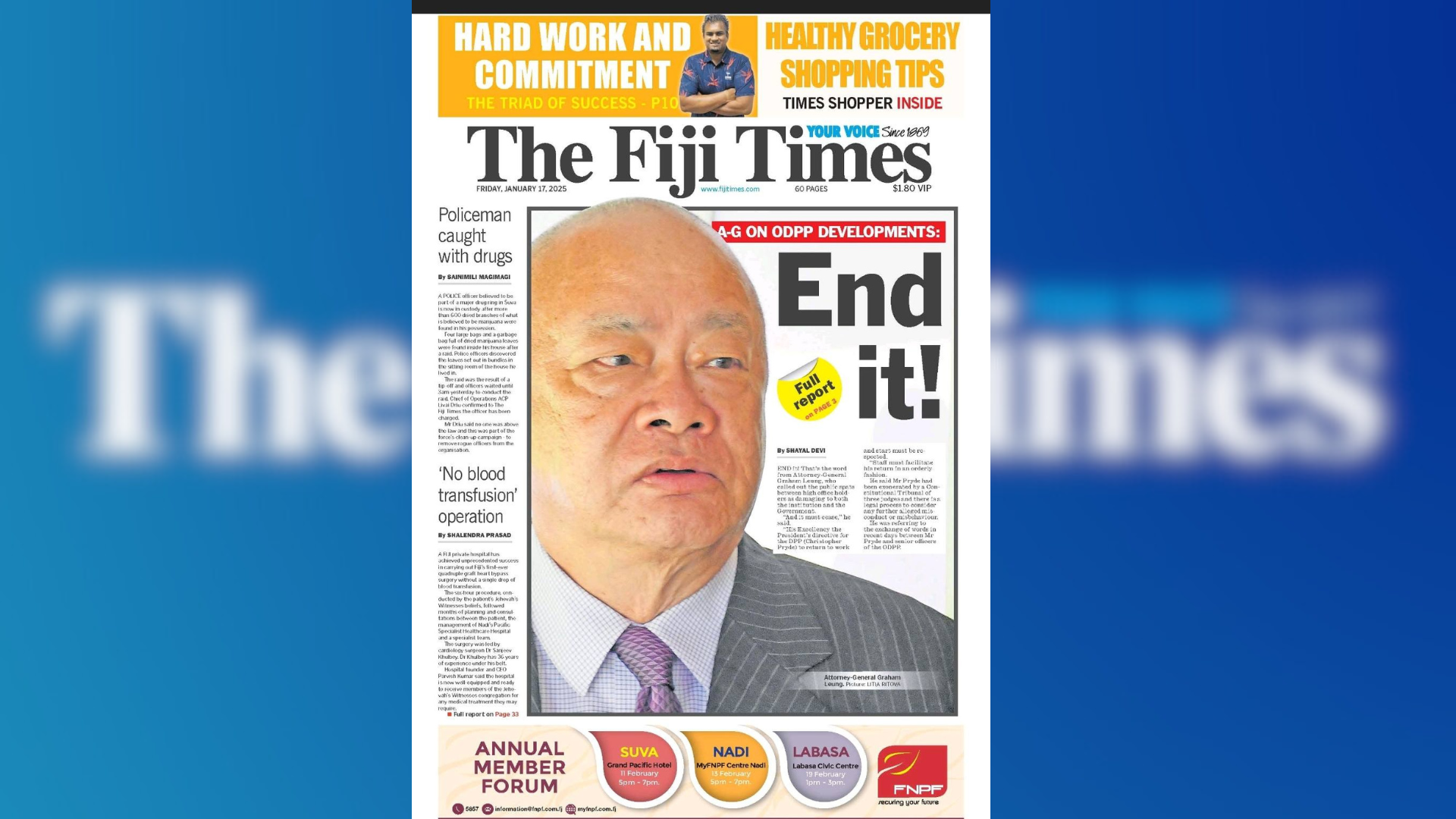
A POLICE officer believed to be part of a major drug ring in Suva is now in custody after more than 600 dried branches of what is believed to be marijuana was found in his possession. Four large bags and a garbage bag full of dried marijuana leaves were found inside his house after a raid. Police officers discovered the leaves set out in bundles in the sitting room of the house he lived in.
Fiji’s largest private hospital has achieved an unprecedented milestone by successfully carrying out the first ever quadruple graft heart bypass surgery and that too without a single drop of blood transfusion because of the patient’s religious beliefs.
A-G says respect tribunal decision.
Synopsis
So school heads have been told to “pull up their socks!”.
They have been told to stop confining themselves to their offices and venture into classrooms to monitor how children are being taught.
That’s the word from Fijian Teachers Association (FTA) general secretary Paula Manumanunitoga during a consultation in Suva yesterday.
They discussed the repeal of Fiji’s automatic progression in schools.
Now this is serious.
We have to admit there is a real problem out there. And our children are just not learning as well as we would like them to.
Mr Manumanunitoga believes we should have children who are fluent readers.
“Now, what’s happening to us now? Why are there literacy issues up at secondary schools? I can tell you that we were sent to school to be able to read and write.”
He said there were some reports of heads of schools who stayed in their offices and usually told their admin officers that they were doing their work.
“But he’s grog-doped and sleeping it off. I think this is a timely reminder for all heads of schools now, we must all pull up our socks and try to have our teachers work harder.”
Now that’s a serious statement.
Education Minister Aseri Radrodro believes automatic progression had created a culture of complacency among teachers, parents and students.
He said students might not feel the need to put in the required effort to achieve academic excellence as a promotion to the next grade was guaranteed regardless of the academic performance.
In August last year, Mr Manumanunitoga revealed some primary students entering secondary school still do not know how to read.
He turned the spotlight on the issue during the association’s AGM in Suva, where he raised concerns over the low literacy rate among students fresh out of primary school.
Mr Manumanunitoga said the excessive reliance on artificial intelligence was a contributing factor.
“There will be some children who cannot use their minds because everything is given to them on a plate.”
Before the FijiFirst government took office, literacy and numeracy rates in Fiji, he said, were the highest in the Pacific. However, according to Manumanunitoga, those standards have declined over the years.
“We were once number one in the Pacific. Now, we are lagging behind, with Tonga, Samoa, Vanuatu, the Solomons, and Kiribati all surpassing us,” he said.
This decline in educational standards represents a major challenge, but it also presents an opportunity for change. The key to addressing these issues lies in changing mindsets—embracing new approaches, fostering accountability, and committing to improvement across all levels of the education system.

