
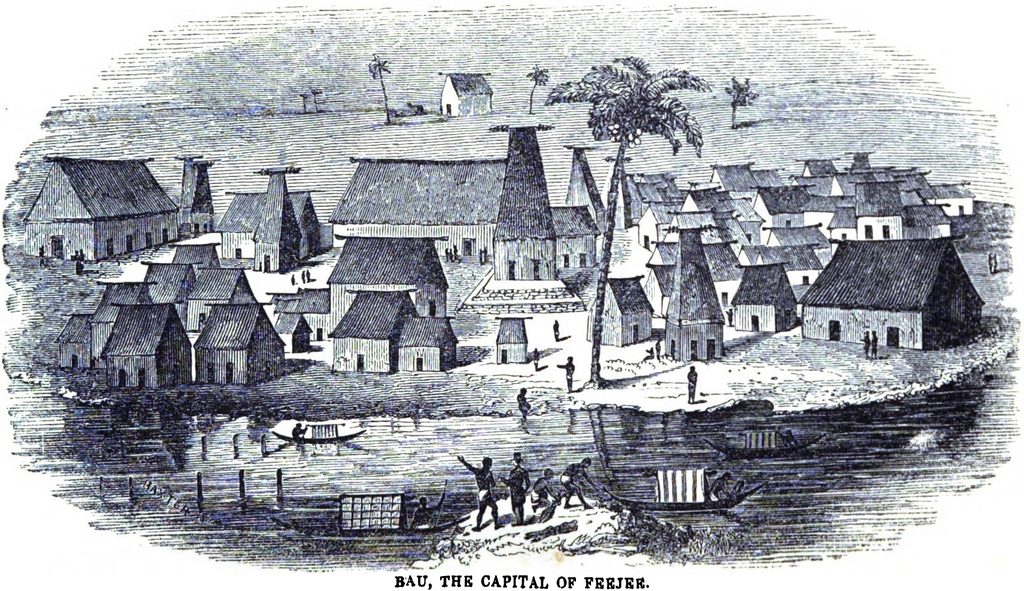
There are people in Fiji whose story begins not where they are, but where they were driven from.
The children of Levuka who live at Lakeba were not always Lakeba men. Their fathers dwelt in Bau, in the old, old days when they were many and lived all together on their own land. Two tribes shared the place: the men of Butoni who dwelt on the beach, and the men of Levuka whose place was on the high ground, and who were called Dwellers on the Hill.
A tribe came over from Great Fiji once and fought them many days, until the spirit of the Levuka men broke and they carried an oro, a peace-offering, to the warriors. “Let us live that we may be your servants.” The chiefs answered: “You shall live and be our fishermen.” And so they became fishermen of the children of Bau.
The Bauans were great men. They were tall, chiefs and chief-like in their ways. The Levuka tribe loved them and followed them to their wars, conquering everywhere, so that their land became great and mighty and all the towns along the coast feared them and brought them presents.
But all of it – every last good thing – came undone because of a fish.
Some of the Levuka men went out on the reef and speared something they could not name. It was great and long, such as had never been seen before. No man knew what it was, only that it was very big, and its flesh was sweet and good.
They stood there on the reef looking at it. The lords of Bau were not there – no one was watching.
“Why should we take this great fish to our lords, the children of Bau? Let us eat it ourselves. Let everyone keep silent that the thing may not be known, lest our lords be angry, and evil befall us.”
So they ate the fish. Every piece of it. Not even the women spoke of what had happened.
But one of the boys took a rib of the fish and made himself a bow, for it was long and tough and good to make bows with. His mother Nabuna put the roe (fish eggs) in her basket for bait. Together, the two of them went back out on the reef to fish.
Some of the children of Bau were also out on the reef that day. They saw the boy shooting at the fish with his bow. Something about it caught the light strangely.
“The bow! Its whiteness! See how it shines in the sun!” They called the boy over. “Show us your bow. Why, this is not wood, nor is it the bone of a man. What is it?”
The boy looked at them. He did not think to lie. “It is the bone of a great fish.”
“A great fish! What fish? Who caught it? When was it caught? What was done with it?”
“We caught it, my lords. We speared it out there, and we all ate it in our town. See there, my mother Nabuna, she goes carrying its roe in her fish-basket.”
The Bauans stared after the woman walking away along the reef with the basket on her back. Then they went back to Bau.
Great was their anger. “Let us kill these impudent fellows and burn their town.” So they made ready for war, and word reached the Levuka settlement before the warriors did. The town filled with crying. People sat in their houses trembling.
“Alas! The great fish! Why did we eat it and not give it to our lords of Bau? Now we are all dead men. We are but bokolas. Bodies for the oven.”
The Bauans came on to attack. And then the sea did something no one had seen before.
Just as the war-cry began to rise, a great wave came slowly in from the sea. It rose higher and ever higher as the warriors advanced. When they stopped, it stopped. The Bauans stood there watching it, not one of them moving. Then the god entered into the priest.
The priest fell to the ground, shaking and convulsed. The people gathered round him in silence, waiting.
“Let them not die, the men of Levuka and the men of Butoni. Let them live. Only drive them out of the land. Let them now see to the fastenings of their canoes, and when that is done let them hoist their sails, and I will take them to the lands whither I wish them to go.”
The Bauans looked at the wave. They looked at the priest. “It is well. Let them live.”
So the Levuka people began to bind their canoes and make all things ready for sailing. Not knowing where they were going. Not knowing what land the god had chosen. Only that they were leaving, and that Bau, the place their fathers had made their own, would not be theirs again.
They pushed off from the shore. Behind them Bau grew small. Ahead, the water stretched out dark and wide in every direction, and the god had said nothing more than this: hoist your sails, and I will take you where I wish you to go.
What the god knew, and what the men of Levuka did not, was that far away to windward, at that very moment, a king’s daughter had fallen asleep in the shade while a piece of cloth lay unguarded on the grass.
Next: A girl cast out, a giant bird, and a secret hidden in a sail.
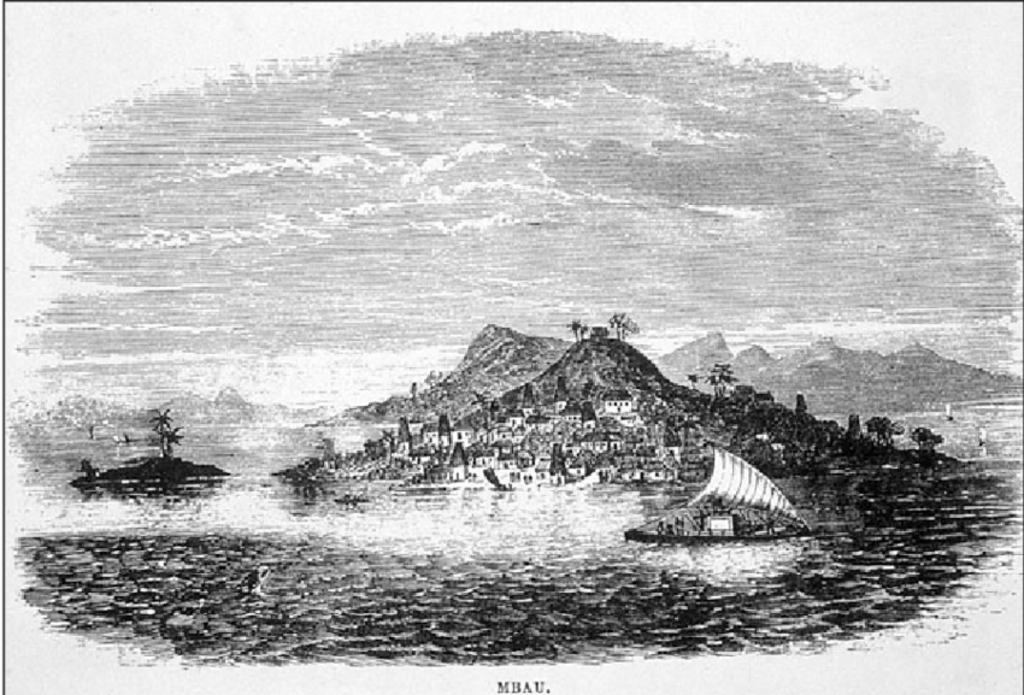
The island of Bau, Kubuna, Fiji. Reproduced from Fiji and the Fijians, Vol. II by James Calvert. Source: RESEARCH GATE

