
This is part two of a multi-part series adapted from “How the Livuka Men Came Up to Windward” in Tales from Old Fiji by Lorimer Fison, De La More Press, London, 1904. The story was told to Fison by Inoke Wangka-qele, a man of the Levuka tribe at Lakeba. Some place names and proper nouns have been updated to reflect current Fijian spelling and usage.
THE men of Levuka had come a long way from Bau. Driven out by the anger of their chiefs, guided by a god who told them only to hoist their sails, they had sailed east through the islands of Fiji, returned a king’s daughter from the dead, and built a town at Lakeba. But the land was small and some of them were still sailing. They came to Oneata and danced the dance of spears. From Oneata they steered for Vatoa and danced there too. From the top of the highest hill at Vatoa they could see nothing farther on. Only water in every direction.
“This is the end of the earth,” they said. “There is nothing but water beyond. Let us go on board and sail back to Lakeba.”
Among them was a man who had not gone ashore with the rest. He was a leper. While his fellows danced and sang on the beach, he sat alone on the canoe in the passage, watching the shore. It was from that solitary watch that he saw what no one else saw.
Two heads rose slowly above the rim of a hollow tree stump at the edge of the dancing ground. Two gods, drawn by the clashing of the spears and the tramp of feet and the song of the god, peeping out at the strangers.
He called out to his fellows on the shore. “Ya! Ya! Here! Come here! Make haste!”
They would not come. He kept calling until they were angry, and some of the young men ran down to the beach and cursed him for breaking in upon their dance and song. But still he said: “Come here! Come here quickly!” And he told them about the two gods he had seen.
“Make haste! Loose the stay of the mast!” They loosed the stay and crept up with it in their hands to the hollow stump, hiding themselves behind it. They made a running noose in the end of the rope and put it over the top of the stump, then signed to the rest to go on with the dance and the song.
As soon as the two gods lifted their heads above the stump, the young men pulled the rope and the gods were caught in the running noose. All the Levuka men came running down brandishing their weapons.
“You two, who have been looking at our dance, you shall both die!”
“Let us live,” said the two gods, “and we will be the gods of your houses.”
“No. We want no gods for our houses. You shall die.”
“Let us live, and we will be the gods of your sailing.”
“No. We sail wherever we please. We want no gods for our sailing. You must die.”
“Let us live, that we may be the gods of your wars.”
“No. We hill-dwellers are chiefs. When we are hungry, we kill our enemies. We make war by our own might, and they flee before us. We want no gods to fight our battles. You must die.”
“Let us live,” said the gods, weeping bitterly, “and we will take you to a land where you may settle.”
“A land! What land?”
“Its name is Ono. A land great and pleasant. See, the wind is now fair. Hoist your sail, and we will take you there. Tonight you will fasten your canoes to the shore.”
“It is well. Take us to Ono, and you shall live. But look now, we will bind you and carry you on board, and if we find you have lied to us, we will eat you.”
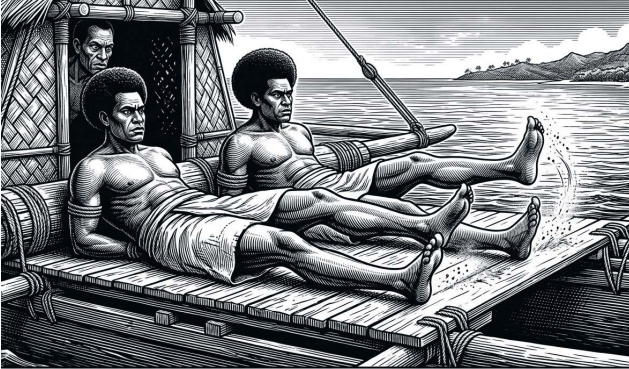
So they bound the two gods and laid them down on the deck with their feet towards the land to which they were sailing, because the two gods told them to. But it would have been better if they had not listened to their deceitful words, for then Ono would have been much nearer to Lakeba than it is today.
The wind was fair. Not long had they sailed before they saw the land of Ono and their hearts were glad. “Here at last is a place where we may settle.” But as they neared the shore it went back before them, and they sailed and sailed and sailed, and still the land was far away.
The leper crept forward and watched the two gods. He found that as the canoe drew near the island they kicked out with their feet, and when they kicked the land went backwards. This is the reason why Ono is now so far from Lakeba.
He told the rest. Their anger was hot and they struck the two gods with their clubs until the gods cried out: “Kill us not! Only turn us round, that we may not push away the land with our feet.”
So they turned the gods round with their feet towards the stern. Soon after they reached the land and anchored within the passage. They went ashore, leaving the children on board.
“See that you do not loose these two deceitful ones. Watch them well, or they will do you a mischief. And we, your fathers, we will make you eat of the whip.”
So they went ashore, dancing the spear-dance and singing the song of the god. The people of Ono took them by the hand and welcomed them, and gave them much land to settle on. There they live to this day.
But when the elders had gone ashore, the two gods began to beg the children to unloose them.
“Children of chiefs, untie our bonds and we will teach you a song. A new song. A beautiful song.”
All the children said: “Let us untie them.”
A single lad, whose soul was ripe, cried: “No! Untie them not. Have you already forgotten the words of our fathers? The whip is ready for us!”
But they would not listen. They untied the hands and feet of the two gods and let them go.
“Sit down on the deck,” said the two gods, “and we will climb the mast and sing you our beautiful song.”
Next week: The beautiful song. The mast that bent to the water. And the voices still heard today on the Ono passage.

