
This is part three of a multi-part series adapted from “How the Livuka Men Came Up to Windward” in Tales from Old Fiji by Lorimer Fison, De La More Press, London, 1904. The story was told to Fison by Inoke Wangka-qele, a man of the Levuka tribe at Lakeba. Some place names and proper nouns have been updated to reflect current Fijian spelling and usage.
THE king of Lakeba thought his daughter was dead. He had eaten the death-feast. He had wept until his eyes were dry. He had performed every rite his people knew for the dead. Then five strangers walked into his town and told him his daughter was alive.
On the morrow the Levuka men sailed to Nayau, where the people gave them a house filled with wealth. One night only did they stay. Then, the wind being fair, they sailed to Lakeba and furled their sails at Waqatalaca. Five of their number were sent ahead to report.
The five walked towards the town with their turbans on, talking loudly after the manner of chiefs. The Lakeba men in their gardens stopped and stared. “See the strangers! The loudness of their voices! Their turbans! They must be chiefs from a land of chiefs!” And they followed them up to the town.
The king was asleep under his mosquito curtains. The women were silent that they might not wake him. But these five men asked in a loud voice: “Where is the Lord of Nayau?”
“The king sleeps,” the women whispered.
“Wake him then.”
The women were afraid. But the loud talk woke him. “You, O chiefs, whence do you come?”
“From Ra.”
“From Ra! Where then is Ra?”
“We are from Bau.”
“Bau! And where is Bau?”
They told him. The king was full of wonder. “We, the men of Lakeba, thought we were the only people in the world. But now we find there is another kingdom down at Ra, whose name is Bau. Truly the world is larger than we thought.”
“The world, sir,” said the Levuka men, “is still larger than that. There is Great Fiji, which is so large you could not sail round it with a fair wind in four days. There is Long Island, great and full of people, and beyond it the Yasawas, which are but small, and there the earth ends and all beyond is water. Of a truth, sir, the world is large.”
“Woi! Woi!” cried the king. “These are great things. Listen, my people, that you may know more than your fathers knew. And you, O chiefs, what good thing sent you sailing to this poor land of mine?”
Then the orator, the salt of words, made his report. He told the king how they had come from Bau, bringing with them his daughter, the Lady Lagi, that they might rejoice and be glad with him.
“Speak not thus, ye strange chiefs. Your words are not just, for we have long ago eaten the death-feast, and our eyes are dry after the weeping for my daughter. Why should you speak thus and make sore my soul?”
“Let there not be even so much as a little doubt in your mind,” the Levuka men said. “Why should we come here bringing a lie? If we do not bring your child, then let us die.”
Their words pierced the soul of the king.
“You are gods! You are gods! O Bulu, Spiritland, have you brought my daughter back to me? But where is she?”
“She is here, sir. Our canoes are anchored at Waqatalaca. We come now to know your mind as to when we shall bring her up to your lordly town.”
Then was the king full of joy. “Not today nor tomorrow, O chiefs. Wait four days, that we may make ready all things for you and welcome you with feasts and presents, as it is right that you should be welcomed, you the great chiefs whom the gods have sent us.”
“Good is the word of the king. We will wait.”
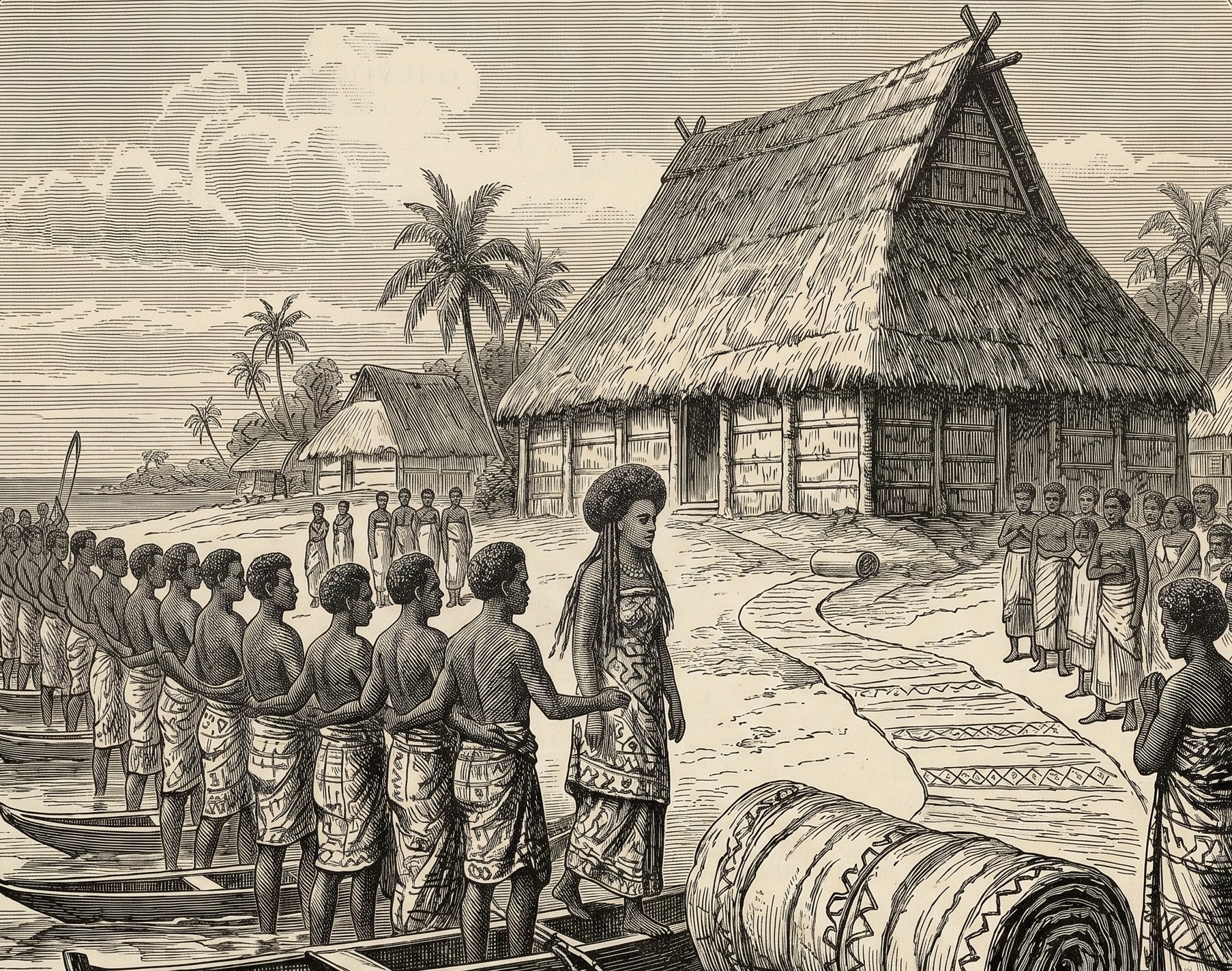
On the fifth day, when the tide was high, they poled their canoes along the shallows from Waqatalaca up to the beach, bringing with them the Lady Lagi and singing the song of the god Rokoua. Every one who had a canoe leapt on board, two men to each canoe, in a long line from the shore, and joining their hands they made a path for the Lady Lagi that she might walk thereon to the land. Down to the shore they brought a bale of native cloth, one end of which lay in the water, and they unrolled the bale as the lady went forward so that it became her path up to the town. The children of Levuka followed, dancing the dance of spears and singing the song of the god.
Great was the feasting, and rich the presents. Land was given to the Levuka men, whereon they built the town of Levuka. Hot was the friendship between them and the children of Lakeba, though it was not long before war sprang up between them. But the tale of that war, and how the Levuka men attacked and took Kedekede, the town of the king (the ancestral hilltop fortress of the Tui Nayau, confirmed by archaeologists as one of the largest fortified sites in the Pacific), is another story, kept by Chief Sakiusa and passed down through his fathers before him.
The men of Levuka were many and the land was small. Some took their wives and children and sailed farther on. They came to Oneata and danced the dance of spears. From Oneata they steered for Vatoa and danced there too. But the land did not please them. They climbed to the top of the highest hill and could see nothing farther on.
“This is the end of the earth. There is now nothing but water beyond. Let us sail back to Lakeba.”
But it so fell out that, while they were dancing, two gods who lived in the hollow stump of a tree heard the clashing of the spears and the tramp of feet and the song of the god. And they put up their heads to look at the strangers.

