
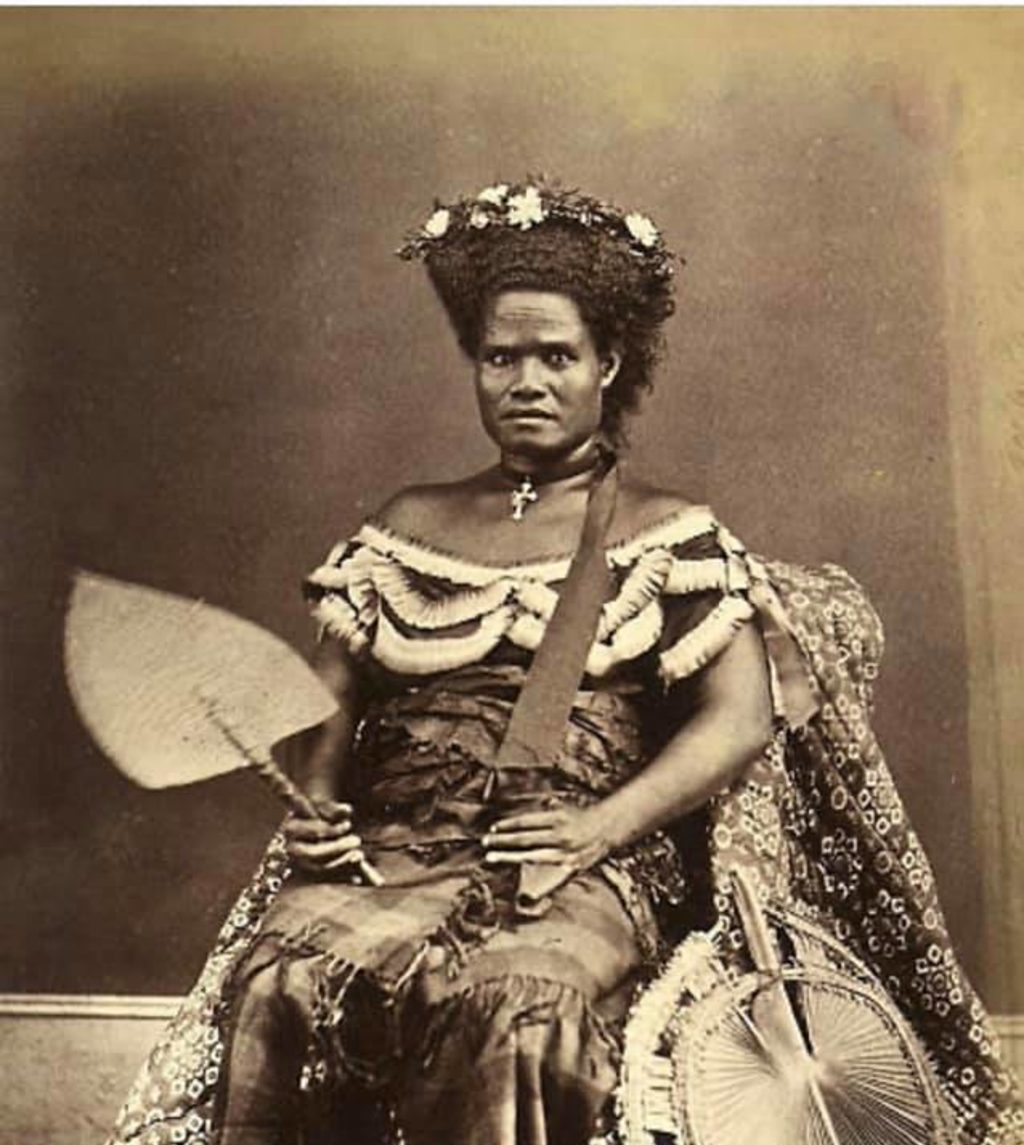
This is part two of a multi-part series adapted from “How the Livuka Men Came Up to Windward” in Tales from Old Fiji by Lorimer Fison, De La More Press, London, 1904. The story was told to Fison by Inoke Wangka-qele, a man of the Levuka tribe at Lakeba. Some place names and proper nouns have been updated to reflect current Fijian spelling and usage.
Adi Lagi
Far away to windward, while the men of Levuka were preparing to leave Bau, events were unfolding at Lakeba that no one yet understood.
The king had ordered a fine piece of native cloth to be made and laid out on the grass to bleach before painting. One day, as he went to bathe, he called to his daughter, the Lady Lagi.
“I am going to bathe. Watch the cloth. If it rains, take it inside at once.”
She looked across the sky in every direction. There was not a cloud to be seen. “There will be no rain,” she said, and lay down to sleep.
But while she slept, the sky darkened. Rain fell, and the cloth was ruined.
When the king returned and saw it, his anger was fierce. He struck her again and again, calling her idle and useless, until his arm tired, and then drove her from the house.
Weeping, the Lady Lagi went down to the beach. There she gathered old coconuts and tied them together into a great floating heap below the high-water mark. She waited until the tide rose. When it came in, she set herself upon the nuts and drifted out to sea before the trade wind.
She did not go in hope of rescue. She went to die in the midst of the waters.
For two days she drifted. Then she saw a great bird flying toward her and hid among the coconuts in fear. The bird settled upon them. It was vast and terrible.
“If I remain, I will die,” she thought. “If I fasten myself to this bird, perhaps it will carry me to land.”
She tied herself to one of its breast feathers. Soon the bird rose and flew through the night, carrying her far across the sea. Before dawn, it came down at Kaba, which in those days lay empty.
The people of Levuka would come there from Bau to set fish-snares in the evening and return in the morning. When the bird departed, it left the Lady Lagi alone.
At sunrise, an old chief from Bau came ashore to gather his snares. Walking along the beach, he saw her and stopped in wonder. She was tall, fair, and unlike any he had seen.
“Who are you? You must be a god. Let me live.”
“It is you who are a god,” she replied. “I am only a mortal.”
He asked her story, and she told him everything – her father, the ruined cloth, her punishment, her drifting to die, and the bird that had brought her.
“Lakeba,” said the old chief. “Where is this place?”
“Far to the east, where the sun rises.”
The chief understood at once. His people were preparing to leave Bau without knowing where they would settle. Their god had told them only to sail. Now, on an empty shore, stood the daughter of a king whose land lay to windward.
“The gods have sent you,” he said. “I will return you to your father. In return, he may grant land for my people.”
But he warned her: she must remain hidden at Bau until they were ready to sail. If anyone saw or heard her, they would know she was a stranger, and she would be in danger.
He took her back, concealed in the sail of his canoe, and hid her in the loft above his fireplace. Each day he brought her food in secret while preparations for departure continued.
When the canoes were ready, he built a high fence around the deck-house of his vessel. Inside it, he placed the Lady Lagi. He told his people that a god would sail with them and that no one must look within the enclosure. Fear kept them obedient. When passing it, they crawled to avoid seeing over the fence. Each day, the chief placed the best food inside for her.
The fleet set out. The sea was calm. On the second day they reached Koro. There, the Bu-toni men chose to remain, saying the land was good. They settled and became fishermen.
The Levuka people continued on. Some stopped along the way, but the rest sailed on to Vanua Levu. There, they grew weary.
“Why should we sail endlessly?” they said. “This land is good. Let us remain.”
But the old chief refused. “There are better lands ahead.”
Still, doubt troubled him. That night, he went to the Lady Lagi.
“Where is your land? We have sailed many days.”
“Do not lose heart,” she said. “It is near. Tomorrow you will see an island before sunset. Its name is Cicia. It marks the boundary of my father’s land.”
They sailed on, and by evening they reached Cicia.
In the morning, they went ashore. The chief brought the Lady Lagi with him, for they had now entered her homeland.
On the beach, they met women going out to fish. Among them was an old woman who had once lived at Lakeba and knew the Lady Lagi well. When she saw her, she stared in disbelief.
“How like our Lady Lagi that stranger is,” she said.
She asked the Levuka women, “Is this our lady, whom we have mourned?”
They dismissed her. “We have brought no such woman. Only our god, who remains on board.”
But the old woman drew closer. She looked carefully, then fell at the girl’s feet, weeping.
“It is she! Our lady lives!”
She ran to the village, crying out that the Lady Lagi had returned.
The people came running to the shore. When they saw her, their grief turned to joy. They embraced her, rejoicing that she had been restored to them.
Their gratitude to the men of Levuka was great. They welcomed them, gave them gifts, built them a house, and filled it with wealth, promising more to come.
Next week – the king who had already eaten the death-feast, five men who woke him, and a daughter returned from the dead.

