For years, public debate around smartphones and social media has focused overwhelmingly on young people.
Concerns about screen addiction, cyberbullying, declining attention spans and mental health have dominated headlines, prompting calls for tighter controls on children’s access to digital devices.
But a new study published recently by Frontiers in Psychology suggests society may have been looking at only half the problem.
The research report titled “Mommy, Do You Love Your Phone More Than Me?”: Parental Device Use and the Adolescent-Caregiver Attachment Bond which is authored by Don Grant, Payne Winston-Lindeboom, Linda Ruan-Iu, Karen E. Shackleford, Barbara Nosal and Michael Roeske – who are all researchers and academics from universities and institutions across the United States, shifts attention away from children’s screen use and towards the behaviour of parents themselves, finding a significant link between adolescents’ perceptions of parental phone distraction and feelings of insecurity within the parent-child relationship.
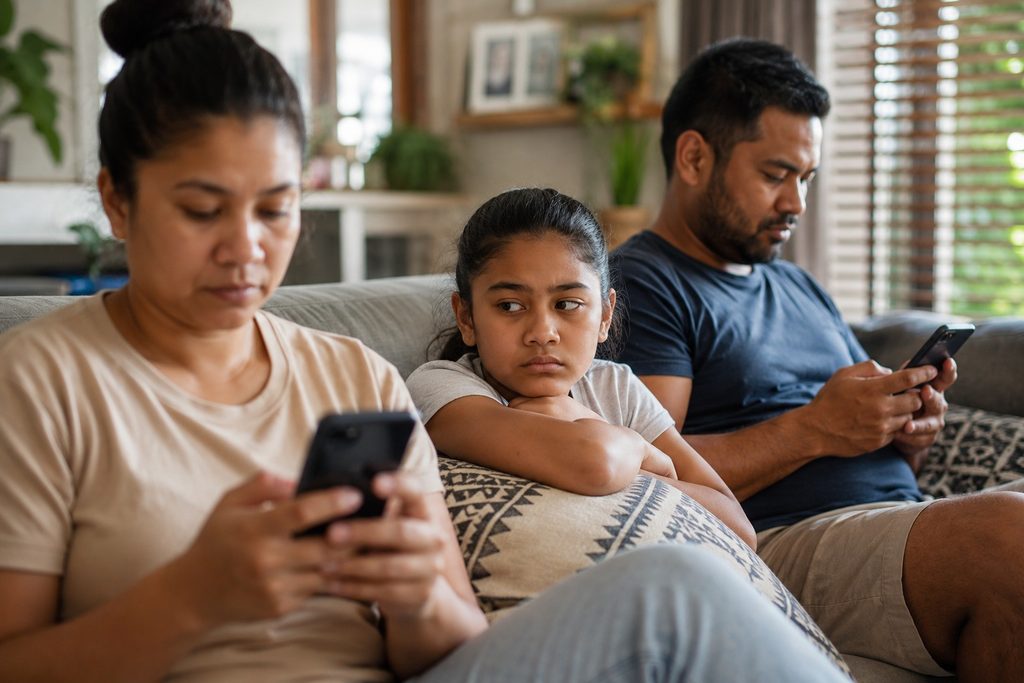
The study, involving 600 adolescents aged between 12 and 17 across the United States, examined what researchers describe as “technoference” and “phubbing” — situations where digital devices interfere with face-to-face interactions. The results suggest that when teenagers perceive their parents as frequently distracted by phones or other devices, they are more likely to report insecure attachment patterns characterised by anxiety, avoidance and emotional distance.
At first glance, the findings may seem unsurprising. Most people have experienced a conversation interrupted by a text message, social media notification or phone call. Yet the implications become more significant when viewed through the lens of parenting and child development.
Attachment theory, one of the most influential frameworks in developmental psychology, holds that children develop a sense of security through consistent, responsive and attentive caregiving. These early experiences help shape how young people understand relationships, trust others and regulate emotions.
The new research suggests that smartphone distraction may be affecting this process in subtle but important ways.
Unlike more traditional parenting challenges such as economic hardship, family breakdown or mental health difficulties, digital distraction often appears harmless. Parents may still be physically present while scrolling through social media, responding to work emails or watching videos. However, researchers argue that adolescents may interpret these moments differently.
From a teenager’s perspective, a parent who repeatedly looks at a phone during conversations, family activities or important events may appear emotionally unavailable. Over time, such experiences can contribute to feelings of being ignored, dismissed or unimportant.
The significance of these findings lies not necessarily in the severity of each individual interaction but in their frequency.
Modern smartphones are designed to command attention. Notifications, alerts and endless streams of content create constant demands on users’ focus. What might once have been a brief interruption can now become a recurring feature of daily family life.
The study notes that nearly half of teenagers surveyed in previous research reported that a parent is at least sometimes distracted by a phone during conversations. Similarly, a majority of parents acknowledge that devices occasionally interfere with time spent with their children.
In other words, this is not a marginal phenomenon. It is increasingly becoming part of the everyday reality of family relationships.
For Pacific societies such as Fiji, the findings are particularly relevant.
The region has experienced a dramatic increase in smartphone ownership over the past decade. Mobile connectivity has transformed communication, commerce and access to information. Social media platforms have become central to daily life, connecting families across islands and international borders.
These benefits are undeniable. For many families, digital technology strengthens relationships by allowing relatives separated by distance to remain in close contact.
However, the same devices that connect people across oceans can sometimes create barriers within households.
In Fiji’s communal culture, family interaction has traditionally centred on shared meals, storytelling, village gatherings and face-to-face communication. Such interactions play a critical role in transmitting values, culture and social support between generations.
As smartphones become more embedded in daily routines, questions inevitably arise about what may be lost when digital engagement competes with these forms of connection.
Importantly, the researchers do not claim that smartphones cause attachment insecurity. The study was observational and cannot establish direct cause and effect. It remains possible that adolescents who already feel insecure in relationships may be more likely to interpret parental behaviour negatively. Other family dynamics may also influence both device use and relationship quality.
This distinction matters.
Public discussions about technology often fall into simplistic narratives that portray devices as either entirely beneficial or entirely harmful. The reality is far more complex.
Technology itself is not the problem. Rather, the issue concerns how it influences human attention and relationships.
One of the study’s most compelling observations is that device-related distraction differs from many other risk factors associated with family relationships because it is largely under voluntary control. While parents cannot always eliminate financial pressures, workplace demands or health challenges, they can make conscious decisions about when and how devices are used.
Small behavioural changes may therefore have meaningful effects.
Simple practices such as device-free meals, uninterrupted conversations, designated family time and greater awareness of phone use during important interactions could help strengthen parent-child connections.
The broader lesson extends beyond parenting.
In an age where digital technology increasingly mediates human interaction, attentional availability has become a valuable and sometimes scarce resource. Relationships thrive not merely on physical presence but on the sense that another person is genuinely engaged and responsive.
The question posed in the study’s title — “Mommy, do you love your phone more than me?” — is intentionally provocative. Most parents would instinctively reject such a suggestion. Yet the question captures an uncomfortable reality of the digital age: children often measure care not simply by what parents say, but by where their attention is directed.
While societies continue to grapple with the effects of technology on wellbeing, this research serves as a reminder that screen time is not solely a youth issue. Adults, too, must consider how their own digital habits shape the relationships that matter most.
The challenge therefore facing modern families is not abandoning technology but ensuring that the devices designed to connect us do not inadvertently weaken the connections closest to home.