
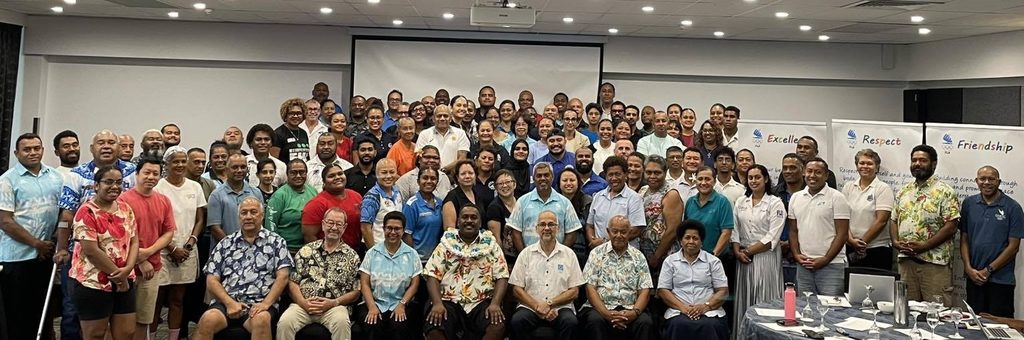
CLOSE to 100 participants from 33 National Sports Federations, alongside key stakeholders, came together on Saturday for a full-day Team Fiji Performance and Pathways Workshop in Suva, marking a decisive step in Fiji’s preparation for the 2027 Pacific Games in Tahiti.
With less than 17 months remaining before the Games, the workshop was designed to mobilise a focused national performance effort, positioning Tahiti 2027 as a proving ground to strengthen performance systems, clarify athlete pathways and embed accountability, while building momentum toward Brisbane 2032 and beyond.
At the previous 2023 Pacific Games in Honiara, Fiji finished sixth on the medal table. The workshop was convened to ensure preparation for Tahiti 2027 is deliberate, coordinated and disciplined, rather than reactive.
Assistant Minister for Sport Aliki Bia, together with Fiji Association of Sports and National Olympic Committee (FASANOC) president Cathy Wong, jointly challenged Team Fiji to return to the top three on the medal standings in Tahiti. Both reinforced that the ambition has been clearly set and that delivery now requires stronger leadership, sharper planning and sustained follow-through across all sports.
Chef de Mission for Tahiti 2027, Ajay Ballu, formally accepted the challenge on behalf of Team Fiji and the National Federations, emphasizing that expectations must now translate into measurable action and consistent progress.
The workshop was facilitated by veteran sports leader Atma Maharaj, who provided a candid overview of Fiji’s performance trends over recent decades and outlined how every sport must contribute to the overall medal tally. To sharpen focus, the 24 sports were grouped into four performance categories: those with large volumes of medals at stake, those with multiple medal opportunities, catalyst sports that strengthen overall outcomes and team sports whose success, while limited in medal count, plays a critical role in national pride and momentum.
Former national hockey representative Samu Savou highlighted trust as the cornerstone of high-performing teams, stressing that leadership is not a title but a responsibility that emerges when trust is strong. He urged sports to unite around a shared vision, build disciplined routines, and commit to processes that allow teams to perform under pressure, describing Fiji’s challenge as climbing its own “Everest” together.
A central session titled Winning on Purpose examined what best-practice preparations looks like at the highest level. Fiji Rugby high performance leader Naca Cawanibuka shared practical lessons from Rio 2016, Tokyo 2020 and Paris 2024, highlighting the importance of preparation that matches competition demands, disciplined routines and mental readiness.
Funding and support pathways were also addressed. Lyndall Fisher outlined the range of Olympic Solidarity funding available and urged National Federations to maximise their grant applications. Fiji National Sports Commission chief executive officer Peter Mazey spoke on government funding support and highlighted plans for a forthcoming National Sports Conference, which will explore the possible establishment of a High Performance Sports Science Support structure to lift performance standards across Fiji sport.
Looking beyond Tahiti, Maharaj introduced key strategic considerations for Brisbane 2032, encouraging sports to begin long-term planning immediately. He outlined how Tahiti 2027 outcomes should be used to define future pathways, performance timelines and priorities and confirmed that a further multi-stakeholder workshop is planned for late April to examine both high-performance outcomes and opportunities beyond sport.
A major outcome of the day was the introduction of the National Federation Performance Planning Contract, titled Turning Ambition into Action. Each National Federation is required to complete and submit the contract by 28 February 2026. The document is not a funding application but a practical accountability tool that will form the basis for future performance discussions, monitoring and targeted support.
To reinforce follow-through, the workshop also introduced an Accountability Buddy system, pairing the 33 sports into eight peer-based clusters. These groups will meet monthly over the next three months to review commitments, delivery and next steps, with the emphasis firmly on outcomes achieved rather than intentions expressed.
The workshop concluded with a clear message: Tahiti 2027 is not just another Games. It is a test of Fiji’s ability to plan, prepare and deliver with intent. The ambition has been set. The systems are being aligned. The responsibility now sits with each sport to do the work.

