
Niukabe Hill in Levuka hardly sparks a conversation anywhere these days.
But in the formative years of the old capital, Niukabe Hill, colonial Fiji’s equivalent of Washington D.C. ‘s Capitol Hill, bustled with activities just like any office in the corridors of power would.
Niukabe, sometimes referred to as Niukabi, was the site of Fiji’s Supreme Court building and Parliament House during the reign of Ratu Cakobau’s Kingdom of Viti, between 1871 and 1874.
It was the melting pot of members of the Legislative Council, made up of five Europeans and two Fijians.
Later, an elected House of Delegates worked out a Constitution whereby legislation was passed by a Privy Council of Fijian chiefs and governors, and a Legislative Assembly of European members.
According to Fiji Museum literature, the popularity of Cakobau’s government fizzled out because of worsening differences between Fijians and European viewpoints which later evolved into “open defiance and armed resistance”.
“Frequent Cabinet changes and defections to the opposition, financial chaos, punitive expeditions and mounting dissent plagued the Government, with intervention in local affairs by British and American warships further undermining the Government’s position,” the Fiji Museum text noted.
On January 17, 1880, six years after Fiji’s annexation to Britain, The Fiji Times reported that the original builders of the hill property wanted to refurbish the offices because it was viewed as “inhabitable.”
Builders and authorities had not envisaged that it was going to be used for a variety of uses.
Because of this reason, the sittings of the Supreme Court were held at the Mechanics’ Institute for some time.
The old building was first erected by the public as a “reading room” and consisted of “one apartment surrounded by a veranda” but was later used for a variety of reasons.
It “accommodated the house of delegates” who framed the country’s constitution and the base of the first court.
Within its walls, Parliament, under King Cakobau, held its sessions.
Its portals bristled with cannon of frowning defence of turbulent Ku Klux Klanites
“It witnessed the framing of governmental laws and installation of the first judges who gave effects to amendments and it eventually beheld the Constitution of the Supreme Court of Fiji,” The Fiji Times once described the structure.
The building’s old age made it too expensive to maintain because its original plan had “become lost in the modern rookery” into which it had developed.
“In its old age, it hath grown gross and pursy; the chaste simplicity of the original plan has become lost in the modernised rookery into which it has developed and after this most eventful career it sinks into the sere and yellow leaf, full of age and hour,” The Fiji Times added.
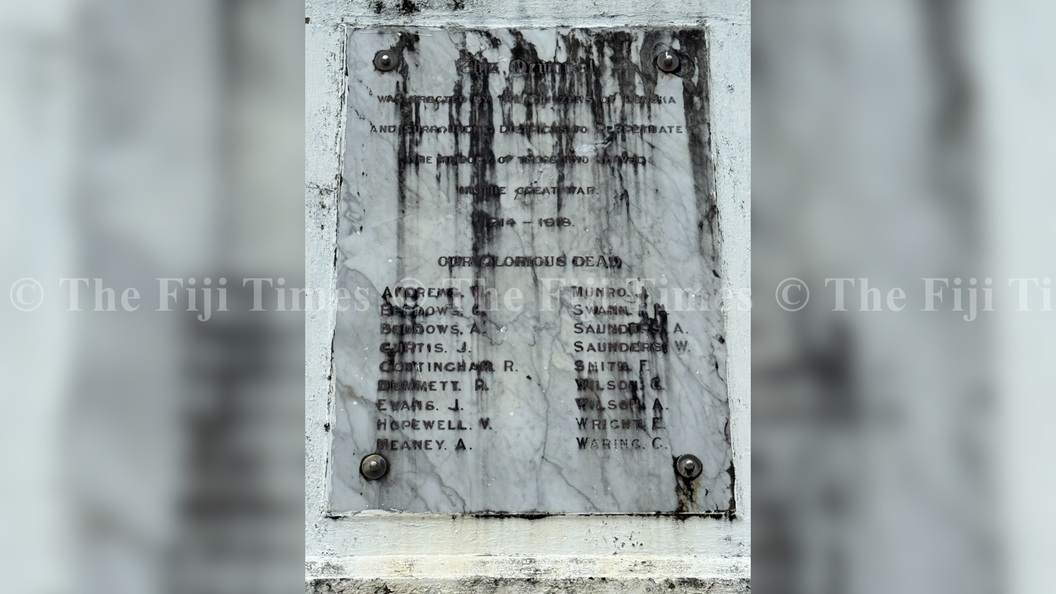
Today, Niukabe Hill is a place of solitude and peace. It is the site of one of Levuka’s two war memorials known as the Europeans War Memorial.
This war memorial was set up to remember British residents of Levuka who perished in the First World War between Britain and her allies and Germany.
Opposite of Niukabe Hill is a guesthouse called The Sailors Home, named after the steam ship, of the same name – Sailors Home which sailed the England to China route in the 1850s.
The Fiji Times’ first office building was located near the hill, at a site near today’s Church Street.
By 1881, plans were out regarding the proposed Government Buildings in Suva and the shifting of Parliament House. Nuikabe Hill ceased to be the historical hill that it used to be.

