
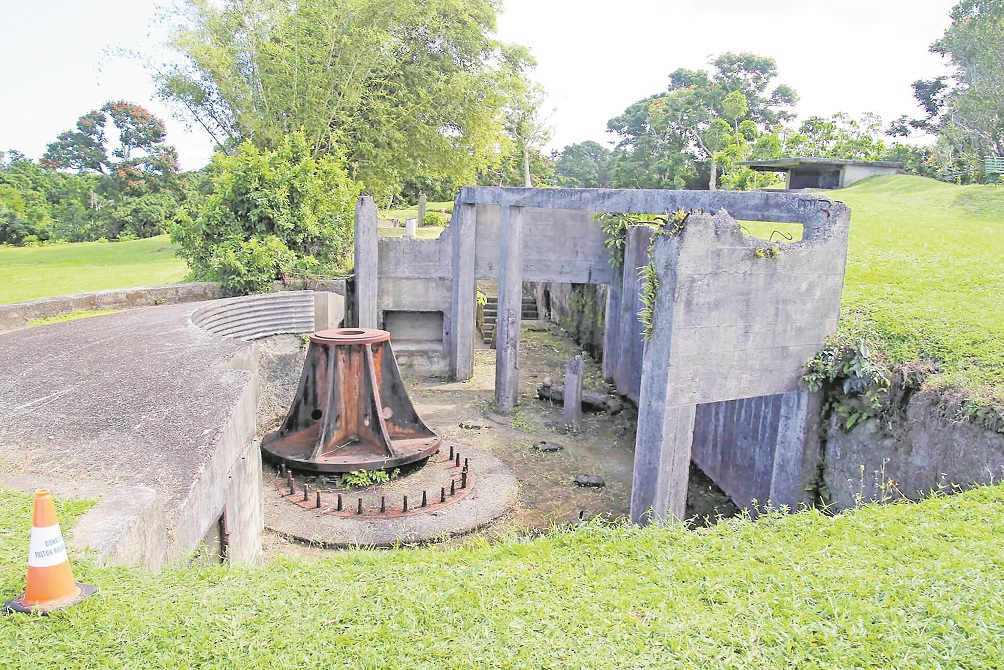
From the bustling Queen’s Road, a turn toward the coast at Bilo will take you on a gravelly ride blessed with great vista and an abundance of nature.
Somewhere near the end of this road, where the panoramic view of the Suva Harbour becomes ethereal in front of you, sits the Bilo Gun Battery.
Today, this place is largely desolate and ghostly, a stark contrast to what it used to be like in the 1940s when brave foreign soldiers were stationed there, in anticipation of a possible Japanese invasion from along Suva’s coastline.
The Bilo Gun Battery was constructed in January of 1941 in an effort to bolster the defence of the inner parts of Suva Harbour during the days of British Colonial rule. This was a few years after a gun battery was first set up in Suva.
It is no wonder then, that if you stand at the site, you’d clearly spot Suva’s hazy high-rise buildings and the flotilla of cargo ships and fishing vessels berthed at sea or making waves into the harbour.
For those who have limited military weapons knowledge, a battery is a parapet or fort equipped with artillery.
In Fiji’s case, all our battery sites were permanent structures used primarily as strategic points from which to defend the country. A gun battery site similar to Bilo is located at Momi, in the western division.
The construction of the Suva battery began in September of 1939, about 80 years ago. It is said that model guns were first put in place until real guns arrived in December, three months later.
Republic of Fiji Military Forces (RFMF) historical accounts contend that “the first two 4.7” guns were brought into the country on board the HMS Leander, a British warship that was commissioned in 1933 but later made part of the Royal New Zealand Navy’s fleet in 1941.
Leander was part of the Mediterranean Fleet and was active against the Vichy French during the Syria-Lebanon Campaign but after serving in the Mediterranean, she returned to the Pacific Ocean on September 1941.
“A blackout was observed within the Suva vicinity to allow the two guns to be conveyed to the Muanikau hill to avoid the enemy’s knowledge of its location,” the website www.rfmf.mil.fj said.
The barracks of the battery were completed in January of 1940 and the first test shot from the 4.7” guns was fired in March of 1940.
The two 4.7” inch guns were then taken from the Suva Battery to Bilo where they were mounted in 1941. Two new 6” guns were then brought in and mounted in January 1941 at the Suva site.
The Suva Battery was operational from March 1940 to January 1941 with two 4.7” guns and from February 1941 to February 1944 with two 6” guns.
During WWII as many as six-gun battery locations were set up around Suva and Nadi on Viti Levu. It was felt by the powers that were, that the two districts were the two most likely points for a coastal invasion from the Japanese.
The Momi Battery, which is looked after by the National Trust of Fiji, has two 6” naval guns, each within separate defensive bunkers.
Structures around the Nadi site include an observation and command post, a fire control room, a restroom, two ammunition storage rooms, a range finder and a magazine room. Though no war was physically fought in Fiji, battery sites such as the one at
Bilo stand as a reminder of Fiji’s role in military defence during the first half of the 20th century. This was at a time when the country had no previous modern military tradition.
According to records, shortly after being built, the Bilo Battery was hit by a devastating cyclone during February of 1941 which damaged most of the infrastructure in the Suva peninsula.
The damage to the newly completed Bilo Battery was fixed, however, and military training and planning took place normally.
The Bilo Battery was a key part of in Fiji’s security and defence, is one of only four gun positions protecting Suva. The others were located near the Parliament House in Veiuto, at the Forum Secretariat grounds (Nasonini) and at the Flagstaff Reservoir Hill.
Other gun batteries in Fiji were set up on the western side of Viti Levu, at Momi and Vuda.
While there are no guns at the Bilo site, what remains are the underground ammunition storage rooms, a command post and remnants of the two guns.
Different parts of the site are connected by underground trenches, tunnels and a network of walkways which can be tricky to access during or after a downpour.
During WWII the New Zealand Army replaced the Fiji Defense Force. They were in turn replaced by the United States Army, before the U.S. Army pulled out of Fiji in 1944, to head to the Solomon Islands and Papua New Guinea as the battle continued in the northern Pacific.
Today, though a mere shadow of its former days, the Bilo Battery stands as a physical reminder of World War II in the Pacific and Fiji’s involvement in promoting world peace.
The Bilo site is looked after by the Fiji Museum.
History being the subject it is, a group’s version of events may not be the same as that held by another group. When publishing one account, it is not our intention to cause division or to disrespect other oral traditions. Those with a different version can contact us so we can publish your account.

