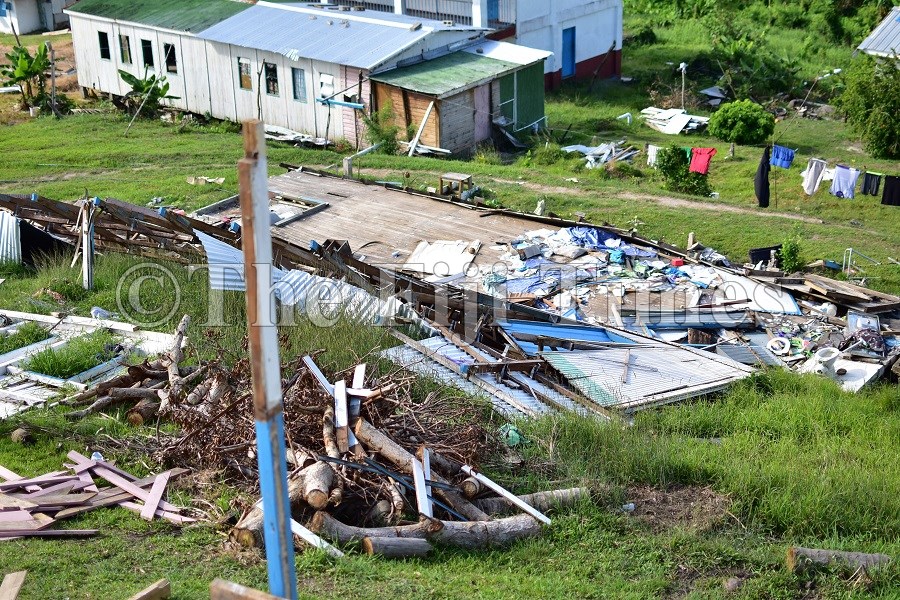
Fiji will pilot the Project for Anticipatory Action for Tropical Cyclones funded under the Central Emergency Response Funds (CERF).
The ministries of Finance, Women and Children, and the National Disaster Management Office will coordinate the pilot project with the World Food Programme and other relevant United Nations agencies.
The Coalition Cabinet had agreed to this at its meeting on Wednesday last week.
Anticipatory Action (AA) refers to actions triggered before a crisis to mitigate the worst effects of the crisis, or even avoid crisis altogether.
It is a new global concept used in humanitarian aid, climate change, disaster, and climate finance.
According to Cabinet, Fiji is the first country in the Pacific to pilot AA related to tropical cyclones.
“AA builds on existing Disaster Risk Reduction (DRR) frameworks that enable actions and financing to be triggered on forecast of impending hazard rather than reacting to its impact,” Cabinet stated.
It stated the UN Office for the Coordination of Humanitarian Affairs (OCHA) Centre for Humanitarian Data had been working closely with NDMO and Fiji Meteorological Services (FMS) to design the triggers.
The AA project will be triggered by a tropical cyclone that is forecasted by Regional Specialised Meteorological Centre (RSMC) Nadi to be a:
- Category 4 or 5 while within 250 km of Fiji (The Category in the Australian scale, corresponding to 10-minute sustained wind speeds of >107 kn for Cat 5, 86-107 kn for Cat 4, and 64-85 kn for Cat 3), or
- Category 3, 4, or 5 while making landfall in Fiji.
Each time RSMC Nadi produces a tropical cyclone track forecast, it will be evaluated to determine whether the trigger conditions have been met, Cabinet stated.
Upon readiness triggers, CERF funds will be immediately disbursed to UN agencies which can only spend up to 15% of the allocation. The rest can be spent once the activation trigger is activated, it added.