Twenty-eight companies signed the RAKORAKO: Building a Safe and Resilient Business workshop series organised by the Fiji Human Resources Institute (FHRI) and IFC.
This has been done with the support of the governments of Australia and New Zealand to help the private sector address childcare demands and workplace responses to domestic and sexual violence.
According to a statement by IFC, Fiji had one of the highest rates of domestic and sexual violence in the world with almost two-thirds of women experiencing domestic or sexual violence during their lifetime.
Across the world, the rate of gender-based violence has been increasing since the COVID-19 outbreak. In Fiji, two-thirds of companies who were surveyed by IFC in April this year believe the pandemic had increased employees’ experiences of domestic and sexual violence.
The violence also comes at a cost to business.
A 2019 study by IFC titled ‘The Business Case for Workplace Responses to Domestic and Sexual Violence’ revealed that the impact of domestic and sexual violence on businesses translated into lost staff time and reduced productivity of up to 10 days of lost work per employee each year.
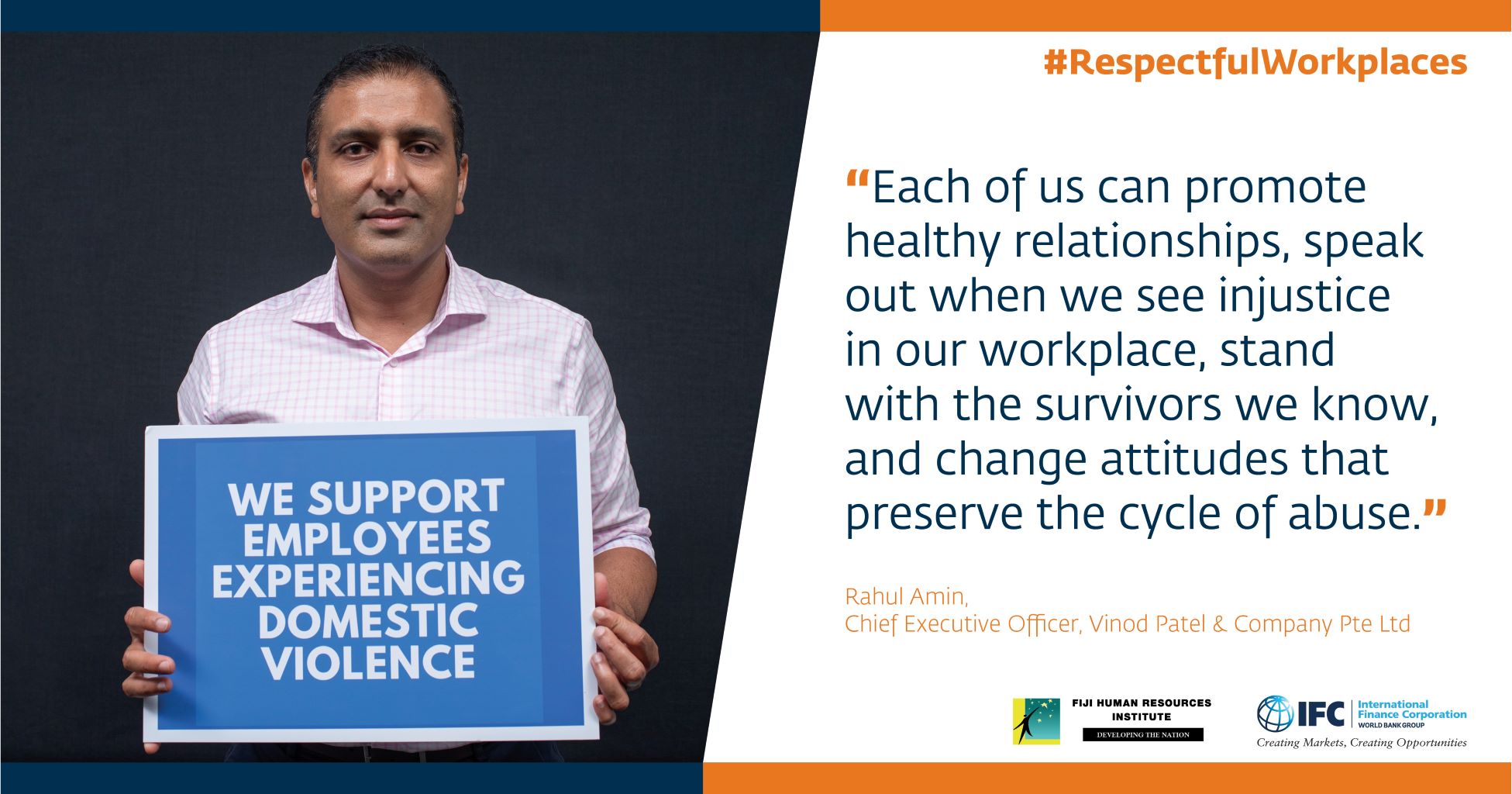
Vinod Patel and Company Pte Ltd CEO Rahul Amin said he believed it was possible to change the perspectives of people who perpetrated violence against women.
“Each of us can promote healthy relationships, speak out when we see injustice in our workplace, stand with the survivors we know, and change attitudes that preserve the cycle of abuse,” Mr Amin said.
“Companies survive only if they work to serve the nation and its people,” FMF Foods Ltd managing director Ram Bajekal said.
“It starts with caring for employees’ safety and well-being. That is why we implement workplace policies and practices on respectful workplaces.”
Meanwhile, FHRI president Kameli Batiweti said: “COVID-19 has seen exponential growth in reported cases of gender-based violence. The private sector is well-positioned to be part of the response.”
“Ending gender-based violence is a national effort – we can, and all should be part of the solution,” said Deva De Silva, IFC Resident Representative for Fiji.
“Our study had shown that having workplace responses to domestic and sexual violence is not only morally right but leads to more satisfied employees, ultimately improving business results.”
Through the RAKORAKO series, a number of companies have started implementing their own workplace responses to address the impact of domestic and sexual violence in their company workplaces.
Several companies now offer counselling services for staff and many will implement policies and mechanisms to support safe and respectful workplaces.
“Domestic violence is a national problem that affects our workers’ physical and mental health and their productivity,” Munro Leys managing partner Jon Apted said.
“As employers, we must do our part to enhance the safety and wellbeing of every member of our team,” Mr Apted said.