
Parts of the theology long used to guide communities are now being questioned for reinforcing inequality and environmental harm, as Pacific voices push for a radical rethink of how faith, climate justice and gender intersect.
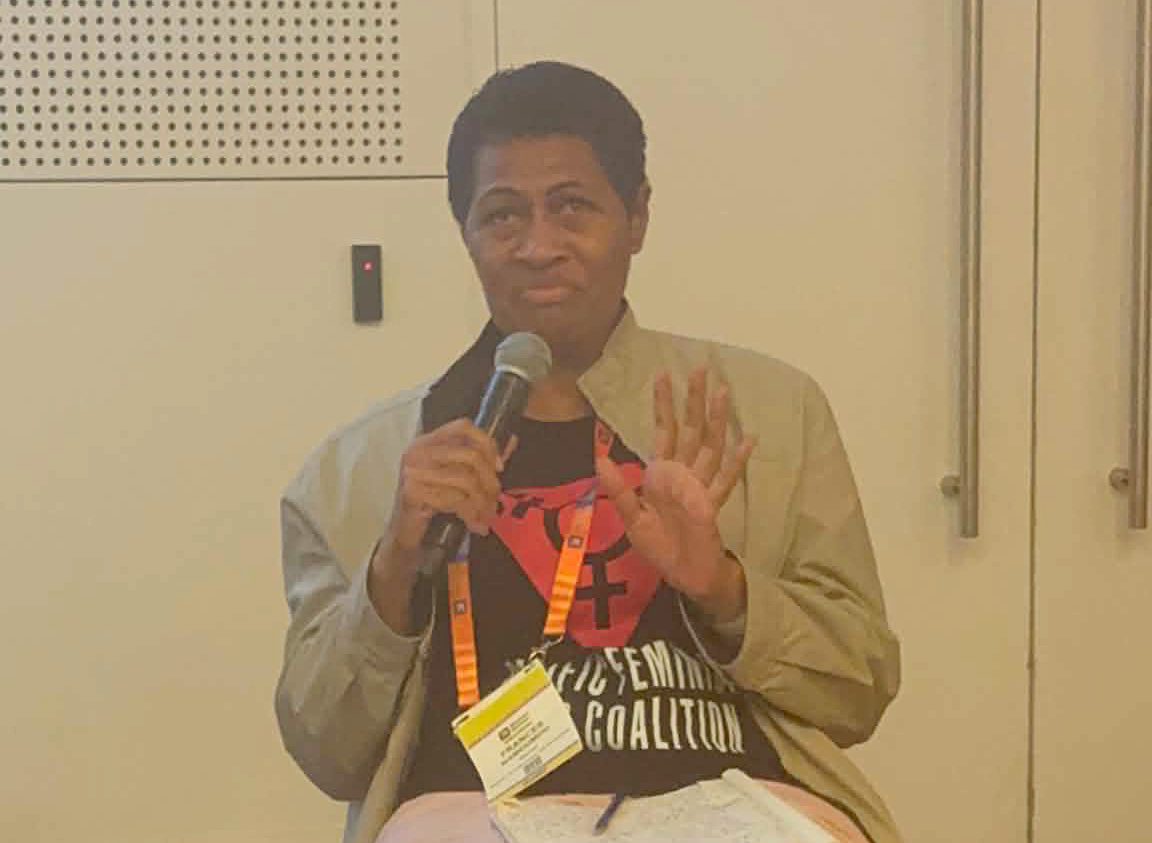
Speaking at the Women Deliver Conference 2026, Frances Namoumou of the Pacific Conference of Churches said climate and gender injustice in the Pacific cannot be tackled without confronting how religion itself has been interpreted and misused.
“Bible contexts have been used to justify ideologies, actions and practices that put one group above another,” she said.
It is a striking intervention from a region where churches remain among the most influential institutions in daily life shaping not just belief, but behaviour, leadership and community decision-making.
Ms Namoumou’s message was clear: if faith is to play a role in climate justice, it must first confront its own foundations.
Rethinking dominion: “We are not above creation”
At the centre of Ms Namoumou’s argument is one word – dominion.
She said traditional interpretations of biblical teachings, particularly the idea that humans have dominion over the Earth, have contributed to a mindset that places people above nature.
“For us, even the creation story … when they use the term dominion, it gives a sense that people are more than other creations.”
In the context of a climate crisis already reshaping Pacific communities, that interpretation is no longer sustainable.
Instead, Ms Namoumou is calling for what she describes as a “re-reading” of scripture — one that reflects the realities of climate change, gender inequality and rising violence across the region.
“We need to really learn, and relearn, what our Bible is telling us in this context.”
It is not just a theological exercise. It is, she argues, a necessary step toward justice.
Breaking silence inside the church
Over the past five years, the Pacific Conference of Churches has been working with feminist groups across the region to do exactly that – open up difficult conversations that have long been avoided.
Ms Namoumou said these dialogues have brought together women theologians and feminist advocates to examine how faith intersects with lived realities.
“What does climate justice look like from the church perspective? What does gender justice look like,” she said.
But just as importantly, the process has been about confronting assumptions.
“It is also about breaking the silence of assumptions that we might have over each other.”
For many, that has meant challenging long-held beliefs not rejecting faith, but deepening it.
Climate impacts are not equal and the church is learning that
One of the biggest shifts, Ms Namoumou said, has been recognising that climate change does not affect everyone in the same way.
“Over the years we’ve learned that the way climate impacts women is totally different from men.”
The same, she added, applies to people with disabilities, young people and children.
That realisation is forcing churches to rethink how they engage with communities.
Traditionally, many church responses have been broad and communal addressing issues at a group level. But Namoumou said that approach can overlook the specific needs of different groups.
“How do we then, when we gather as congregations, address these different aspects,” she asked.
The answer, she said, begins with awareness but must go further.
It requires reinterpreting scripture in ways that speak directly to these realities, and working closely with women’s and feminist groups to see issues through different lenses.
“It’s not always through the lens that we like. But it challenges us.”
A warning to researchers: “Communities are not extraction sites”
Ms Namoumou’s message was not directed at faith institutions alone.
She also delivered a sharp critique of how universities and researchers engage with Pacific communities – a concern echoed across the conference.
“Communities say: they come and extract.”
Researchers arrive, collect data, publish findings and then leave.
“What comes back to the community?” she asked.
For many communities, the answer is: very little.
Ms Namoumou said the problem often starts at the beginning with communities brought in too late, or not at all, during the design phase of research.
“If you are thinking about us as the last option… you’re only taking us on because of the network we bring,” she said.
Her call is simple but direct: involve communities from the start.
“That step one is critical.
From partnership to power-sharing
Beyond consultation, Ms Namoumou is calling for a deeper shift from partnership to shared power.
She said meaningful collaboration means recognising communities not just as participants, but as co-designers and decision-makers.
It also means acknowledging the legacy of work already done by women and grassroots movements across the Pacific.
“We are not starting something new. “There has already been work done.”
That history, she added, must be recognised and built upon – not overlooked.
“Who are the women who created this space for us?” she asked.
For Ms Namoumou, this is about understanding climate and gender justice as part of a broader, ongoing movement – one that spans generations.
The funding reality: “$10,000 is not a small grant”
If power is one part of the equation, resources are another.
Ms Namoumou said funding structures often fail to reflect the realities of working across Pacific island communities – particularly those in remote and rural areas.
“We’ve realised how important resourcing is.”
What donors and institutions define as “small grants”, she argued, are often insufficient to reach the communities most in need.
“Ten thousand is not a small grant to us.”
In many cases, she explained, that amount might only cover activities in central or urban areas – leaving out rural, maritime and hard-to-reach communities.
“If you really want to reach the most affected communities… then you give more than $40,000,” she said.
It is a practical reminder that climate justice is not just about ideas but about investment.
“Shift the centre of power back to communities”
At its core, Ms Namoumou’s intervention is about where power sits and where it should sit.
Too often, she said, decision-making remains concentrated in institutions far removed from the realities on the ground.
What is needed instead is a shift toward community-centred approaches.
“That’s where the action is taking place.”
It means trusting local leadership, investing in grassroots organisations, and ensuring that decisions reflect lived experience.
It also means recognising intersectionality – how climate, gender, disability and social inequalities overlap and reinforce each other.
Faith as part of the solution but only if it changes
Despite her critique, Ms Namoumou is clear that faith institutions have a crucial role to play.
Churches, she said, are deeply embedded in Pacific communities with the reach and influence to drive change.
But that influence must be used carefully.
It requires humility, reflection, and a willingness to challenge long-held beliefs.
It also requires listening – to women, to young people, and to communities on the frontline of climate impacts.
A call to action: “Climate justice is about people”
As the session closed, Ms Namoumou returned to a central point echoed across the conference: climate justice is not just about policy or theory.
It is about people.
It is about dignity.
And it is about ensuring that communities especially those most affected are not left out of the solutions.
Her message to academics, activists and institutions was direct: work together, but do it differently.
Start from the ground.
Share power.
And ensure that what is taken from communities is returned in ways that make a difference.
Because in the Pacific, she said, the stakes are not abstract.
They are lived every day.
And if systems – whether religious, academic or political fail to adapt, it is communities who will continue to pay the price.
CHEERIEANN Wilson is a communications consultant. She attended the Women Deliver 2026 Conference in Melbourne as a scholarship awardee.

