
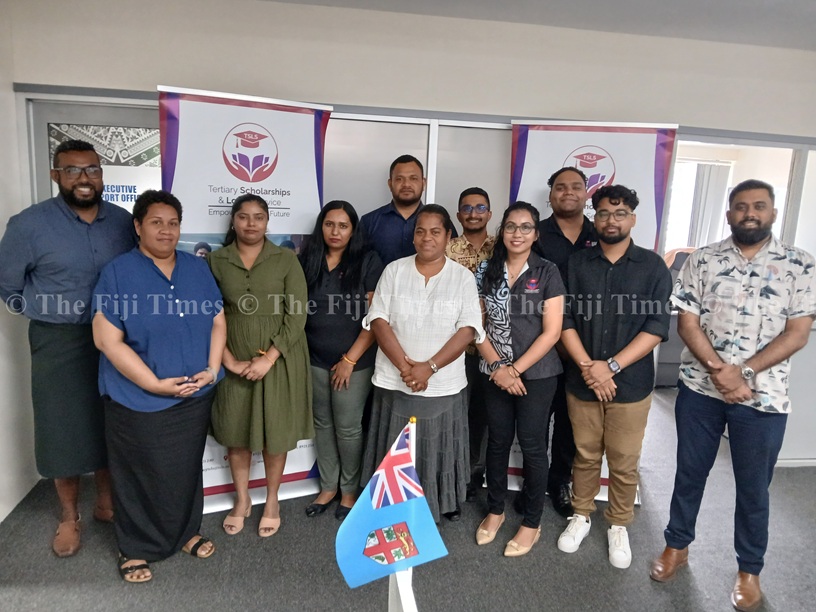
The Tertiary Scholarship and Loan Service (TSLS) as an institution is the doorway into realising the aspirations and ambitions, and the capacity and future of Fiji.
While acknowledging that education is enshrined in the Constitution as a right, the new leadership of the institution has indicated that much needs to be done within the institution’s systems, and it has also realised and accepted their responsibility to educate our future people.
Being the custodian of close to $160 million in budgetary allocation for the 2025-26 financial year, new TSLS chief executive officer Dr Apisalome Movono and his team acknowledge the onus that is on them to provide and facilitate the flow of that money so that Fijians can pursue further education, upskill and go wherever they are accepted.
In an interview with this newspaper early this month, Dr Movono said exciting days were ahead for the TSLS, and their mission to make education accessible across the board, in particular making the prospects of education at all levels encouraging and attractive to youths and younger people.
This month, the TSLS team is focused on processing applications from the thousands of students wanting to pursue tertiary studies, for both local and international applicants.
Last year, TSLS issued more than 22,000 scholarships, including grants for both local and overseas studies, and expects to issue more this year. Dr Movono said there would be changes gradually happening in various aspects of the organisation’s service, which should prove beneficial to the institution and the populace.
Systems strengthening
With institutions like the TSLS, new leaderships inherit systems.
And with his expertise in systems thinking and systems management, Dr Movono said he came in with a systems perspective, and added it was obvious that systems needed to be strengthened in various areas – from customer service to looking after the finances.
He said that was their immediate job.
“Looking at the entire TSLS system and systems, identifying the gaps and working to improve synergies between systems; because when systems within this organisation work well, we deliver better outcomes,” Dr Movono told this newspaper.
“And with this position, that’s the responsibility. I report directly to the chair of the board, and of course the two ministers – Minister of Finance and Minister for Education, and we know they have confidence in what we bring to the table, and what we’ve presented so far.
“Right now, it’s empowering our staff – to let them know this is a different style, we are approachable and I want them to know that we are a team.”
He said they were also opening up internet access to students outside in their screening areas to make the environment less corporate.
He said their team were also reminded to be hospitable to everybody who walked into their office – to remember their sirs, ma’ams, smiles and greetings.
“We manage humans and we all have relational exchanges, and respect is a big part of it.
“Your approach, how you greet people in the morning, how you talk to people, we don’t like being talked down at and neither does anyone else. And in this day and age, management is less hierarchical but more systems-based and empowering.”
Priority changes
Dr Movono said changes they would implement would be based on evidence, need and in alignment. He said this was a deliberate leadership philosophy that leaned on evidence, on demands of the country, now and into the future.
Those evidence, based on internal and external research would inform changes that would come.
Overseas students
He said one of the key changes was addressing the many challenges students overseas faced.
He said the scholarship was dependent on cumulative GPA, compared to term-by-term, which is the common practice everywhere.
“Because at an undergraduate level, we would flop a few units, and we can pull up in the next semester so that’s something that we want to look at.”
While he could not reveal further details, Dr Movono said the first change, which they had brought to the attention of the TSLS board by way of the first flying minutes, was to change their recruitment process for overseas students.
“Previously, you get the mark, you get the letter. Whether you swim or sink, or whatever happens to you, that’s on you.
“That will change. We’re going to start screening with an interview, checking the attitude and the abilities before we (issue a scholarship). And it’s not entirely for our benefit; it’s for our students so that they go in knowing and prepared for an overseas exchange experience.
Schemes
At present, there are 15 scholarship schemes, which he said would need be relooked at in the immediate term. While that change cannot be implemented during this recruitment period, it needs to be ironed out, he said. Dr
Movono said there was a lot of confusion from the students and members of the public on the differences between those schemes, names and terminologies.
“We need to streamline that and to make it simple.
“And some of the entry pathways are really difficult for our people, particularly from rural and maritime – that too will need to change.
“We want to encourage in-service; if you’re working and you’ve got a degree and you want to do your post-grad, we need to facilitate for those changes.”
Dr Movono said in the interest of efficiency, government spending to be efficient and prudent in that area, but also in alignment with the priorities set out in the National Development Plan (NDP), they had an MoU with the Fiji Commerce and Employers Federation (FCEF).
“We want to be able to facilitate and promote studies that will meet the current and future demands of our country.
“An investment in our students is an investment in the future development and prosperity of this country.
“I firmly believe that the most precious asset in this beloved country of ours are our people. If our people are not encouraged to upskill and to be educated, it’ll go the way of other countries who have not invested in their people.”
Repayments
Last year, the Government wrote off $650 million in student debt, which assisted over 53,000 students and their families; and the debt was replaced with a service bond system that meant students did not have to repay their loan if they completed their required years of service in-country. “Right now, the debt is on time,” Dr Movono said. He said the collection situation was also healthy.
“It’s just, again, for our systems, systems of bond and travel clearance. We have an entire system who are connected to FRCS [to] manage those departing, when some people want to go on holiday.
“The last thing that we want to do is to deny somebody the travel but it’s the systems and processes that we want to massage to make sure that everybody is happy.
“After all, we are accountable to taxpayers of this country.”
Addressing student concerns
In the past, applicants have shared unpleasant experiences of not being able to pursue their dream career study pathways because of limited scholarship quotas despite attaining the marks, only to be directed to another pathway other than that they have worked hard for. Dr Movono said he was aware of personal case studies, and that those were not isolated incidents.
He said the justification from the organisation was there were certain needs and quotas to be met.
“But with all things, it’s a negotiated process. I’ve got my job cut out for me and this is what I want to change.
“We want to realise people’s dreams in alignment with the country to be fair, transparent of how we select people. If the money is there and the student is willing, that is my job to facilitate, to be able to convince the board of why
we need to change, and it involves writing those policy papers, justifying it with evidence, this needs to be changed.
“We’ve heard from heaps of parents on these very issues, from students who’ve had their dreams broken because they’ve worked so hard to get in somewhere and only to be told, no this is only available for you. That is something that we are definitely working to change.”
The future
Waraka, namaka! (Wait for it, expect it!)
“Exciting times are ahead. We are responsive. We want to hear from people, we are here to improve the system, take it further and facilitate,” Mr Movono said.
“Let’s make education attractive for our youths, let’s give them a prospect, something to hope for, and this is it.
“This is the bedrock of a prosperous future for our Fiji – to invest in our people, our youths, existing workers, people in government, whoever it is that wants to study.
“Let’s encourage them.”

