
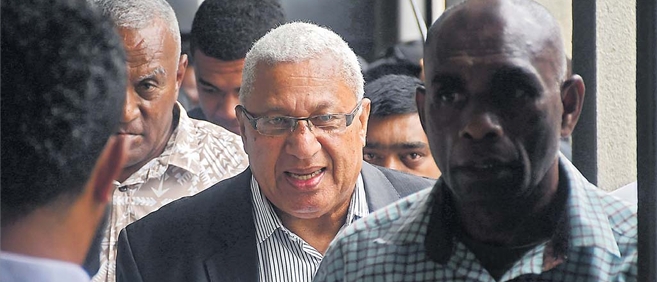
NEWLY released Australian cabinet papers reveal former army commander Frank Bainimarama had told Australian military that he “would not be donning balaclavas and scaling fences,” as tensions rose with the Laisenia Qarase government.
In September 2005, Commodore Bainimarama privately assured Australian officials he would challenge Fiji’s controversial Reconciliation, Tolerance and Unity Bill in court — not through military action — even as Canberra worried tensions could still escalate.
The documents, declassified on January 1, form part of a National Security Committee briefing assessing the growing rift between the Fiji Government and the Republic of Fiji Military Forces in the lead-up to the 2006 election.
According to the papers, Mr Bainimarama told Australian Chief of Army Lieutenant General Peter Leahy that although he strongly opposed the Bill’s amnesty provisions, he did not intend to use force.
He reportedly said he “would not be donning balaclavas and scaling fences” and that, if the legislation passed, he would instead challenge it “in the courts on constitutional grounds.”
Despite those assurances, Australian officials warned the situation remained volatile. The briefing cautioned that further flare-ups between the government and the military were likely and could “again raise the possibility of conflict, although not necessarily a ‘coup’.”
It noted concerns over Mr Bainimarama’s “unpredictable behaviour,” suggesting he might feel compelled to act if he believed he was about to be removed or if the government pressed ahead with the Bill in its existing form.
The papers also suggested the military commander’s position inside the force was not universally secure, stating he “appears to lack the necessary support of his key senior officers” and could rely only on a small number of soldiers personally loyal to him, “such as his bodyguard.”
Beyond the immediate political standoff, the cabinet noted broader risks of instability, including looming economic pressures and simmering ethnic tensions.
Political violence ahead of the 2006 election was deemed unlikely, but the papers warned that Fiji’s politics would remain fragile “as long as indigenous Fijians feel insecure about their future and about the ability of the political system to maintain their position.”
Economic vulnerabilities were also highlighted, with sharp downturns forecast in the sugar and textile, clothing and footwear industries.
Growth projections in the 2005 budget were revised down significantly, underscoring what the papers described as “the problems confronting Fiji.”
The declassified documents provide a rare insight into Canberra’s internal assessments a year before Mr Bainimarama ultimately removed the Qarase government in 2006.

