
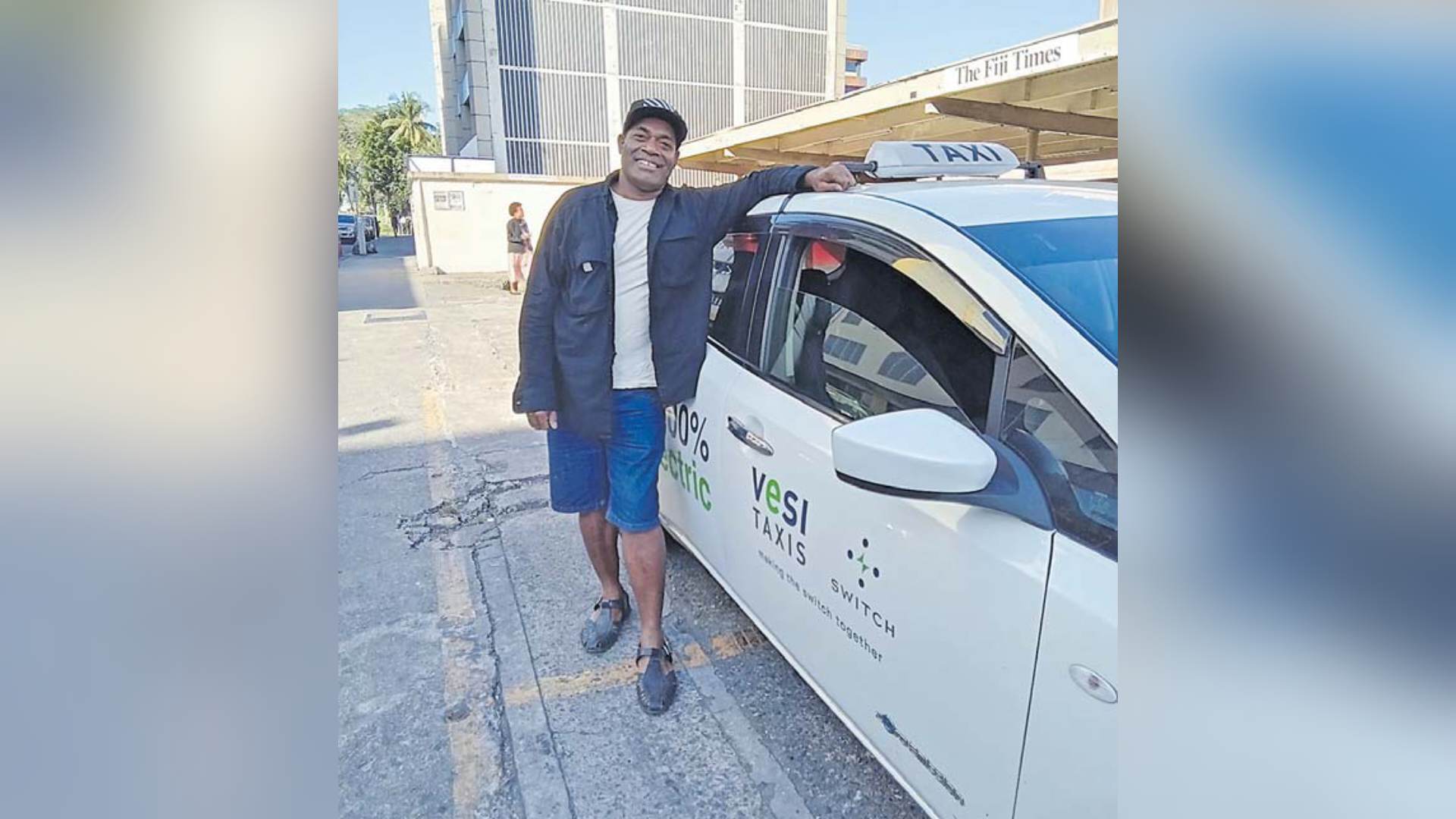
For a mere $20, Eparama Tukana can chalk up a distance of roughly 300 kilometers, driving passengers around Suva and nearby areas in his taxi.
This is why he has becomes a celebrity of sorts among fellow taxi drivers, because what he could enviably do for $20 would normally cost them $60.
The secret? Mr Tukana does not buy petrol or diesel.
As the driver of LT7207, the only Electric Vehicle (EV) taxi in Fiji, he pays just $7 at the EV charging station at Kundan Singh supermarket on Princess Road in Suva and the car battery is fully charged, enough to for it to run 150 kilometers, a distance equivalent to driving from Suva to Sigatoka.
“I’ve been driving for over 10 years here in Suva as a taxi driver then I went to the village in Vanua Levu, drove pine trucks there and then one of my nephews called and asked me to come back to Suva to drive this taxi,” said Mr Tukana when the Fiji Times caught up with him in Suva.
“I was quite surprised when it turned out to be this one – the only fully electric taxi running on Fiji roads today,” he smiled.
“100% electric” is splashed across both sides of the EV taxi in bold light blue letters so it isn’t hard to miss. A Nissan import from Japan, the car is owned by the proprietor of Vesi Taxi service in Nabua but was initially brought to Fiji by Leaf Capital (trading as SWITCH Network), which is currently building Fiji’s only EV charging infrastructure to cater for the nascent EV market.
“This is still a new thing for us in Fiji,” said Mr Tukana.
“I meet a lot of curious people every day asking me about it. When I’m charging it at Kundan Singh, other taxi drivers come around and they want to look inside and ask me a lot of questions. I tell them that for $20, you can drive this car for 12 hours. Just $20 you can do 300km. So, very big difference compared to petrol/diesel cars in terms of fuel costs and cost savings. You spend about $60 fuel for normal cars for 12 hours of driving. For this one – only $20. By the time they go, they want one too. They all say I’m very lucky to be driving one,” said Mr Tukana, who has been driving the taxi for the third month now.
The upside doesn’t end there. It is also clean, almost noiseless and very light. So light that controlling its speed takes some getting used to, said Mr Tukana.
“It doesn’t have an engine or need fuel to run it, so there’s no exhaust and therefore it’s very clean. The biggest difference for me as a driver is this one is very fast. It is fully automatic and has only 3 gears – reverse, echo drive and drive.
“I use echo drive a lot because it consumes very little battery power and is also safe because it lets you slow it down before it stops. Normally, if you’re driving and you tap it to stop, it stops immediately even if you’re running at 80km per hour. Normal cars can’t stop immediately.
“This one stops as soon as you tap the brake. So if you’re new driver, you really need to take extra care because once you tap it to drive, it just goes really fast. But once you control it, it’s a great car to drive. It’s clean, so much cheaper and very convenient because you can just charge it at home using your normal power switch, just like charging your mobile phone.”
A downside though is the time it takes to power up the battery and the availability of charging stations, which at the moment is only confined to Suva and Nadi as there are still very few EVs on Fiji roads.
The SWITCH Network charging stations provide a single phase-charger, which would require up to four hours to fully charge the battery, and a threephase super charger, which only takes 45 minutes. “You can also use the normal power point at home, so you can charge the car when you go to sleep at night,” said Mr Tukana.
“In the morning, it’s fully charged. And that’s free because you’re only using your own electricity. But for me, when I’m working in Suva and I feel the battery charge has dropped slightly, I go and super charge it for about 20 minutes and I move around again. For 20 minutes, you can do 50km,” said Mr Tukana.
SWITCH Network founder and Leaf Capital director Alex Reddaway said the company had carried out an assessment using the Vesi EV taxi to calibrate the cost of charging at their charging stations.
“We found that the taxi uses the equivalent of 7.5c/km compared to 22-30c for a petrol vehicles,” said Mr Reddaway.
The cost savings however do not filter down to the Vesi EV taxi passengers as it uses the normal taxi meter calibrated using the current taxi fares determined by the Fijian Competition and Consumer Commission (FCCC).
Meaning passengers still pay taxi fares that reflect the cost of fossil fuel imports.

