The fact that there is no indigenous word for mining clearly demonstrates how it is a completely alien and unwanted practice.”
That stark observation by made indigenous Fijian cultural consultant and academic Simione Sevudredre cuts to the heart of Fiji’s increasingly complex debate over deep-sea mining (DSM).
As Mr Sevudredre rightly pointed out, the ocean is not merely a resource frontier or economic asset.
It is a sacred realm tied to ancestry, governance, spirituality, identity, and the very foundations of indigenous Fijian society.
In explaining ancient chiefly honorifics such as Tui Cakau — “King of the Reef” — and the ocean-linked origins of clans across Fiji and the wider Pacific, he argued that the sea is inseparable from indigenous cosmology and collective memory.
“Mining has never been — and never will be — a part of our vocabulary because the process involves entering the tabu zone, bulu, where our ancestors sleep,” he said.
His remarks, first published in an article in The Fiji Times in February 2025, have gained renewed relevance amid growing regional tensions over whether Fiji and the Pacific should open the ocean floor to industrial extraction.
Pacific resistance grows
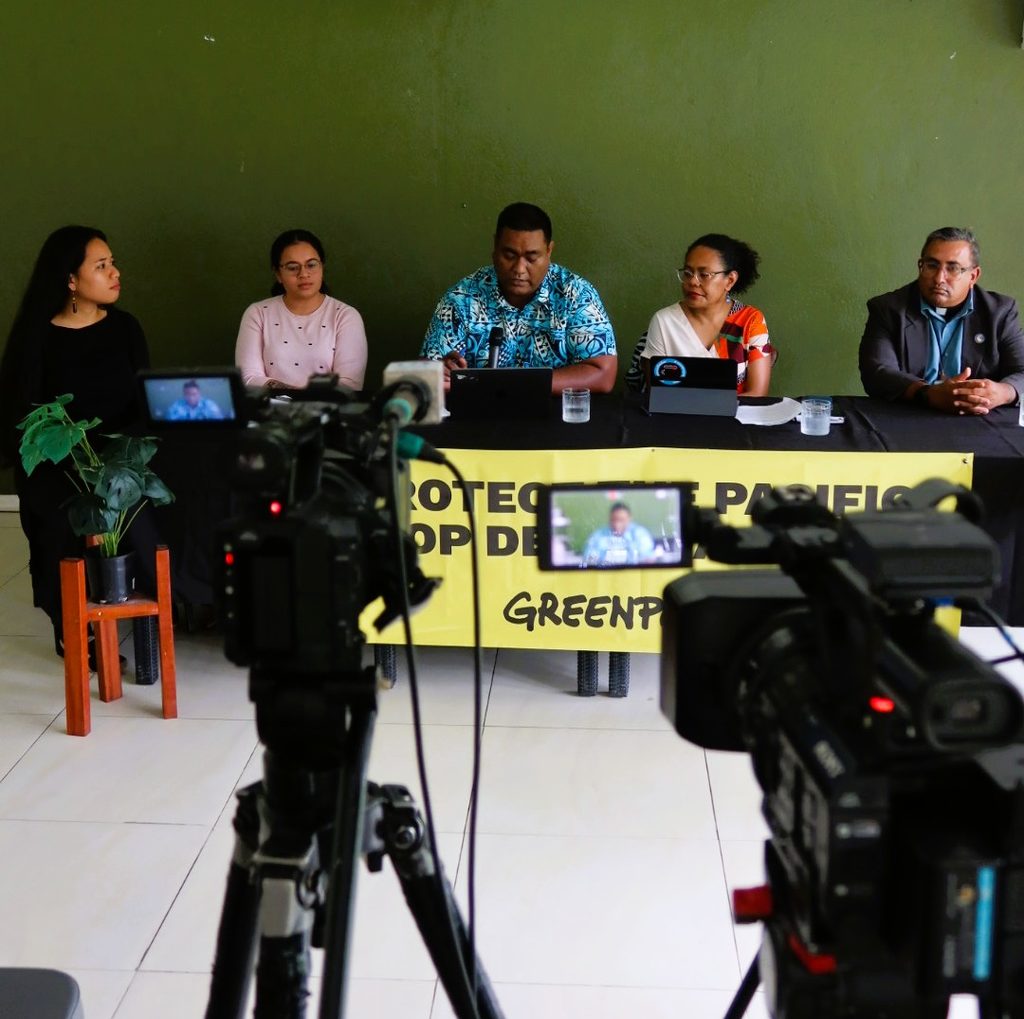
This week in Suva, the Pacific Regional Non-Government Organisations (PRNGO) Alliance intensified criticism of the International Seabed Authority and its ongoing push to develop a global “mining code” that could pave the way for commercial deep-sea mining.
At the centre of the debate lies a defining question for Pacific nations, which is can economic opportunity justify irreversible ecological and cultural risk?
Fiji has so far answered cautiously.
The country maintains a 10-year moratorium on deep-sea mining from 2020 to 2030 and has repeatedly insisted that no extraction should proceed until comprehensive international regulations and environmental safeguards are finalised.
Prime Minister Sitiveni Rabuka’s government has positioned Fiji among Pacific nations advocating a science-first and precautionary approach, alongside countries such as Palau and Samoa.
Yet Fiji’s stance also exposes the growing geopolitical and economic fault lines emerging across the Pacific.
Global rush for seabed minerals
The global deep-sea mining industry is being aggressively marketed as the next frontier of the green economy.
The Clarion-Clipperton Zone (CCZ), a vast abyssal plain between Hawaii and Mexico, is estimated to contain approximately 21 billion tonnes of polymetallic nodules rich in cobalt, nickel, manganese, and copper — minerals heavily used in batteries, electronics, infrastructure, and defence industries.
Supporters argue these minerals are essential to the global transition away from fossil fuels.
However, that argument is increasingly being challenged.
At Tuesday’s PRNGO Alliance press conference, the general secretary of the Pacific Conference of Churches, Reverend James Bhagwan said the narrative surrounding DSM had repeatedly shifted whenever earlier justifications were undermined.
“Up until maybe last year, in the green transition, deep-sea mining was touted as needed for the transition away from fossil fuels,” Reverend Bhagwan said.
“Once that has been addressed and debunked, the conversation as of last year has shifted globally to critical defence minerals.”
He warned Pacific leaders against being rushed into accepting an industry whose long-term consequences remain poorly understood.
“The precautionary pause is what’s important,” he said.
Is deep-sea mining really necessary?
That caution is increasingly supported by emerging scientific and economic research.
Major independent studies released in 2026 indicate that the global renewable energy transition can proceed without seabed extraction.
Rapid advances in lithium iron phosphate (LFP) and sodium-ion batteries are already reducing dependence on cobalt and nickel — the very minerals driving interest in deep-sea mining.
At the same time, researchers argue that improvements in recycling, battery recovery, and circular economy systems could dramatically reduce demand for newly extracted minerals.
Critics also point to a growing timeline mismatch.
While demand for transition minerals is rising immediately, commercial-scale deep-sea mining technology remains largely untested and international regulations are still unresolved.
In effect, DSM may arrive too late to meaningfully solve short-term supply pressures.
Environmental risks beneath the surface
The debate for Fiji extends well beyond global climate politics.
The country’s economy is deeply dependent on tourism, fisheries, and the long-term health of marine ecosystems.
Environmental scientists warn that deep-sea mining could generate widespread and potentially irreversible ecological damage through habitat destruction, sediment plumes, toxic heavy metal release, underwater noise pollution, and disruption of fragile food chains.
The environmental risks are especially alarming because more than 90 per cent of species in targeted deep-sea zones remain undiscovered.
Mining vehicles weighing dozens of tonnes would scrape polymetallic nodules from the seabed, permanently removing habitats that took millions of years to form.
Sediment plumes could travel kilometres through the water column, smothering marine organisms and introducing toxins into migratory fish stocks.
Noise pollution from mining machinery may also reverberate across hundreds of kilometres, disrupting whales, fish, and deep-sea species that rely on acoustic communication in the dark ocean environment.
Promise or gamble?
The consequences are not abstract for Pacific Island communities.
Fisheries underpin food security, employment, and regional economies across the Pacific.
The ocean also supports more than half of the world’s wild fish catch.
A 2023 financial study cited in The Fiji Times found that restoring damaged deep-sea ecosystems could cost between US$5.3 million and US$5.7 million per square kilometre — roughly double the estimated extraction revenue.
That raises a troubling economic paradox, that the Pacific may bear the environmental cost while multinational corporations capture most of the profits.
Research released this year suggests Pacific Island nations sponsoring mining ventures may receive only limited financial returns through fees and compensation frameworks, while private companies potentially secure billions in mineral revenue.
This imbalance is fuelling growing civil society opposition throughout the region.
Communities demand a voice
Executive director of the Fiji Council of Social Services (FCOSS) Vani Catanasiga warned that Pacific societies were not prepared for the social and governance implications of DSM.
Drawing parallels with black sand mining controversies, she argued that Fiji still lacks robust frameworks for free, prior, and informed consent.
“There is a relationality to the ocean,” Ms Catanasiga said.
“How do we navigate that conversation with people who see their role at community level as custodians?”
She stressed that decisions over ocean governance could not be confined to closed-door policy negotiations.
“Whatever conversations take place in Fiji take place guided by our values,” she said.
Those values increasingly place Fiji at odds with some neighbouring Pacific nations pursuing exploration partnerships with mining corporations.
Countries such as Nauru and Cook Islands have supported exploration efforts linked to companies such as The Metals Company, viewing seabed minerals as a potential economic lifeline.
Meanwhile, Fiji continues to advocate restraint.
Yet despite the moratorium, environmental groups warn that Fiji’s protections remain politically vulnerable because no permanent domestic legal ban currently exists. Outdated legislation, including the Mining Act of 1965, could theoretically be amended by future governments.
That uncertainty explains why regional activists are now pushing beyond temporary pauses and demanding outright permanent bans.
A defining Pacific debate
Ultimately, the deep-sea mining debate reflects a wider struggle over the Pacific’s future.
For corporations and industrial powers, the Pacific seabed represents an untapped strategic resource, but for many Pacific Islanders, it represents ancestry, identity, sustenance, spirituality, and survival.
In Fiji, Mr Sevudredre’s words capture that divide with unusual clarity.
While to the industrialised economies, the ocean floor may appear as a mineral reserve, it is in fact to many indigenous Pacific communities, is and remains the resting place of the ancestors.
Prime Minister Sitiveni Rabuka walks alongside ISA secretary-general Leticia Carvalho during the official welcome ceremony at the Grand Pacific Hotel in Suva earlier this week. Picture: FIJI GOVERNMENT
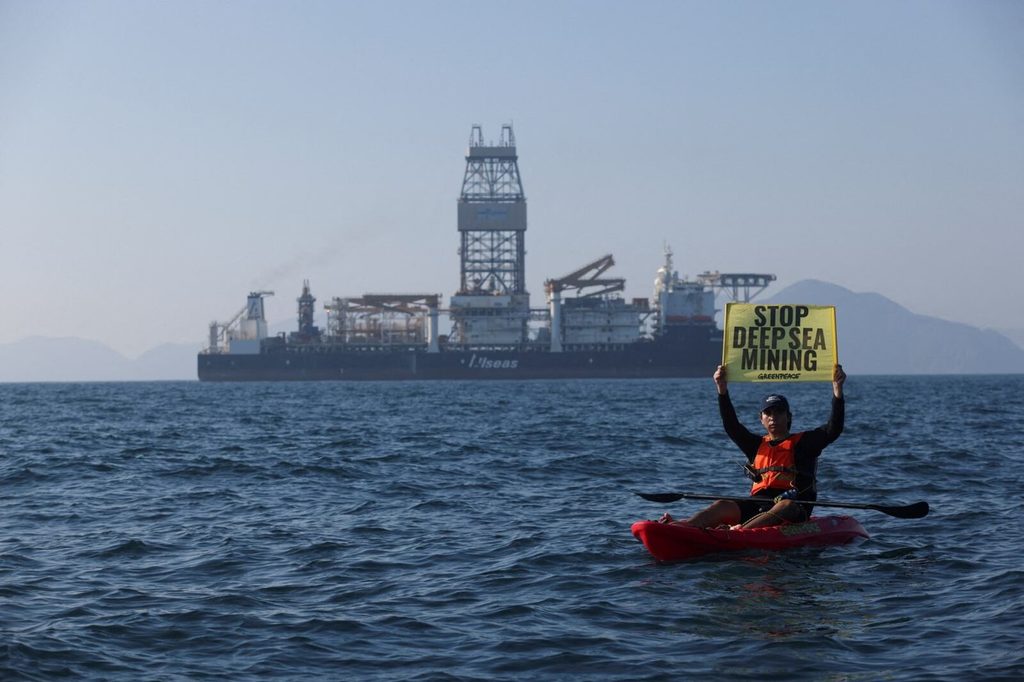
A lone protester paddles a canoe while holding a placard opposing deep-sea mining during a demonstration, reflects the growing resistance to DSM and calls to protect the ocean from industrial extraction. Picture: REUTERS