
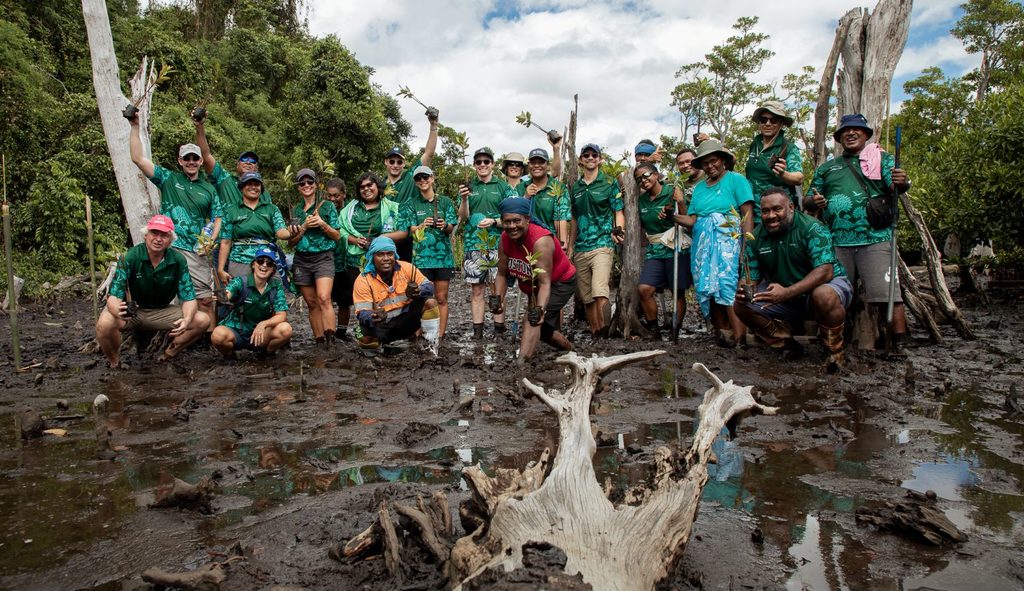
EVERY June 5, the world marks World Environment Day. This year’s theme, “Inspired by Nature. For Climate. For Our Future”, is a reminder that the most durable climate solutions are often the ones nature has already designed. This year, some of the most meaningful action is happening in the water and along the shorelines of Fiji, Samoa, and Timor-Leste, where communities are doing something that matters: planting mangroves, supporting coral reef restoration, and looking after coastlines that their families and communities depend on.
This is the work of the Kiwa RESTORE Project, implemented by Conservation International with funding from the Kiwa Initiative. But the people doing it are not scientists or outside experts. They are fishers, farmers, students, women, youth groups, and community leaders who live alongside these ecosystems every day.
Navitilevu Bay, Fiji: Rebuilding what Winston took
When Severe Tropical Cyclone Winston made landfall in February 2016 – the most powerful cyclone ever recorded in the Southern Hemisphere – it tore through Fiji’s Ra Province with gusts exceeding 320km/h. The damage to homes and crops was visible. The damage to the mangroves that lined Navitilevu Bay was quieter, but just as devastating.
For fisher Meri Vuda from Barotu Village, who has spent more than 40 years harvesting crabs from Barotu’s mangrove forests, the change was unmistakable.
“Before Winston I didn’t have to go any further into the mangroves for a decent catch,” she said.
“It was just there. Walking into the mangroves always guaranteed enough catch for my family’s needs.”
After the cyclone, the catches got smaller. Barotu Village headman Meciusela Tulewa described how the loss made people rethink the way they had been fishing.
“Our fisherfolks knew that the marine life existing in the mangroves was in abundance. We would fish to catch as many as we can, rather than ‘just enough’. We treated our marine ecosystem as a bottomless pit that would never dry up.”
That reckoning is now driving one of the most tangible restoration efforts in the Pacific. Today, five communities, Nanukuloa, Naiserelagi, Barotu, Matawailevu, and Navuniivi, are working together to restore the bay’s shared fishing ground, the qoliqoli cokovata.
More than 80,000 mangrove seedlings have been potted in the mother nursery, with over 12,000 now transplanted to the restoration site – bringing the total area restored to over eight hectares across two Kiwa RESTORE mangrove restoration sites, with a target of 20 hectares across the bay. This marks the successful restoration of two out of five sites proposed under the Kiwa RESTORE Project, and builds on earlier restoration of nine hectares co-financed by DFAT’s Fiji Blue Carbon Project. The primary species, Bruguiera (dogo), is being replanted through community-managed in-situ nurseries.
“The mangroves are returning now, and so are the crabs. We can see it. That’s why I’m happy this project is focusing on mangroves. It brings back life – for us and for the sea,” said Setaita Biu, Fish Warden from Barotu Village in Navitilevu Bay.
The project has also helped communities find other ways to earn a living while the mangroves recover. In Nanukuloa, community members now keep bees. In Matawailevu, women are making and selling honeycomb coconut cream and honey. When people have something to gain from healthy ecosystems, they work harder to protect them.
Samoa: Scaling up coral restoration
In Samoa, the challenge is underwater. Coral reefs across the Pacific have been hit hard by warming seas, storms, and pollution. In seven communities along Samoa’s coast, people are doing what they can to bring them back.
On 4 May 2026, the Kiwa RESTORE Project launched a Coral Restoration Training of Trainers (ToT) program in Samoa, bringing together communities from Faleatiu, Lalovi, Fuailolo’o, Apai-uta, Salua-uta, Samatau, and Matautu-Falelatai, along with government and regional partners including SPREP.
The launch marked the handover of equipment – masks, fins, snorkels, and boots that communities would use to plant coral and monitor reefs at their sites. Each person trained was also expected to pass on what they learned to others in their village.
Then the teams got in the water. Over two weeks, each of the seven communities deployed 100 reef stars and planted 1,800 coral fragments at their site. That adds up to 700 reef stars and 12,600 coral fragments in total, placed by hand into reefs that community members will keep watching and caring for in the months ahead.
Timor-Leste: Planting before the rains
In Timor-Leste, the work is about getting seedlings into the ground before the coastline loses any more ground to the sea. Mangrove forests along the country’s shore have been cleared over the years, and communities living nearby have watched the water creep closer; the fish grow scarcer.
On 24 April 2026, CI Timor-Leste planted 5,000 mangrove seedlings in Batugade, in Bobonaro Municipality. A month later, on 28 May, another 5,000 went into the ground in the Beacou area of Aidabaleten – planted by government staff, community members, youth groups, students, and partners who came together for the day.
But the planting day was only the visible part. Adelino Pires, who leads the Aidabaleten Restoration Group, described what the community had already put in before a single seedling was placed: months of training, building nursery shelters, preparing the soil, checking on seedlings weekly, keeping the area clean.
Why this matters on World Environment Day
Mangroves and coral reefs are not just pretty features of tropical coastlines. They are what stand between coastal communities and the sea. Mangroves absorb the force of waves and storm surges, hold the soil together, and give fish a place to breed. Coral reefs do the same for underwater life – feeding families, supporting livelihoods, drawing the tourists whose spending keeps island economies going.
When these ecosystems disappear, people feel it quickly – in smaller catches, higher food costs, and homes that sit more exposed to floods and storms. Climate change is making all of this worse.
The Kiwa RESTORE Project, funded by France, the European Union, Canada, Australia and New Zealand through the Kiwa Initiative, is one response to that. But what makes it work is the fact that the people doing the planting, the monitoring, and the care are the same people whose lives depend on what grows back.
As Mere Lakeba, Interim Vice President of Conservation International’s Pacific Program, said: “Restoration is not only improving the environment – it is strengthening resilience. Alongside mangrove planting, the project supports sustainable livelihoods linked to ecosystem health.”
Ten years after Cyclone Winston, and with seas still rising, the work in Fiji, Samoa, and Timor-Leste is a reminder that recovery is possible. It just takes time, care, and people who are willing to show up.
This World Environment Day, the message from the Pacific is simple: the time for climate action is now.
About the Kiwa RESTORE Project
The RESTORE Project is funded by the Kiwa Initiative and implemented by Conservation International. The project strengthens the adaptive capacity and economic resilience of Pacific Islanders through Nature-Based Solutions focused on community-based ecosystem restoration in Fiji, Samoa, and Timor-Leste. The Kiwa Initiative is funded by the European Union, Agence française de développement (AFD), Global Affairs Canada, Australia’s DFAT, and New Zealand’s MFAT.
Conservation International protects nature for the benefit of humanity. Visit conservation.org for more information.
Shreya Kumar is Kiwa Communications Coordinator for Asia Pacific Field Division. This article has ben shortened for space.)

