
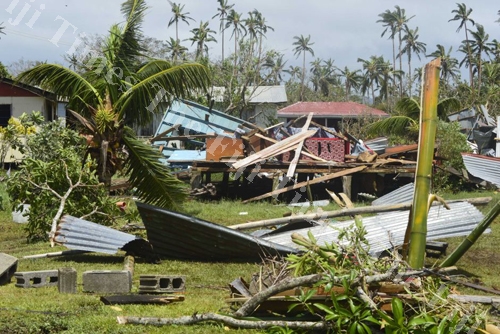
As damage assessment teams filtered in their reports from around the country on February 23, 2016, it became increasingly clear that Severe Tropical Cyclone Winston, which struck us on February 20, was powerful and ruthless.
By then, just days after the Category 5 system cut across the country, the national death toll sat at 21. Twelve died in the Western Division.
As State emergency teams headed out to troubled spots around the country, there was hope that would be the final figure. Unfortunately, it wasn’t to be. In the end, there were 44 confirmed deaths and 540,000 people affected.
In many areas, entire villages were devastated by the powerful winds raked in by Winston.
Homes were missing their roofs, some blown off their foundations, and others torn to shreds by the angry winds.
The National Disaster Management Office confirmed very early that day back in 2016 that 8438 evacuees were sheltered in more than 50 evacuation centres across the four divisions.
There were nine evacuation centres in the Eastern Division with 121 evacuees; 20 centres in the Central Division housing 1177 evacuees; and 22 centres in the Northern Division with 1260 occupants. For the Western Division, there were a total of 5880 evacuees.
NDMO director at the time, Akapusi Tuifagalele, revealed that preliminary costs of damage to schools in the Western Division alone initially stood at $2.2million. In the end, losses around the country climbed to as much as $2billion, making Winston the costliest natural disaster in Fiji’s history.
Approximately 80 per cent of the country lost power, and 495 schools and 88 health clinics were damaged or destroyed.
It was difficult to shrug off the massive impact Winston left in its wake, financially, physically and emotionally. People who experienced the terror of this mega storm still live with frightening memories today.
Yet even in the midst of devastation, we reflect on stories of heroism.
Moments like these have a way of revealing heroes, men and women who set aside concerns for their own safety to ensure others survive.
Many may never be known. Some, like Atunaisa Raralevu III, made the ultimate sacrifice.
The 24-year-old farmer was not famous. He was loved by his family.
At the height of Winston’s fury, he tried to save 15 people trapped in a house.
He did what many might not have done.
He had already carried a woman, her three children and another girl to what he believed was the safest home in the village.
He will be remembered by those he touched that night. His reassurance and bravery in the face of overwhelming danger meant everything to those who survived.
This is just one of many stories of courage from the terrifying night when Winston wreaked havoc on Fiji.
We must remember Winston. This powerful system should serve as a constant reminder of the dangers we live with, and also of our resilience.
While the storm exposed our vulnerability, it also revealed our greatest strength, and that was the willingness of ordinary Fijians to stand together in extraordinary times.
We must reflect on Winston as a constant reminder of the dangers we live with!

