
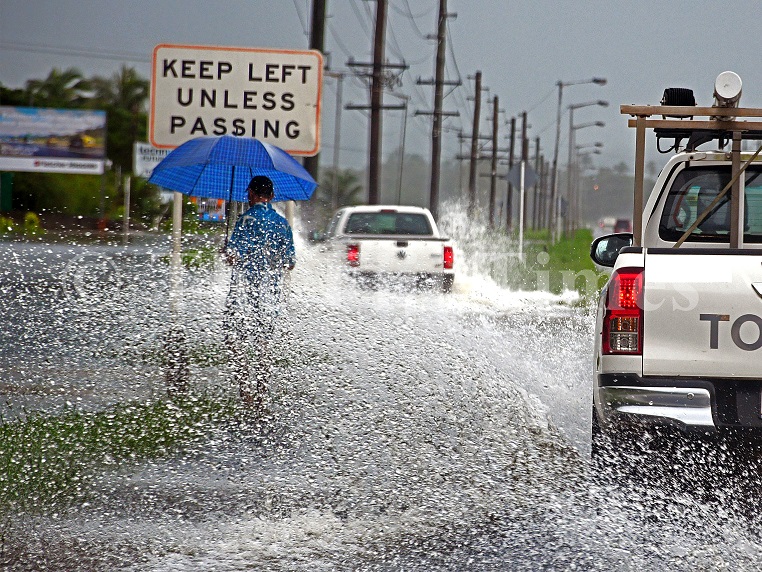
Families in the Central Division suffered thousands of dollars in damage after Sunday night’s flooding, triggered by hours of heavy rain.
Among them was 48-year-old construction worker Shalen Singh of Muslim League Settlement in Nabua, who watched helplessly as floodwaters swept through his home and destroyed more than $15,000 worth of electrical construction equipment.
“I couldn’t move the equipment to a safer place because the water rose so quickly,” Mr Singh said. “When the rain first got heavy, I drove my car to a friend’s place and parked it safely. But by the time I returned, the rain had intensified, and the water level kept rising.”
With water pouring in, he, his wife and their children scrambled to lift belongings onto higher ground. But the flood was relentless.
“I realised I wouldn’t be able to save anything,” he said. “So I focused solely on my family’s safety.”
In the aftermath, anger and frustration hang thick in the air. People are counting losses, cleaning up, and trying to make sense of how quickly the waters rose and how they destroyed what families had worked years to build. Mother Nature, when she turns, can be unforgiving.
Yet even in the chaos, what stunned Mr Singh most was not the water, but a thief.
As the rain hammered down and his family tried to salvage what little they could, he heard noise on his roof. Stepping outside, he found a man attempting to pry off his solar panel.
“At first, I thought he was trying to escape the flood,” he said. “But no, he was after the solar panel.”
It might have been almost amusing if it weren’t so disturbing. Here was a family in the middle of a natural disaster, struggling to save their home and stay safe and someone chose that moment to commit theft. It was a sad reflection of how far some in our society have drifted from basic decency.
This act, committed in the middle of a storm, reveals an erosion of empathy and responsibility and a willingness to prey on the vulnerable, even at personal risk. While the community battled rising waters and fear, this thief’s only concern was self-gain.
It forces us to ask hard questions. How have we reached a point where some members of our society see tragedy as an opportunity to exploit others? What does it say about our collective values when, in moments that should unite us, others choose to take advantage?
Disasters have always tested our resilience, but they also reveal our character. Historically, communities faced with danger rallied together.
Neighbours helping neighbours, strangers offering hands, families finding strength in unity. Sunday’s events did show acts of courage and cooperation across the division. But incidents like the one Mr Singh experienced remind us that something fundamental is fraying at the edges.
If we are to rebuild our homes and trust, then we must confront this moral slide. Compassion, empathy, and a sense of shared responsibility cannot be optional values. They are the glue that holds a society together, especially in times of crisis.
We can only hope that when disaster strikes again, as it inevitably will, more of us choose humanity over opportunism. We hope that we rediscover respect for the rights of others and the understanding that in moments of vulnerability, we all depend on each other.
Because one day, any one of us may be the person standing knee-deep in rising floodwaters, praying that those around us choose to help, and not to steal!

