
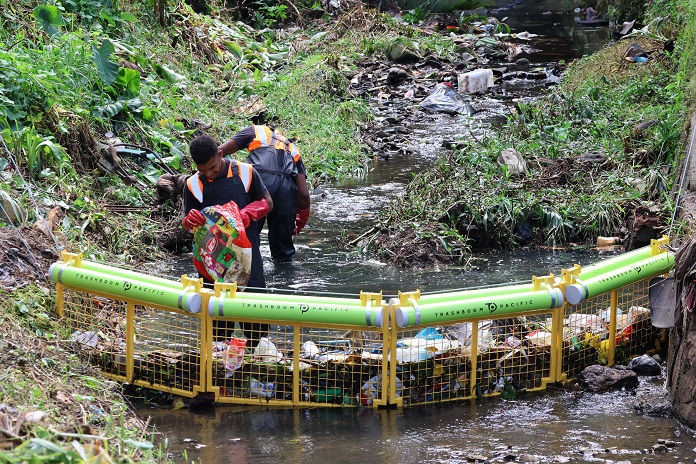
It is encouraging to note that the Nasinu Town Council is focused on tackling waste pollution.
In collaboration with the United Nations Development Programme (UNDP), it launched the Trash Boom Pilot Project last Friday.
The goal is to tackle waste pollution which is affecting our waterways and environment.
Nasinu TC special administrators chairman Felix Magnus said the program is a pro-active approach to protect marine life and fosters a culture of responsibility in waste management efforts among members of various communities within the township.
They have taken a proactive step towards a cleaner and more sustainable future for the community.
According to the UNDP, plastics pose a significant threat to our Blue Pacific.
Annually, 8 million tonnes of plastics enter our oceans, equivalent to a garbage truck dumping its contents every minute.
We learn that Fiji generates around 15,000 tonnes of plastic waste each year, exacerbating the crisis, with less than 10 per cent of this waste being recycled.
So the idea to have trash booms at strategic locations, will “significantly reduce the flow of plastics and other debris into our oceans and rivers, thereby protecting marine life and preserving our natural ecosystems”.
The result is that we can focus on moving towards a cleaner, more sustainable environment for all.
The United Nations Environment Programme jointly published with the International Solid Waste Association (ISWA), the Global Waste Management Outlook 2024.
This was released in February this year.
The report provides an update on global waste generation and the cost of waste and its management since 2018.
The analysis uses life cycle assessments to explore what the world could gain or lose through continuing business-as-usual, adopting halfway measures, or committing fully to zero waste and circular economy societies.
The report also evaluates three potential scenarios of municipal waste generation and management, examining their impacts on society, the environment, and the global economy.
It also presents potential strategies for waste reduction and enhanced management, following the waste hierarchy, to treat all waste materials as valuable resources.
As part of its key findings, municipal solid waste generation is predicted to grow from 2.3 billion tonnes in 2023 to 3.8 billion tonnes by 2050.
In 2020, the global direct cost of waste management was an estimated $US252 billion.
When factoring in the hidden costs of pollution, poor health and climate change from poor waste disposal practices, the cost rises to $US361 billion.
Without urgent action on waste management, by 2050 this global annual cost could almost double to a staggering $US640.3 billion.
Let’s be reminded though that we also have a major role to play.
We must have the initiative to dispose our rubbish thoughtfully.
That means collecting our rubbish when we are out at our beaches for instance, and placing that in a provided bin, and in a plastic bag if there is none, and finding a bin to dispose that.
Let’s teach our children to value cleanliness and the need to dispose rubbish carefully.
Let’s place value on our environment and protect it.
We live in such a beautiful country.
Let’s not take that for granted.
We hope the trash booms can inspire residents to embrace responsible waste management practices in their daily lives.
What the NTC is doing is commendable.
This effort to focus on a cleaner and healthier future must be acknowledged.
It is a proactive approach to combating a critical environmental concern – plastic pollution in our waterways.

