
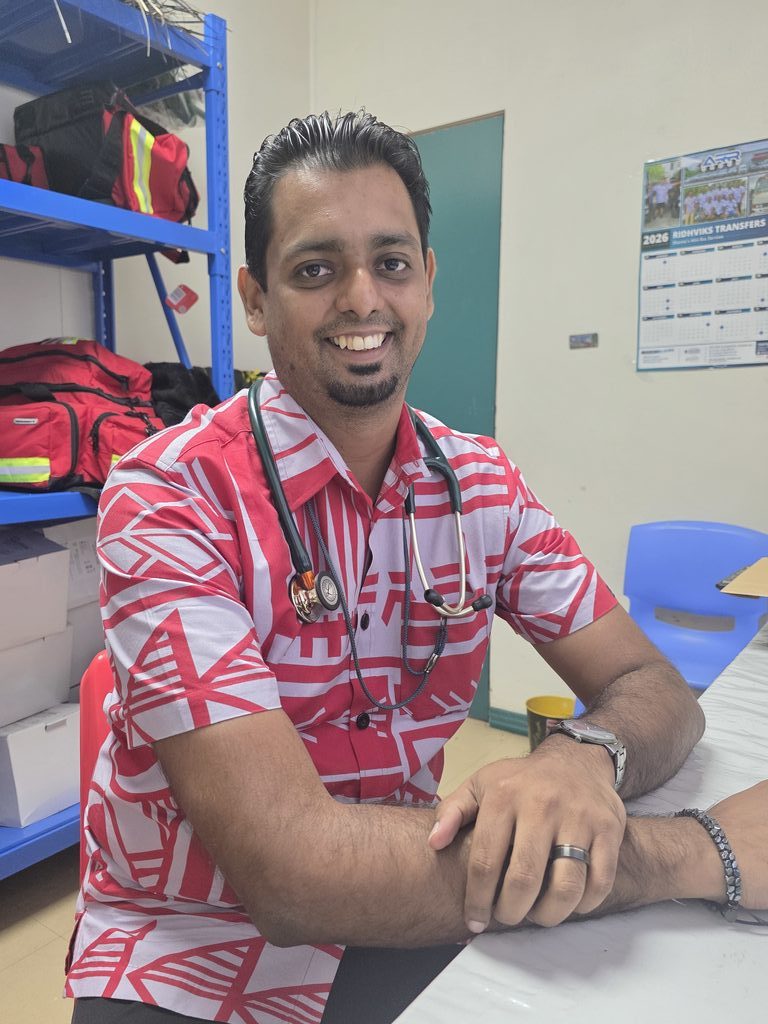
At Colonial War Memorial Hospital, emergency physician Dr Deepak Sharma, moves between patients with focus.
But beyond his ward rounds and clinical routines in Fiji’s busiest hospital, lies a journey shaped by dedication and an evolving sense of leadership.
Dr Sharma describes himself simply as “a Suva boy,” raised between Suva and Nausori, with family roots in Rewa and Nasinu.
His childhood was marked by frequent relocations as his father worked as a health inspector, taking the family across different parts of the country.
His education began in Nadi before the family eventually returned to Suva, where he completed secondary school and later entered medical school. After earning his MBBS, his first posting took him to the Yasawas, followed by Rakiraki Hospital, before he returned to CWM Hospital.
Years later, the pressures of serving through the COVID-19 pandemic would prompt him to pause and reconsider not only his career path, but his broader purpose.
Discovering Leadership Fiji
Dr Sharma first learned about Leadership Fiji through a newspaper advertisement. However, it was his wife, an economist at the Reserve Bank of Fiji who had been nominated by her employer, who truly sparked his interest.
At the time, Fiji was emerging from the height of the COVID-19 crisis. For many in the medical field, it had been an exhausting and emotionally demanding period. Dr Sharma found himself at a crossroads.
“I was looking for a sense of direction, whether I wanted to continue in the medical field or I needed to take a break,” he said.
“I applied without expectations, viewing it simply as an opportunity to explore a different perspective.”
However, when he was called for an interview and later selected, it marked the beginning of a transformative chapter.
Program structure
The Leadership Fiji program spans nine months and brings together 30 participants from diverse professional backgrounds across the country.
The journey begins with a launch event where participants meet for the first time and draw inspiration from the previous cohort’s Fellows Project.
From there, they move into an opening retreat designed to foster self-awareness and group cohesion.
Dr Sharma explained that participants are divided into smaller groups that remain together throughout the year.
Fortnightly sessions explore key pillars that shape Fiji — leadership, history, politics, law, health, poverty, social welfare and Fiji’s place in the global community.
“The diversity within the cohort was one of the program’s greatest strengths.”
Toward the end of the program, participants are given the opportunity to select speakers and topics of particular interest.
Field trips form a critical component of the experience, allowing participants to apply classroom discussions to real-world contexts and better understand national challenges.
The Fellows Project
While the nine-month program focuses on learning and development, Leadership Fiji includes a second-year commitment — the Fellows Project, centred on giving back.
Each cohort develops a shared long-term vision for Fiji and identifies a community initiative aligned with that vision.
For his 2022 cohort, that project took them to Vunidogoloa in Cakaudrove, Vanua Levu, widely recognised as one of the first villages in the world to relocate due to climate change.
That field visit to the Northern Division left a lasting impression on the group.
Witnessing firsthand the realities of climate displacement strengthened their resolve to contribute meaningfully.
The cohort later partnered with the relocated community, now known as Kenani, to assess their needs.
In their second year, operating independently as program alumni, they completed a multi-purpose bus shelter with an accompanying ablution block.
The facility was handed over to the community and managed by the village and women’s club.
Dr Sharma described the project as both a practical contribution and an opportunity to apply leadership principles learned during the program.
Experiential learning
Central to Leadership Fiji is experiential and reflective learning — concepts that initially felt unfamiliar to him.
He acknowledged that during the program he was still learning how to engage deeply in reflection.
However, the true impact became clear only after returning fully to his medical career.
The reflections crystallised “a year or two after completing the program,” Dr Sharma said, when he began reassessing his professional path and long-term purpose.
The idea of “balcony moments” — stepping back to view the bigger picture — resonated strongly.
Through adaptive leadership principles, he gained clarity about his role within the health sector and beyond.
He said the experience helped him understand why he wanted to continue practising medicine and why he chose to involve himself in broader initiatives.
“This clarity later led me to accept a role as trustee of the Leadership Fiji Foundation, the organisation’s philanthropic arm.”
“Reflective learning, once unfamiliar, became a valuable tool in shaping my personal and professional decisions.”
Advice to applicants
Dr Sharma believes many people hold themselves back through self-doubt.
“If you do get the opportunity to apply for Leadership Fiji, go for it,” he said.
He emphasised that the program’s value depended on personal commitment.
“It is a very fulfilling experience, but you will only get what you give,” he said, adding that participants who fully engage and seek to understand their purpose will find it deeply rewarding.
25th Anniversary message
As a member of the 2022 alumni cohort, Dr Sharma expressed gratitude as Leadership Fiji marks its 25th anniversary.
“I’d like to say thank you very much. Thank you for your investment in the leaders of Fiji and the upcoming leaders of Fiji,” he said.
He expressed hope that the program would continue to grow and strengthen in the decades ahead, shaping leaders committed not only to professional excellence but to national development.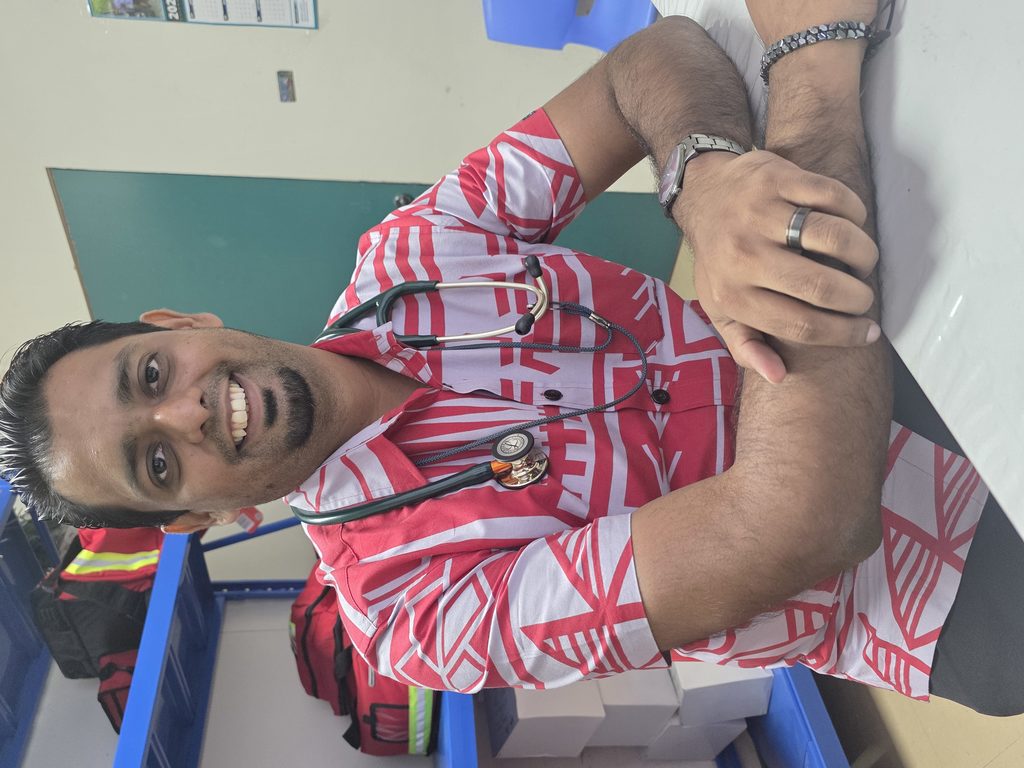
Dr Deepak Sharma at his work station within CWMH’s emergency department, Suva. Picture: JOHN KAMEA
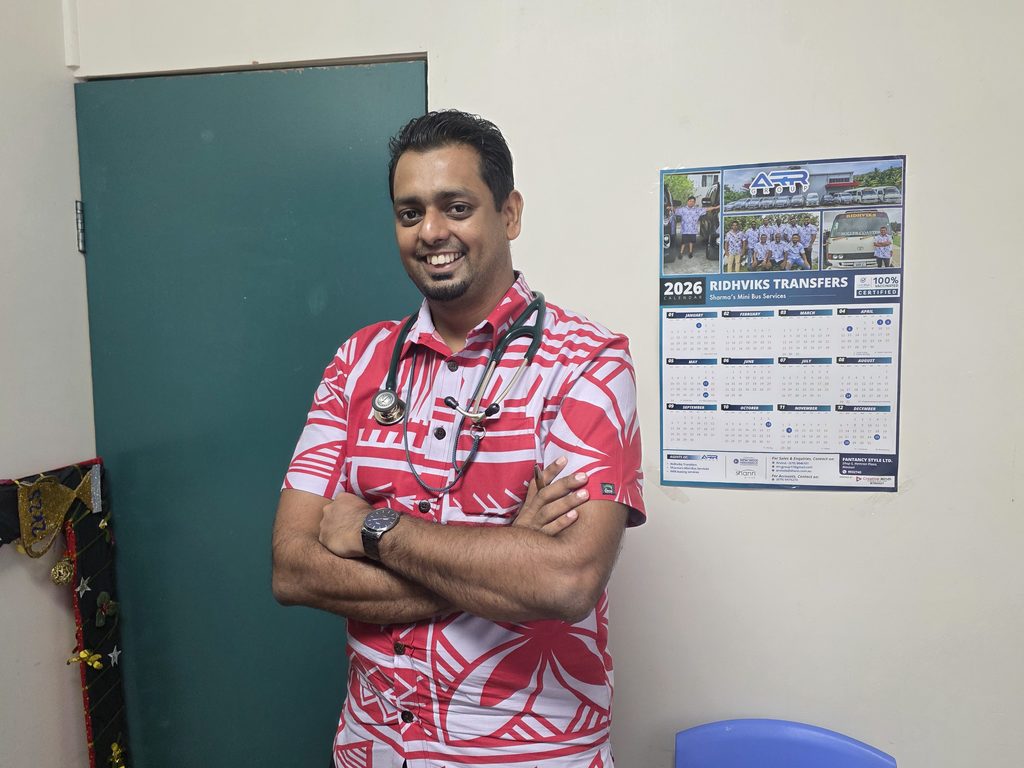
Dr Deepak Sharma at his work station within Colonial War Memorial Hospital’s emergency department, Suva. Picture: JOHN KAMEA

