
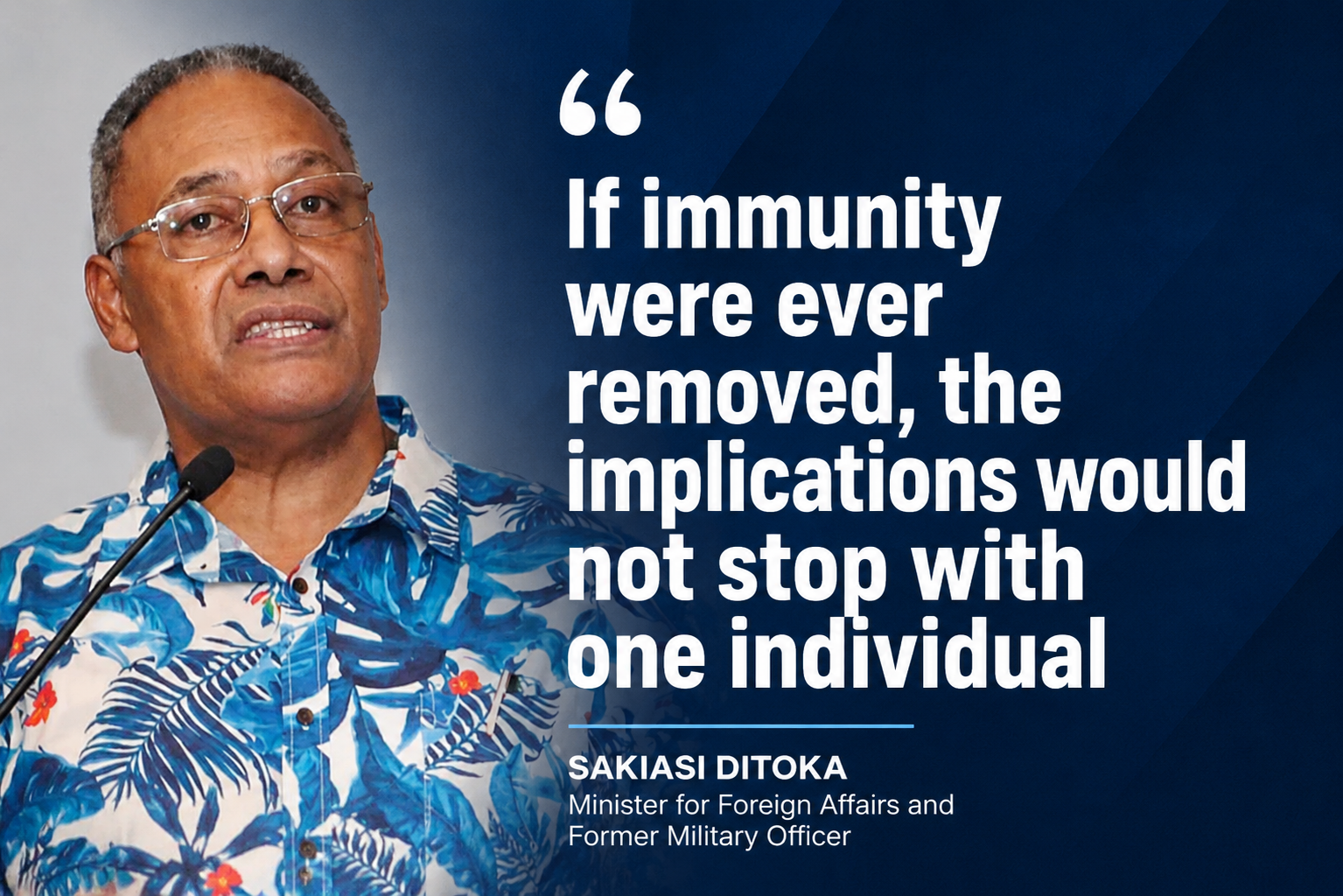
Minister for Foreign Affairs and former military officer Sakiasi Ditoka has defended the Coalition Government’s cautious approach to constitutional reform, warning that any move to remove immunity provisions could have far-reaching consequences extending well beyond a single individual.
In a lengthy social media post, Ditoka said public discussions on removing immunity provisions often oversimplify a highly complex issue by focusing narrowly on the coups of 1987 and 2006.
“Some people speak about removing them as though it is simply a matter of making a declaration and moving on,” he said.
“They appear completely fixated on one individual and one outcome. They see the immunity provisions and immediately think about the events of 1987 or 2006.”
Ditoka argued that the law could not be selectively applied and warned that any legal action arising from the removal of immunity could affect a broad range of people who played roles during those periods.
“If immunity were ever removed, the implications would not stop with one individual,” he said.
“They would inevitably extend to others who participated in, assisted with, or were involved in the events of 1987 or 2006 at various levels.”
He noted that some individuals who served during those periods remain in the security services today, raising questions about their legal status and future should immunity provisions be revisited.
“The law does not selectively apply itself only to the people we dislike. It follows the facts wherever they lead,” Ditoka said.
The minister also questioned how far accountability efforts would extend, asking whether responsibility should apply only to military officers or also to ministers, public servants and senior state officials who continued to operate institutions during the post-2006 period.
Referring to former Reserve Bank Governor Savenaca Narube, who has advocated constitutional reform, Ditoka said reopening old chapters could expand beyond the original targets.
“The point is not to accuse anyone. The point is to demonstrate that these issues are far more complex than some people pretend.”
Ditoka said the Coalition Government had deliberately prioritised stability and institutional trust since taking office in December 2022.
He likened the process to curing concrete.
“When concrete is first poured, you do not immediately walk across it because you are impatient,” he said.
“You allow it to set properly so that it becomes strong enough to carry weight.”
According to Ditoka, Fiji has been “carefully disentangling” itself from aspects of its post-2006 political legacy through “patience, engagement and steady reform” rather than confrontation.
He said broader constitutional discussions only began once the country had achieved sufficient stability.
“The objective was never simply to win an argument about the Constitution,” he said.
“The objective was to leave behind institutions strong enough to withstand the full pressures of democratic competition without threatening national stability.”
Emphasising the importance of democratic governance, Ditoka said Fiji’s future rests with its people.
“I believe that after four coups and decades of political upheaval, Fijians of every province, every community, every faith and every background are thoroughly sick of coups, sick of instability and sick of seeing our nation repeatedly dragged backwards by the mistakes of the past,” he said.
“We should trust our people enough to choose a different future and never look back.”
He concluded by saying that safeguarding Fiji’s future requires “wisdom,” “patience” and “courage.”
“Above all, it requires faith in the good sense of the Fijian people. I have that faith,” Ditoka said.
“That is not weakness. That is statecraft.”

