
Did you know that bananas were a key driver of trade and commerce in some of the heartlands of the Naitasiri province during Fiji’s colonial era?
After a one-and-a-half hour drive up the bumpy Sawani-Serea Rd, The Sunday Times team arrived at the village of Serea nestled within the lush greenery and mountain ranges of Naitasiri.
After the traditional presentation of a sevusevu to the Turaga na i Taukei Waimaro, Ratu Viliame Rarogaca Ravuilagi, we were permitted to move around freely as well as document and visit the village’s historical sites. To top it all off, we were privileged to be given the tour by the Taukei Waimaro himself.
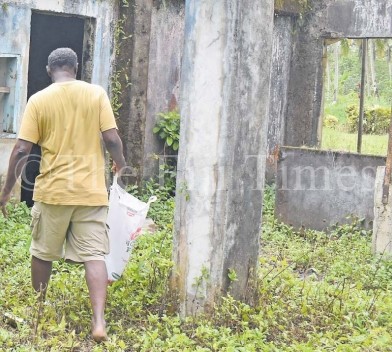
As you enter the village it is hard to miss the dilapidated remains of what used to be a large village enterprise, the first of its kind in Serea, that was established by the son of a Girmitiya known among locals as Sukh Lal.
Ratu Viliame and his extended family now live on and have preserved what is left of the structure, which was a centre of commercial activity in the early 1900s.
“What I heard was that Sukh Lal’s mother died when he was just an infant,” Ratu Viliame said.
“As a result, an iTaukei family from Nawaisomo took him in and raised him. He drank from the breast of an iTaukei woman, he was one of us.”
The Taukei Waimaro revealed that later, the family came down and settled in Serea and Sukh Lal established himself there.
“All his children grew up here and we knew them very well, they were very dear to us.”
“When Sukh Lal set up this shop it started small, but eventually he became very wealthy and expanded his business. The flourishing banana trade in Naitasiri at the time was indescribable and Sukh Lal’s shop here in Serea transformed into a center of business for the whole province,” he said.
Ratu Viliame recalled that several cooperative businesses owned hundreds of acres of banana plantations all across Naitasiri and transporting the commodity along the river was a more viable option.
Serea’s strategic location being along the Sawani-Serea Road and on the banks of the mighty Wainimala River, made it an important stop for travelers, villagers, and farmers.
An enormous raintree grew meters away from the village and Sukh Lal’s shop. It was close to the river’s edge and was ultimately developed into a kind of landing for bilibili rafts and punts travelling along the Wainimala.
“Most of these punts and rafts would carry freshly harvested bananas in huge quantities, these farmers would not take them straight to Suva, instead the transactions would take place here in Serea,” Ratu Viliame said.
“As people would get the money for the bananas they sold, they would then spend that money at Sukh Lal’s shop.”
The establishment at Serea had almost everything from general groceries and supplies to diesel and kerosene pumps, a liquor section, and a billiard table. A tailor by the name of Patel who was originally from Bombay (now Mumbai) in India also set up shop within Sukh Lal’s premises.
“This gentleman Patel made some of the best clothes and safari suits and he was a tailor of choice for people who visited Serea,” Ratu Viliame said.
From the descriptions given by the Taukei Waimaro, it would be safe to assume that it was a golden era for the province and a time of plenty.
Ratu Viliame explained that the onset of development and rapid modernization after Independence in 1970 was a critical moment that shaped Naitasiri then, and what it has become today.
“The banana trade here eventually began to decline as new roads into the province were built. People began to leave for the urban centres, and the farms were left idle.”
“Also, the excessive use of fertilizer and chemicals for farming has greatly impacted the soil quality. Bananas are a sensitive crop and because of that they slowly declined in number.”
As a result of the new roads, the Wainimala River ceased to become a major transportation route, and subsequently, Serea gradually declined as a commercial centre.
“Sukh Lal’s business suffered because of this. He later left the business in Serea for his sons to run and moved to Tailevu. He passed away in Wainivesi,” Ratu Viliame said.
“I recall my father eventually having a discussion with Sukh Lal’s sons to sell off whatever they had in Serea and take the money they had saved to make a life for themselves by getting an education or starting a fresh business elsewhere. That’s what they did and I’m glad they have prospered.”
The raintree landing at Serea is far from what it used to be now.
Ratu Peni Rotacikalou, son of the Taukei Waimaro, took us down to the banks of the Wainimala and showed us the site of the landing a few meters from Sukh Lal’s shop.
“Unfortunately, we had the tree cut down last year. Given the significance of it, it was decided to have it carved into a lali for our village church.”
“A carpenter from Levuka who now resides here took on the project and it is nearing completion,” Ratu Peni said.
The significance of the Wainimala River to Serea and Naitasiri is clear. Even though it no longer serves as the main transportation route for the people of the province, it continues to feed and nourish them to this day.
Ratu Peni, however, lamented the fact that developments such as gravel extraction, dredging, and climate change had drastically impacted the health of the river.
“The river used to be deeper and wider, today it is only a shadow of its former self.”
“I remember when sharks would be spotted in the river, signifying how diverse the wildlife was, now we can barely catch a decent number of fish,” he said.
The Taukei Waimaro however revealed that villagers had taken it upon themselves to preserve whatever remains of their pristine environment despite the various challenges they faced.
“We engage actively in sustainable farming here and take very good care of our rivers and waterways.”
Whilst Sukh Lal’s shop may no longer exist today, it stands as a testimony to the progress that can be made through the unity of two major races in Fiji and how the bonds of love and community can bring prosperity to a community no matter its remote location.
History being the subject it is, a group’s version of events may not be the same as that held by another group. When publishing one account, it is not our intention to cause division or to disrespect other oral traditions. Those with a different version can contact us so we can publish your account of history too — Editor.

