
Newly released Australian cabinet papers have shed light on how the John Howard-led government viewed growing instability in Fiji — and its increasingly tense relationship with then-military commander Commodore Voreqe Bainimarama — a year before the 2006 coup.
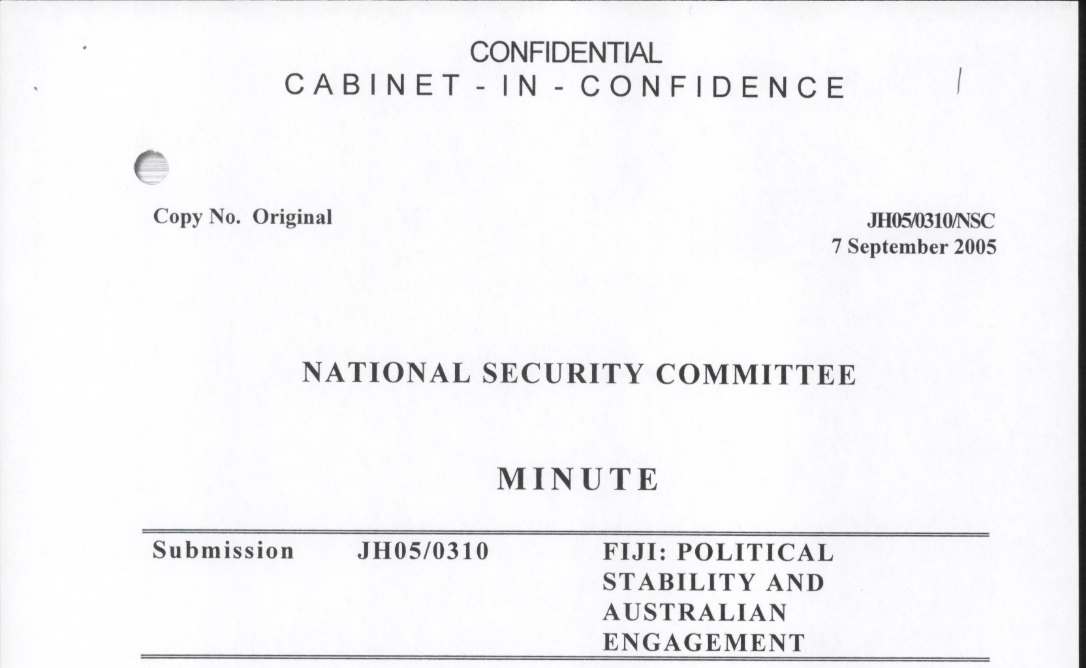
The documents, declassified on January 1, outline confidential discussions held by Australia’s National Security Committee in September 2005 about Fiji’s political trajectory and Canberra’s preparations should tensions escalate.
A cabinet submission titled “Fiji: Political Stability and Australian Engagement” noted that ethnic divisions and an increasingly strained relationship between the Fijian government and the Republic of Fiji Military Forces were exposing “the fragile nature of stability in Fiji.”
The paper warned that the government’s controversial Reconciliation, Tolerance and Unity Bill had aggravated tensions with Bainimarama.
“Tensions have eased recently,” the committee observed, “but they are likely to flare again, with the risk that Bainimarama might take action against the GoF, provoking serious consequences for both the RFMF and internal stability.”
The documents also reveal that Australia was quietly planning for potential unrest.
The Department of Defence, the papers show, had begun “military contingency planning in response to the current political tensions in Fiji” and was preparing an assessment of security scenarios through to mid-2007.
At the same time, Canberra was positioning itself as a supporter of democratic processes in Fiji, committing up to $3 million to help ensure the 2006 elections were “free and fair,” including funding for voter registration and awareness programs through the Australian Electoral Commission.
Australia had also been directly engaging both Fiji’s government and Bainimarama, stressing “the importance of political stability and the rule of law, and the proper role of the military in a democracy.”
Looking ahead, the cabinet concluded that Australia’s engagement strategy should focus on strengthening political ties, supporting reconciliation efforts, and helping Fiji diversify its struggling economy. Ministers agreed Canberra should encourage “more productive relations between the GoF and the military,” as well as consider alternative reconciliation models in partnership with New Zealand.
While many portions of the files remain redacted, the documents provide a rare inside view of how closely Australia was monitoring Fiji’s political tensions — and how seriously it viewed the possibility that Bainimarama could move against the elected government.

