
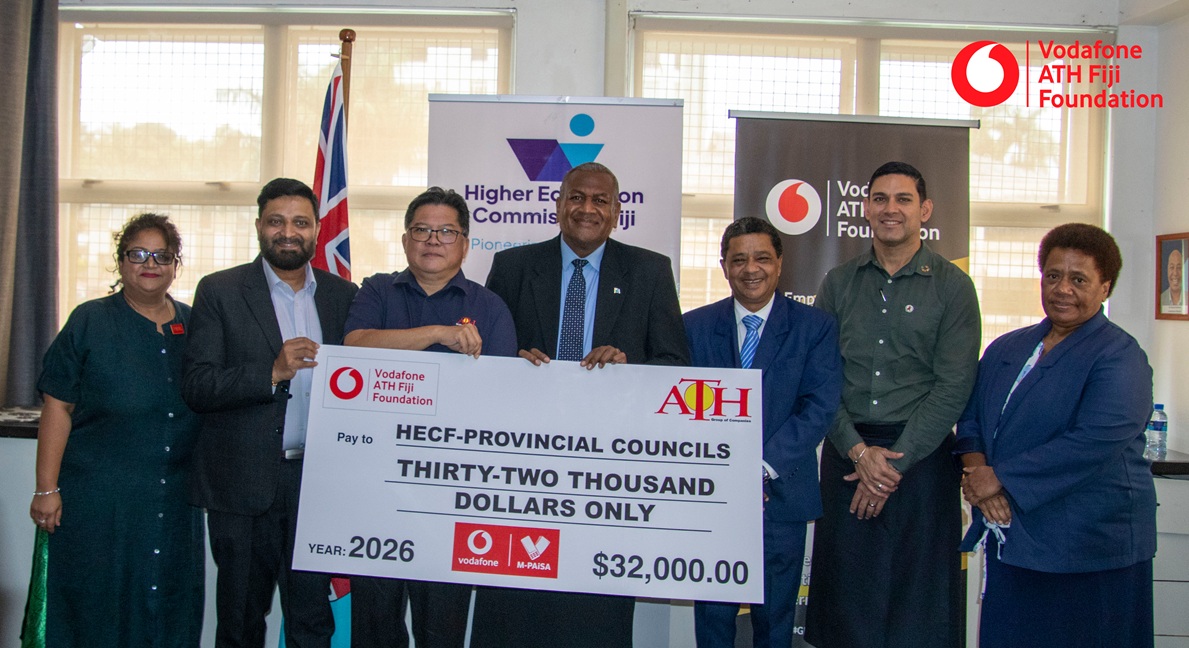
Corporate social responsibility (CSR) for Fiji’s major philanthropic entity Vodafone ATH Fiji Foundation took a new turn in 2026.
In an official ceremony early this month, Foundation director and chief executive officer of parent company Amalgamated Telecom Holdings (ATH) Ivan Fong handed over a $32,000 cheque to the Higher Education Commission of Fiji (HCEF), as it unleashes its financial might to is join the fight against HIV/AIDS in Fiji.
This community-driven initiative to train trainers and educators who will lead awareness of HIV/ AIDS throughout Fiji’s 14 provinces, Rotuma, Rabi and Kiowa, is a watershed combined effort by Fiji’s Health Ministry, the iTaukei Ministry, HECF, APMT and the Vodafone ATH Fiji Foundation against this new silent killer.
Years of suppression in education and awareness on HIV and illicit drug use has seen HIV in particular stalk our society, inflicting unsuspecting victims with its deadly venom and eroding Fiji’s productive population.
In fact, Fiji was recently identified by UNAIDS and health experts as having the world’s fastest-growing HIV epidemic, with Government declaring a national HIV outbreak following an unprecedented spike in new infections.
“Fiji declared an HIV outbreak in January 2025 after 1093 new cases were reported from January–September 2024 – three times the cases in 2023, marking a nine-fold increase over five years,” Woking Paper 10.0 at the 16th Pacific Heads of Health Meeting in Nadi in April last year read.
“This surge exposed gaps in services: over half of people diagnosed are not on treatment, and about 50 per cent of newly diagnosed cases were linked to injecting drug use.
“A 90-day national response plan and a five-year HIV “HIV Surge Strategy” (to 2027) have been launched to contain the outbreak.”
Experts are using the word “crisis” when they talk about HIV in Fiji. In a joint statement in December last year, the Ministry of Health, the UNDP and the World Health Organisation (WHO) announced the findings of a rapid assessment of HIV in Fiji titled: “This is the Health Crisis of Our Time: A Rapid Assessment of Injecting Drug Use and HIV in Suva, Fiji”, putting a pulse on the extent of the epidemic in recent times.
“HIV cases in Fiji, which has a population of just under one million, have been rising sharply,” they stated.
“In 2024, 1583 new HIV cases were reported nationally, while 1226 cases were notified in the first six months of 2025 alone.
“UNAIDS modelled estimates suggest that the total number of people living with HIV in Fiji is higher and has been increasing rapidly from around 2000 in 2020 to an estimated 6100 in 2024.
“Among people starting HIV treatment in 2024, 48 per cent were people who inject drugs, highlighting the disproportionate impact on this group.”
The study, funded by The Global Fund, provides an in-depth assessment of drug use, risk behaviors, health-seeking behaviours and gaps in service delivery, to strengthen Fiji’s public health response.
Its conclusion is bleak: “Without immediate intervention, the number of people living with HIV is projected to rise dramatically reaching 25,000 by 2029.
“It is likely that HIV prevalence in Fiji could escalate and, given the high mobility with the region, potentially catalyse similar outbreaks throughout the Pacific.”
In this light, the corporate intervention by the Vodafone ATH Fiji Foundation is an urgent and timely response to this national health emergency, one designed to promote community awareness that is sorely lacking.
In his speech at the cheque handover, Mr Fong weighed in on the gravity of the situation and described the donation as “more than funding. It is a lifeline…”.
“This grant will directly support the Certificate III in Community Health program, approved for 14 provinces and two island councils,” he said.
“It comes at a time when HIV and drugs are on the rise, threatening the very fabric of our communities. “This program will train young Fijians to become educators, counsellors, and ambassadors of health.
“They will return to their villages not just as graduates, but as role models — living and breathing the outcomes of this training, ensuring that the vanua is protected and nurtured. We must remember: resources alone cannot save us. It is the people who manage these resources — our village health nurses, our community health workers, our youth — who make the difference.
“This training will strengthen their hands and their hearts, enabling them to care for the vanua and its people with dignity and compassion.
“As we hand over this grant today, let us remember: this is more than funding. It is a lifeline. It is a promise that we will continue to connect, empower, and uplift — from the vanua, to the Pacific, and to the globe.”
APMT, which has been approved by the HECF to provide the Certificate III in Community Health program, described the partnership as “an important milestone”.
“This program represents one of the first partnerships of its kind in Fiji, bringing together government, private sector and non-government organisations to stand as one — fighting for a common cause: healthier, stronger communities,” APMT chairman and managing director Renjith Joseph said.
“Today, APMT signs this agreement guided by a clear mission: to place community at the centre of healthcare — ensuring services are accessible, respectful and delivered with dignity, equity, and compassion.
“HIV affects families, villages, and communities. When stigma exists, people step back. When trust exists, people step forward. This program is built on that understanding — bringing services closer to people and empowering communities to lead change.
“Through this initiative, APMT, together with FHEC, ATH, and the Ministry of Health, is not just delivering a program. We are mobilising more soldiers for a shared mission — protecting the health of our people, today and for generations to come.”
In his speech, HCEF chairman Steve Chand described the partnership as a “shared national commitment” to “protect, educate and empower our communities against the ongoing threat of HIV and AIDS.”
“This is not merely a health issue; it is a human development challenge that calls for collective action, compassion, and sustained awareness,” he said.
“The support provided today by the ATH Foundation will go directly toward funding the training of Provincial Council representatives across Fiji.
“Through this program, our people will be equipped with the knowledge and skills to champion HIV awareness and prevention efforts in their respective communities.
“This training will be delivered by our partners at the APMT, whose expertise in community-based education and skills development continues to complement Fiji’s broader goals for inclusive and sustainable development.”
Certificate III in Community Health program follows WHO and UNAIDS guidelines (PrEP, ART, PMTCT, NSP, VMMC), ensuring Fiji’s response is globally benchmarked while tailored to local realities.
Admission to the course is now open.

