
ORGANISED crime groups are increasingly exploiting development and governance gaps across the Pacific.
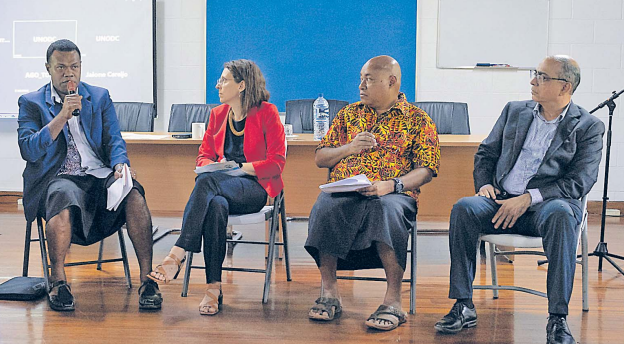
This was highlighted by the Pacific Islands Forum Secretariat Policy Adviser for Regional Security, Neumi Vakadewabuka, during the 6th Anniversary Celebration Event for the Teieniwa Vision panel discussion.
Mr Vakadewabuka said one of the major transitions taking place in the region is the growing presence of organised and transnational crime networks filling what he described as “gaps” created by shifts in power dynamics, governance weaknesses and related climate development challenges.
“One of the biggest transitions and changes that we are seeing in the Pacific right now is how organised crime groups or transnational criminal activity are filling the gaps,” he said.
“When we look at things and connect things in the region, organised crime is filling a lot of those gaps.”
Mr Vakadewabuka said development partners such as the United Nations Office on Drugs and Crime, the Pacific Islands Forum and media organisations including the BBC are working with Pacific governments to strengthen systems while respecting national sovereignty and leadership.
He said a key measure emerging from regional surveys conducted in recent weeks and months is the concept of “integrity”.
“Measuring these systems, one key word and value always comes up, and it’s this simple word, integrity.”
Mr Vakadewabuka said the integrity of border systems, customs, law enforcement and governance structures across the Pacific are being significantly challenged.
He said the issue extends beyond institutions to individuals. “The integrity of people at our borders, the integrity of people who are our leaders, and the integrity of our people who we rely on for being our front liners and our border officials, are being severely challenged.
“And if we look at this holistically, our security is connected in climate, in food, in health, in feeling safe.”
He said these are our common security concerns as Pacific People, and holistic integrity is our solution.
n More on Page 26

